Googling the Life of Muhammad

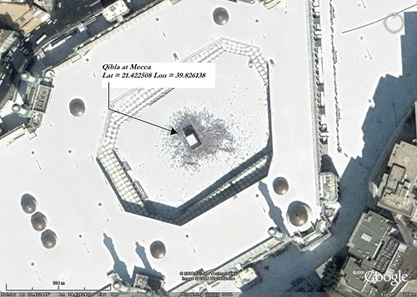
Google Earth provides a virtual geography for anyone with access to the internet. Now, thanks to Thameen Darby, you can examine over 100 places in the life of the Prophet Muhammad close up. To access the site, click here. Here are the particulars.

This is a flyover depicting the life of the prophet of Islam, Prophet Muhammad.

Islam is the second largest religion in the world; Prophet Muhammad who was born in a town in the Arabian Peninsula, Mecca. He lived for 63 years (570-633 AD). During his lifetime, he founded the third monotheistic religion, established the core of the Muslim empire, and started a new era in Human history with its own distinctive civilization that is still alive today. Continue reading Googling the Life of Muhammad

Keith Ellison’s Iran Forum

Keith Ellison’s Iran Forum and the June 10 Call-In to Congress

By Lydia Howell, Engage Minnesota, June 6, 2008

On May 28, U.S. Rep. Keith Ellison, D-Minn., hosted Iran scholars for a community forum in a packed hall at the First Unitarian Society church in Minneapolis. The focus was on the U.S.-Iran relationship, estranged for over 30 years, which many fear may become the next chapter in the Bush administration’s “war on terrorism.”

“Nary a day goes by that someone isn’t saying something abut Iran in the media. Part of my responsibility as a U.S. congressman is to be a forum to discuss the critical issues we face and to promote dialog about the most pressing issues,” said Ellison. “To quote [African-American writer] James Baldwin: Anything that cannot be faced cannot be fixed.”

In the first half of 2008, newspaper front pages and television news have begun repeating a message about a Middle Eastern country that has not attacked the United States but which allegedly “poses a grave threat,” “may build nuclear weapons” and “must be prevented from making war on its neighbors.” In 2002-3, such stories were about Iraq; now, Iran is being described in similar ways. No actual evidence is given for the frightening allegations about Iran—which are too often made by unnamed “Pentagon officials” or the same members of right-wing think tanks that previously pushed the disastrous attack on Iraq. Continue reading Keith Ellison’s Iran Forum

The Overstatement that becomes an Understatement

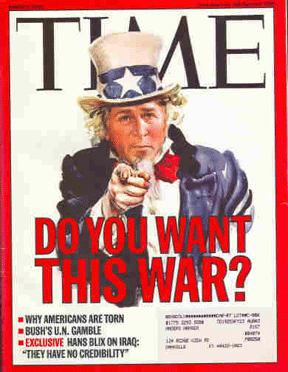
Bush Overstated Iraq Evidence, Senators Report

By MARK MAZZETTI and SCOTT SHANE, The New York Times, June 6, 2008
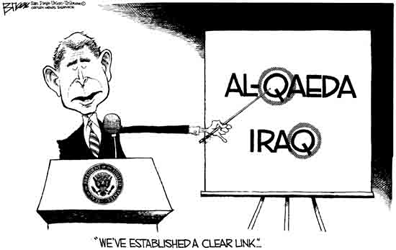
WASHINGTON — A long-delayed Senate committee report endorsed by Democrats and some Republicans concluded that President Bush and his aides built the public case for war against Iraq by exaggerating available intelligence and by ignoring disagreements among spy agencies about Iraq’s weapons programs and Saddam Hussein’s links to Al Qaeda.

The report was released Thursday after years of partisan squabbling, and it represented the close of five years of investigations by the Senate Select Committee on Intelligence into the use, abuse and faulty assessments of intelligence leading to the invasion of Iraq in March 2003.

That some Bush administration claims about the Iraqi threat turned out to be false is hardly new. But the report, based on a detailed review of public statements by Mr. Bush and other officials, was the most comprehensive effort to date to assess whether policy makers systematically painted a more dire picture about Iraq than was justified by the available intelligence.

The 170-page report accuses Mr. Bush, Vice President Dick Cheney and other top officials of repeatedly overstating the Iraqi threat in the emotional aftermath of the attacks of Sept. 11, 2001. Its findings were endorsed by all eight committee Democrats and two Republicans, Senators Olympia J. Snowe of Maine and Chuck Hagel of Nebraska. Continue reading The Overstatement that becomes an Understatement

Deoband first: A fatwa against terror

The Times of India, June 1, 2008

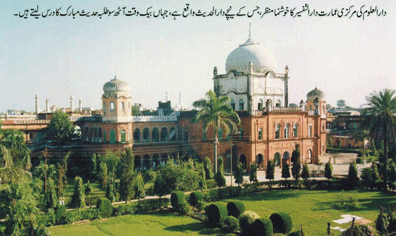
NEW DELHI: For the first time ever, Islamic seminary Darul-Uloom Deoband issued a fatwa against terrorism on Saturday, stating Islam had come to wipe out all kinds of terrorism and to spread the message of global peace. The Darul-Uloom had denounced terrorism for the first time in February, but had not issued a fatwa so far.

Saturday’s fatwa, signed by Darul-Uloom’s grand mufti Habibur Rehman, asserts that “Islam rejects all kinds of unjust violence, breach of peace, bloodshed, murder and plunder and does not allow it in any form”.

Citing the “sinister campaign” to malign “Islamic faith…by linking terrorism with Islam and distorting the meanings of Quranic Verses and Prophet traditions”, Mahmood Asad Madani, leader of Jamiat Ulema-e-Hind, had wanted Deoband to spell out the stand of Islam on world peace.

The fatwa, issued before a huge gathering of Muslims in Delhi’s Ramlila Ground for the Anti-Terrorism and Global Peace Conference, went on to say, “It is proved from clear guidelines provided in the Holy Quran that allegations of terrorism against a religion which preaches and guarantees world peace is nothing but a lie. The religion of Islam has come to wipe out all kinds of terrorism and to spread the message of global peace. Allah knows the best.” Continue reading Deoband first: A fatwa against terror

So al-Qa’ida’s defeated, eh? Go tell it to the marines

Robert Fisk, The Independent, Sunday, 1 June 2008

So al-Qa’ida is “almost defeated”, is it? Major gains against al-Qa’ida. Essentially defeated. “On balance, we are doing pretty well,” the CIA’s boss, Michael Hayden, tells The Washington Post. “Near strategic defeat of al-Qa’ida in Iraq. Near strategic defeat for al-Qa’ida in Saudi Arabia. Significant setbacks for al-Qa’ida globally – and here I’m going to use the word ‘ideologically’ – as a lot of the Islamic world pushes back on their form of Islam.” Well, you could have fooled me.

Six thousand dead in Afghanistan, tens of thousands dead in Iraq, a suicide bombing a day in Mesopotamia, the highest level of suicides ever in the US military – the Arab press wisely ran this story head to head with Hayden’s boasts – and permanent US bases in Iraq after 31 December. And we’ve won? Continue reading So al-Qa’ida’s defeated, eh? Go tell it to the marines

Another Arabesque: Arabs in Brazil

North American to release book about Arabs in Brazil

John Tofik Karam, a grandson of Lebanese born in the United States, should release up to the end of the year, in Brazil, book ‘Another Arabesque’. The work is on the valuation of the Arab tradesman in the country in the late 20th century. To write the book, initially a master’s degree thesis, he was in Brazil for over a year.

Isaura Daniel, ANBA, Brazil-Arab News Agency, 3/26/2008

São Paulo – The North American John Tofik Karam, of Lebanese origin, is going to release in Brazil his book “Another Arabesque” through Martins Editora publishing house. The work is the result of a doctoral thesis that Karam worked on about the Arab community in Brazil and shows the valuation of the Arabs in the late 20th century.

“It shows the greater visibility that the Arabs got during the neoliberal phase,” explained Karam in a telephone interview to ANBA. According to the Lebanese descendant, up to the middle of the 20th century, Arabs were marginalized due to the stereotype of good businessman, always wanting the greatest possible gain in trade. “This idea suddenly became an advantage in the neoliberal phase,” he said. Continue reading Another Arabesque: Arabs in Brazil

Poems from Guantánamo

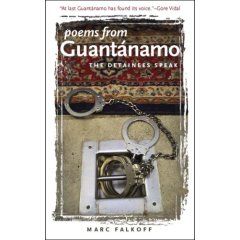
Poems from Guantánamo: The Detainees Speak is a short but provocative book of poems from several of the detainees held at Guantánamo Bay. Much has been written about the legal issues and violations of human rights, but here we can hear the silenced voices of those dehumanized in detention without access to justice. Here is one of the poems:

Death Poem
by Jumah Al Dossari

Take my blood.
Take my death shroud and
The remnants of my body.
Take photographs of my corpse at the grave, lonely.

Send them to the world,
To the judges and
To the people of conscience.
Send them to the principled men and the fair-minded.

And let them bear the guilty burden, before the world,
Of this innocent soul.
Let them bear the burden, before their children and before history,
Of this wasted, sinless soul.
Of this soul which has suffered at the hands of the “protectors of peace.”

Jumah al Dossari, a thirty-three-year-old Bahraini national, is the father of a young daughter. He has been held at Guantánamo Bay for more than five years. In addition to being detained without charge or trial, Dossari has been subjected to a range of physical and psychological abuses, some of which are detailed in Inside the Wire, an account of the Guantánamo prison by former military intelligence soldier Erik Saar. He has been held in solitary confinement since the end of 2003 and, according to the U.S. military, has tried to kill himself twelve times while in the prison. On one occasion, he was found by his lawyer, hanging by his neck nd bleeding from a gash to his arm.

Puzzles and Precious Particularities of Yemen


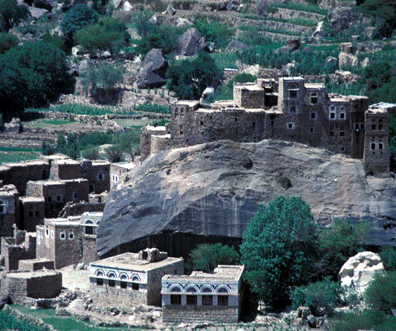
Hamlet of Mais in central Yemen; entrance is carved through the large rock.
Photograph by Daniel Martin Varisco

By: Khaled Fattah, Yemen Times

Outside observers of Yemen’s social and political life can not avoid noticing many conceptual puzzles and precious particularities. One of the widely known puzzles among researchers with political science background is the surprising fact that although Yemen is the least developed and weakest Arab state that governs a society characterized by fierce tribal traditions and structures, it’s a country with a party pluralism system. Precious particularities of Yemen, on the other hand, are numerous. To begin with, there is a coincidence of almost everything- from geographical and topographical destiny to the patterns of habitation and concentration of sects; and from the shades of experienced ideologies and insecurity of economic resources to the peculiar nature of colonialism and regional power interventions. This sharp multifaceted coincidence is not something of the past. Rather, it is being felt in every bone in the political, economic and socio-cultural skeletons of today’s fragile Yemen. Continue reading Puzzles and Precious Particularities of Yemen