Iranian Revolutionaries, 1906

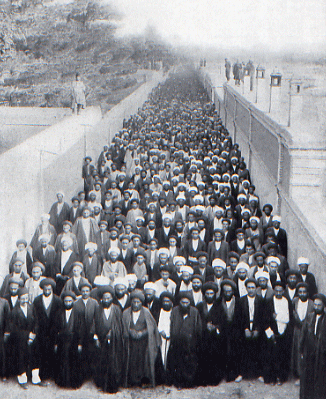
“Crowd of Persian Revolutionists, Who, fearing the vengeance of the royal troops, took refuge int he British Legation in Teheran in 1906, and insisted on remaining there until the Shah gave them a parliament.”

Revolution is no stranger to modern Iran. In the May, 1908 issue of The National Geographic Magazine, published just a century ago, there was an article by W. P. Cresson entitled “Persia: The Awakening East.” Here is an excerpt from Cresson’s account of the newly formed parliament:

The strong nationalistic spirit that marks the new era in Persian affairs is one of the most interesting features of the present movement in Persia. It is not among the frock-coated European dandies of the court that we must look for the men who are now taking the leading part in the new agitation for reform. Many of the constitutionalistic leaders wear the flowing robes and white turban of the Mohammedan priesthood. Recently the Liberal Parliament by an overwhelming majority voted to suppress the publication of a Teheran newspaper which had dared to propose the substitution of a new civil code modeled on European lines for the old common law based on the precepts of the Koran. One of the chief causes of popular complaint against the leaders of the Court party is their subserviency to foreign influences and their unpatriotic policy of importing foreign officials into Persia, notably in the case of the customs administration. Continue reading Iranian Revolutionaries, 1906
Identity and Religion in Palestine

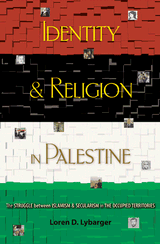
Identity and Religion in Palestine: The Struggle between Islamism and Secularism in the Occupied Territories by Loren Lybarger (Princeton: Princeton University Press, 2007)

This remarkable book examines how the Islamist movement and its competition with secular-nationalist factions have transformed the identities of ordinary Palestinians since the first Palestinian uprising, or intifada, of the late 1980s. Drawing upon his years living in the region and more than eighty in-depth interviews, Loren Lybarger offers a riveting account of how activists within a society divided by religion, politics, class, age, and region have forged new identities in response to shifting conditions of occupation, peace negotiations, and the fragmentation of Palestinian life. Continue reading Identity and Religion in Palestine

Dancing with Snakes

For Yemen’s Leader, a Balancing Act Gets Harder

By ROBERT F. WORTH, The New York Times, Saturday, June 21, 2008.
SANA, Yemen

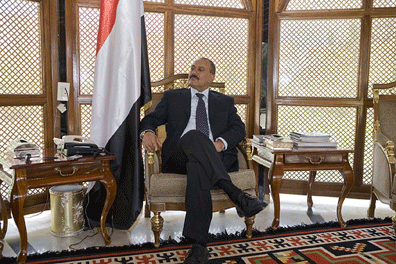
PRESIDENT Ali Abdullah Saleh’s face is everywhere in Yemen. He stares out from billboards, shop windows and living room walls, always with the same proud expression: eyes glinting, chest thrust out as if to confront a challenger. After 30 years in power, Mr. Saleh has become almost synonymous with the state in this arid, desperately poor corner of southern Arabia.

But lately the president, 66, known for his wicked sense of humor, has been uncharacteristically dour. A war with northern Shiite rebels has spread to the outskirts of the capital. Terrorist attacks have led embassies and foreign companies to evacuate their employees. With an insurrection rising in the south as well, the turmoil has renewed fears that this conservative Muslim country of 23 million, a longtime haven for jihadists, could collapse into another Afghanistan.

Mr. Saleh, his gruff voice tinged with anger, dismissed the rebels as “racists” who want to return to Yemen’s ancient system of religious rule. They have won popular support by associating his government with the United States, he said during an hourlong interview inside the sprawling, high-walled presidential palace compound. Continue reading Dancing with Snakes

Introducing “Reading Orientalism”


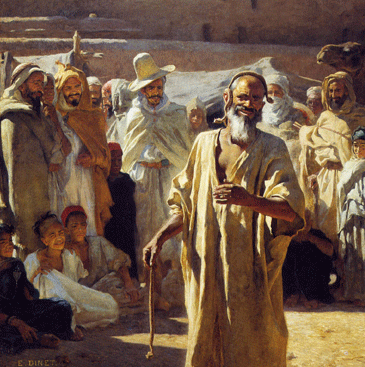
The Snake Charmer, Etienne Dinet, 1889


Last November I published Reading Orientalism: Said and the Unsaid with the University of Washington Press. The issues surrounding “Orientalism” and the legacy of Edward Said’s corpus are ongoing, but much of the debate still centers on personalities rather than pragmatic assessment of the complex intertwining of ethnocentrism, racism and sexism that extends far beyond anything imagined as an “Orient” or a “West.” Here is part of the introductory note to my book.

To the Reader

As an intellectual, I feel challenged by the theoretical incoherence; I feel driven to strive for an answer that, if it has not yet attained universal validity, will at least have transcended the evident limitations of the dichotomized past. Wilfred Cantwell Smith

And is it not further tribute to his triumph to see more clearly what he was battling? Maria Rosa Menocal

You have before you two books about one book.

The one book is Edward Said’s Orientalism, a copy of which should preferably be read before and after you tackle my critical engagement with this powerful text and the ongoing debate over it. More than a quarter century after its first publication, Orientalism remains a milestone in critical theory. Yet, as the years go by, it survives more as an essential source to cite rather than a polemical text in need of thorough and open-minded reading. I offer a commentary, not a new sacred text. Continue reading Introducing “Reading Orientalism”

Picturing Damascus

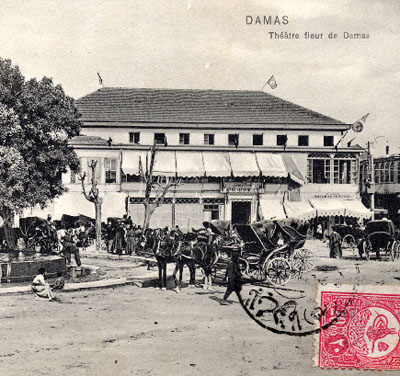
Visual archives abound on the Middle East and a growing number of these now appear on the Internet. One of these is mideastimages.com, which hosts a variety of historic photographs focusing on the cities of Aleppo, Baghdad, Cairo, Damascus, Istanbul, Jerusalem and Palmyra. Here is a postcard mailed from the Thomas Gate post office in Damascus during the Ottoman period. It depicts the Flower of Damascus Theatre, owned by Habib Shamas, in the Marje Square. In 1912 this theatre hosted the first movie played in Damascus. The theatre was converted to a Cinema in 1918. (Source: DAMASCUS BY Dr. K. SHIHABI 1986)

Darfur Crisis


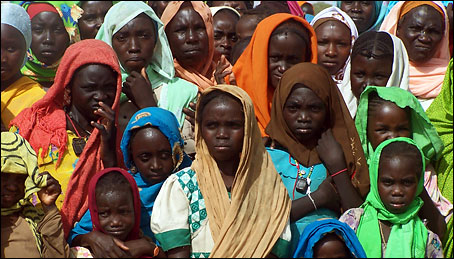
Freshly displaced Darfuris await the arrival of the UN relief coordinator Jan Egeland in the rebel held town of Gereida in southern Darfur, 07 May 2006.
AFP/Getty

The Washington Post has an informative and easy to use web presentation on the crisis in Darfur. Click here to start the tour.

Muslim Women Rejected at Obama Rally

By JEFF KAROUB,AP
Posted: 2008-06-18 19:03:06
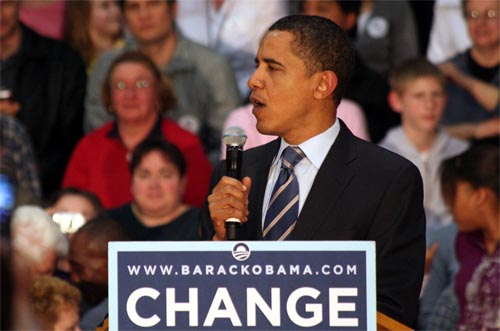
DETROIT (June 18) – A young Muslim woman said she and another woman were refused seats directly behind Barack Obama — and in front of TV cameras — at a Detroit rally because they wear head scarfs. For the full story, go here.
The full story speaks of the irony of Obama’s inclusive campaign excluded these women. Other Muslims, including one of the women’s brothers would have been welcome to these seats but they refused them as a token of solidarity (as did non-Muslims).

The fact that this is even a issue speaks to the ways in which hijab is iconic not only of Islam but of what Americans fear about Islam. I myself have been guilty of this. Once at a Thai (Buddhist) festival, I observed that it was interesting that there were Muslims present. However the only way of identifying Muslims was by the head coverings worn by the women. The men, as is sometimes (often?) the case did not wear anything distinctive. I assume that since some Muslim men could have sat behind Obama means that they were not wearing distinctive clothing.
Continue reading Muslim Women Rejected at Obama Rally

Iraq after a Millennium

There is an old saying, renewed whenever we reflect on contemporary politics: the more things change, the more they remain the same. A little over a millennium ago, the widely traveled scholar Shams al-Din Abu ‘Abd Allah Muhammad al-Muqaddasi wrote a geographical compendium of the world. He is as opinionated as any op-ed columnist, but also an astute observer of the foibles of his own time. So how did al-Muqaddasi, who had traversed much of the known Islamic world in his time, view Iraq? Here is his assessment; c’est la vie!

This is the region of men of refinement, the fountainhead of scholars. The water is delightful, the air marvelous; it is the chosen place of the khalifs. It produced Abu Hanifa, the jurist of jurisprudents; and Sufyan, the best of the Quranic Readers. From here came Abu ‘Ubayda, and al-Farra‘, and Abu ‘Amr, author of a system of Quranic reading. It is the birthplace of Hamza, and al-Kisa’i: of virtually every jurist, Reader, and litterateur; of notables, sages, thinkers, ascetics, distinguished people; of charming and quick-witted people. Here is the birthplace of Abraham, the Compansion of God, thither journeyed many noble Companions of the prophet. Is not al-Basra there, which can be compared to the entire world? and Baghdad, praised by all mankind? sublime al-Kufa and Samarra? Its river most certainly is of Paradise; and the dates of al-Basra cannot be forgotten. Its excellences are many and beyond count. The Sea of China touches its furthermost extremity, and the desert stretches along the edge of it, as you see. The Euphrates debouches within its limits.

Yet it is the home of dissension and high prices, every day it retrogresses; from injustice and taxes there is trouble, and distress. Its fruits are few, its vices many, and the oppression of the people is heavy.

[Excerpt from al-Muqaddasī, The Best Divisions for Knowledge of the Regions. Translated by Professor Basil Collins. Reading: Garnet Publishing, 2001.]