A Course on the Collision Course

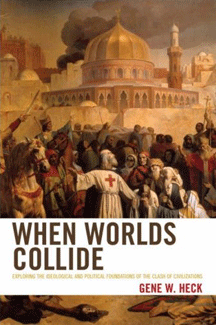
[The aftermath of 9/11 has yielded a stream of books on Islam and violence, so much so that it is rare to find a book about Islam that does not tackle the issue one way or the other. Part of this is due to media promotion of books like Bernard Lewis’s What Went Wrong? and the neocon mantra borrowed from Samuel Huntington’s Clash of Civilizations thesis. A refreshing rejoinder to all this clash talk is provided by Gene Heck in his recent When Worlds Collide: Exploring the Ideological and Political Foundations of the Clash of Civilizations. Here is an excerpt from his Introduction. Webshaykh]

What are the Causes of Modern Middle East Terror?

5. That the so-called Wahhabi movement is often unjustly maligned for alleged doctrines and precepts that do not comport with the actual teachings of the movement’s eighteenth-century founder, Muhammad ibn ‘Abd al-Wahhab, who advocated jihad by peaceful, not militant, means. Continue reading A Course on the Collision Course

Buns and Guns in Beirut

‘Buns and Guns’ Fast Food Eatery Opens in Beirut

Asharq Alawsat, 27/06/2008

BEIRUT, Lebanon, (AP) – At the “Buns and Guns,” the chefs wear military helmets, the food is wrapped in camouflage paper and the advertising slogan is “a sandwich can kill you.”

The fast food eatery with a tongue-in-cheek military theme opened three weeks ago in Beirut’s Hezbollah-dominated southern suburbs and is drawing in residents proud of the Shiite militant group’s battlefield successes.

Done up like a military outpost, the restaurant is located in the heart of a neighborhood heavily pounded by Israel during its 2006 war with Hezbollah, which fought the Israeli military to a standstill.

Neatly stacked sandbags cover the exterior, while the inside is festooned with camouflage nets, defused mortar shells and live ammunition. Employees in military uniforms serve meals to the taped sounds of gunfire as “background music.” Continue reading Buns and Guns in Beirut

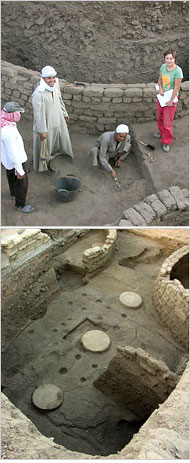
Uncovering Evidence of a Workaday World Along the Nile


Parts of an administration building, above, and a large silo, top, at the site of an ancient provincial capital on the Upper Nile; Top, N.Moeller/Tell Edfu Project; above, G. Marouard/Tell Edfu Project.

By JOHN NOBLE WILFORD, The New York Times, July 1, 2008

Archaeologists have long fixed their sights on the grandeur that was ancient Egypt, the pyramids, temples and tombs. Few bothered to dig beneath and beyond the monumental stones for glimpses into the living and working spaces of ordinary Egyptians.

That is changing slowly but steadily. In the last two or three decades, excavations have uncovered urban remains and swept aside the conventional wisdom that the Egypt of the pharaohs, in contrast to Mesopotamia, was somehow a civilization without cities.

“We can now confirm that this was not the case,” said Nadine Moeller, an Egyptologist at the Oriental Institute of the University of Chicago. Dr. Moeller was speaking of her own recent findings, as well as those of other excavators who practice what is known as settlement archaeology. Continue reading Uncovering Evidence of a Workaday World Along the Nile

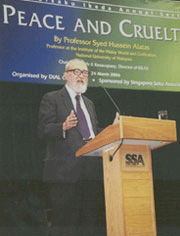
Tribute to Professor Syed Hussein Alatas (1928-2007)

[The following tribute by Alvin Tay is more than a year old, but for those who were unaware of the passing of Prof. Alatas, it is a reminder of the value of his scholarly work, which remains unappreciated in many university settings. Webshaykh.]

23rd January 2007 was a sad day for sociology, Singapore sociology in particular, with the sudden passing of Professor Syed Hussein Alatas, former Professor in Malay Studies at University of Singapore and a pioneer of the kind of sociological theorizing that Singapore, and indeed the region of Southeast Asia, could truly call our own. I did not have the opportunity of the many sociologists before me who had passed through the doors of the department and were taught by him in the university, and so I speak only from the position of one who regrets deeply the loss of a formidable sociologist, and yet feels greatly blessed by the corpus of sociological knowledge which he has left behind. It is the imprint of his many works on me, ranging from religion to race to colonialism, amongst other substantive issues, which impels me to proceed with this modest tribute, albeit with a heavy heart and a prayer for love and peace. Continue reading Tribute to Professor Syed Hussein Alatas (1928-2007)

FGM, Early Marriage and Juvenile Delinquents

MPS say: no to genital mutilation, 18 is minimum marriage age, juveniles cannot be punished as adults

By: Kawkab Al-Thaibani For the Yemen Times

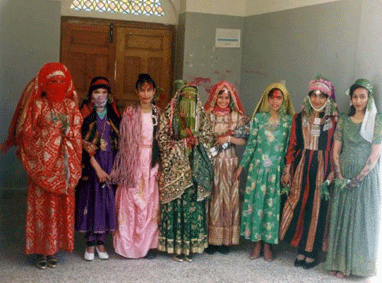
SANA’A, June 24 — A two-day workshop in Parliament concluded that the minimum marriage age in Yemen should be 18, and the sponsors of both brides and grooms should be punished if they allow them to marry under this age.

The workshop’s participants also concluded that juvenile delinquents between the ages of 15 and 18 are not equal to adult criminals. They further recommended laws banning female genital mutilation.

The workshop covered three main areas: the criminality of juveniles, female genital mutilation, and the minimum age of marriage. These three subjects were chosen because the existing laws concerning them are not specific enough and are often ignored.

This workshop was arranged by Parliament, the Higher Council for Motherhood and Childhood, and the Yemeni Network Combating Violence Against Women known as SHIMA, under the sponsorship of the UN Children’s Fund (UNICEF), OXFAM International, and Save the Children, a worldwide children’s rights organization. Attendees included members of the Sharia Committee, who matches the constitutional laws with Islamic sharia law, Parliament members (MPs), doctors and human rights activists. Continue reading FGM, Early Marriage and Juvenile Delinquents

Demise of IsIAO

[Note: IsIAO teaches and researches most Oriental languages and cultures. More information on the situation is available here.]
Dear colleagues and friends,

I have been informed of the shocking news that a decree has been passed by the Italian Council of Ministers to shut down the famous Istituto Italiano per l’Africa e l’Oriente (IsIAO). It is inconceivable that such an extraordinary institution which has been active during the past 100 years in promoting a knowledge of Iran, India, Afghanistan, the Far East, and recently also Africa with amazing success should be abolished.

Professor Giuseppe Tucci and his successor Professor Gherardo Gnoli have done wonders in spreading the knowledge of Iranian lands, their archaeology, their history and their culture. To deprive the Iranian Studies from the services and contributions of this marvelous institution is a severe blow to the promotion of the knowledge of Iran on the international scene.

Professor Tosi has sent an email requesting all supporters of Iranian studies to sign a letter written to the President of the Italian Republic to support the continuation of IsIAO. Please by all means add your signature to this letter and encourage your friends and colleagues to do so as well.

To add your signature visit http://iranica.c.topica.com/maalZ1nabItGzaE1MJ2b/ and please do this as soon as possible, hopefully before the end of the week. Thanks.

With best wishes,

Ehsan Yarshate, Encyclopaedia Iranica

Obama’s other Muslim problem


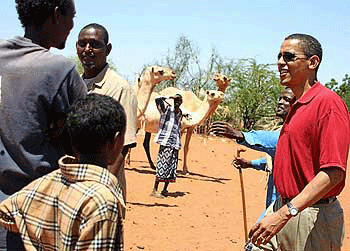
In Kenya on Sunday [August 27, 2006], US Senator Barack Obama on a visit to his late father’s homeland, is pictured with a camel at an animal market in Wajir, an area hit by a severe drought.

By Mark Levine, ALJAZEERA, June 25, 2008

As soon as Barack Obama rose to the top of the field of Democratic presidential contenders, he developed a “Muslim problem” based on false accusations that he is, or once was, a Muslim.

There is little doubt that these accusations will be raised again, however unfairly, when Obama squares off against John McCain, the Republican presidential candidate, in November’s election.

But if we were to assume that Obama overcomes this and other obstacles to win his historic bid for the White House, a far more serious Muslim problem awaits “President” Obama: A majority of the world’s 1.4 billion Muslims have an utter lack of trust in the US.

Senator Obama’s experience of living in a Muslim country (Indonesia, where he attended school during his childhood), along with his relative youthfulness and message of hope, have the potential to heal this rift, however.

He has the merits which can energise young Muslims in the same way he has inspired millions of young Americans. Continue reading Obama’s other Muslim problem