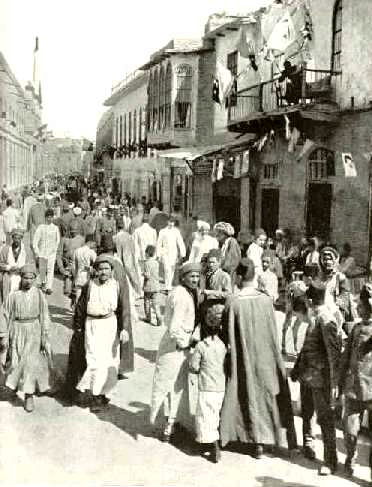
From Failed Resolution 1696 to Real Diplomacy
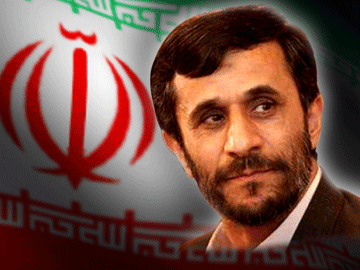
Iranian President Mahmoud Ahmadinejad
by William O. Beeman
The United Nations Security Council Resolution 1696 calling for Iran to suspend nuclear enrichment was passed on July 31, 2006 — nearly two years ago. Every sanction and demand placed on Iran since that time has been based on this Resolution (and its strengthened re-iteration, Resolution 1737 on December 23 of the same year).
Clearly after two years the Resolution and its follow-ups have not worked. Iran has not suspended its uranium enrichment activities, and indications this week are that it is not likely to do so in the future. The United States and its reluctant European allies obviously can not put enough pressure on Iran to cause it to abandon what the Nuclear Non-Proliferation Treaty — to which Iran (but not Israel, Pakistan or India) is signatory – provides as is its “inalienable rightâ€: peaceful nuclear development. As long as it does not violate Provision One of the NPT, namely the agreement not to develop nuclear weaponry. Continue reading From Failed Resolution 1696 to Real Diplomacy
Muslim Metal
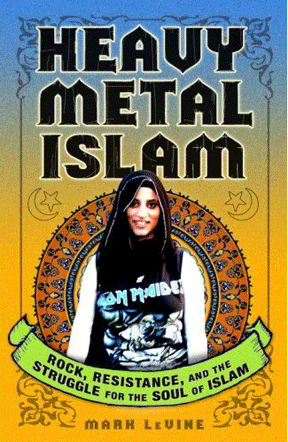
Muslim Metal
Bands crank up multiculturalism in the Islamic world
By MARK LEVINE, The Chronicle Review, July 4, 2008
The first time I heard the words “heavy metal” and “Islam” in the same sentence, I was confused, to say the least. It was around 5 p.m. on a hot July day in the city of Fez, Morocco. I was at the bar of a five-star hotel with a group of friends having a drink — at $25 a piece, only one — to celebrate a birthday. The person sitting across from me described a punk performance he had seen in Rabat not long before we had met.
The idea of a young Moroccan with a Mohawk and a Scottish kilt almost caused me to spill my drink. That the possibility of a Muslim heavy-metal scene came as a total surprise to me only underscored how much I still had to learn about Morocco, and the Muslim world more broadly, even after a dozen years studying it, and traveling and living across it. If there could be such a thing as a heavy-metal Islam, I thought, then perhaps the future was far brighter than most observers of the Muslim world imagined less than a year after September 11, 2001. Continue reading Muslim Metal
A Secular State Must Deliver
by Mohammed Bamyeh, The Immanent Flame, SSRC Blogs, June 20, 2008
It is hard to disagree with the main arguments of Abdullahi an-Na’im’s impeccable book: a healthy religious life requires a secular state, even as political life may remain infused with the religious values of the population. And the historical examples provide added credence to the point. An Islamic state as such never existed historically, even though pre-modern states cannot be regarded as secular in the contemporary sense of the word. But there has never been a state in Islamic history that fused entirely religious and political authority after Muhammad, and it is far from obvious that Muhammad’s own Medina community constituted a state or was meant as a model for any state. All states in Islamic history had a more clearly defined political than religious character, even as they used religion for their purposes or were expected to fulfill some religious roles. In effect, they were political entities that survived to the extent that they accommodated themselves to the diversity (including legal diversity) of Islam and other local traditions. Colonial rule is to blame for rigidifying the sense of what Islam meant, namely by codifying diverse, flexible religious traditions into standard legal formats and ignoring the fluidity of communal boundaries between Muslims and non-Muslims. However, this rigid colonial perspective on the meaning of religiosity and identity was inherited by contemporary Islamic political movements and states claiming to be Islamic. Continue reading A Secular State Must Deliver
Fairuz vs. Haifa Wehbe

Haifa Wehba, left; Fairuz, right
The battle of the Lebanese prima donnas continues. Do you prefer Fairuz or Haifa Wehba? After watching both videos, the main difference may be the cleavage and not just the age.
Syrian Bread a Century Old
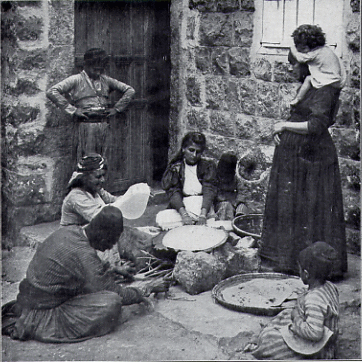
Baking Bread in Syria: The hearth is simply two stones raised on end, over which an iron plate is laid, on which the bread is baked. Source: National Geographic Magazine, XIX(3):171, 1908.
Despair Drives Suicide Attacks by Iraqi Women
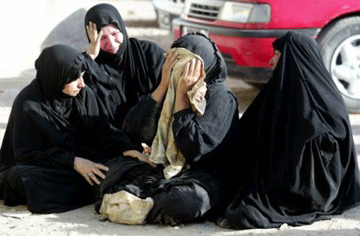
By ALISSA J. RUBIN, The New York Times, July 5, 2008
BAQUBA, Iraq — Wenza Ali Mutlaq walked a bit uncertainly up the long street near the main government offices here on June 22, the hot wind stirring her heavy black abaya. She passed the concrete barricades put up to ward off suicide car bombers and made her way alone, almost haphazardly.
Suddenly, a police car zoomed in. A policeman got out to talk with her. And then their lives were over — torn apart, along with 14 other people, by the huge blast of fire from her concealed explosive vest.
Ms. Mutlaq, who was in her 30s and whose attack was captured on a security video, was the 18th female suicide bomber of the war to strike in Diyala Province, which has been hit by female attackers much more frequently than any other province of Iraq, according to Iraqi police records and the American military. So far, 11 of the 20 suicide bombings carried out by women in Iraq this year have occurred in Diyala. Continue reading Despair Drives Suicide Attacks by Iraqi Women
Virtual Vengeance
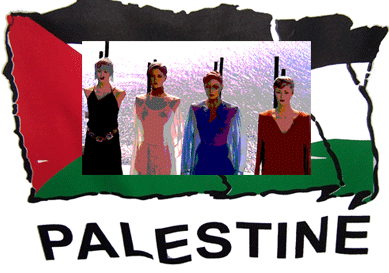
There are more online shoot-em-up games than a person can shake an MK-37 at. The enemies are always the ‘bad guys,’ including Muslim terrorists, who might as well be Nazi or Japanese kamakazi pilots. Of course, video gaming (unlike duck hunting) is all fantasy, I am told. Isn’t it better to shoot fake bullets and rip apart digital bodies online than harm real people (or ducks)? Surely it is. So, if you are interested in seeing the tables turned and are concerned about the usual representation of Palestinians as terrorists, you may find the following video of interest. And remember, it is of course only fantasy.