Farewell Iraqi Style


The shoe-thrower, Muntadhar al-Zaidi, an Iraqi journalist with Egypt-based al-Baghdadia television network

Farewell Iraqi-style: How Iraqis bid vilified leaders goodbye

by Amr al-Azm

As I sat there watching with incredulity and a sense of Schadenfreude that an Iraqi journalist sent one shoe and then the other hurtling at George Bush’s head, I could only reflect on how the same Iraqis, some five year ago, were directing the very same shoes at the face of another much vilified leader: Saddam Hussein.

In Arab culture, showing the soles of the shoes is a sign of great disrespect; throwing a shoe then becomes a symbol of even greater contempt. Bush’s recent unscheduled visit to Iraq, as part of a supposed victory lap, crowning the achievements of his eight-year presidency, ended in ignominy with a shoe in the face. Continue reading Farewell Iraqi Style
If the shoe fits…


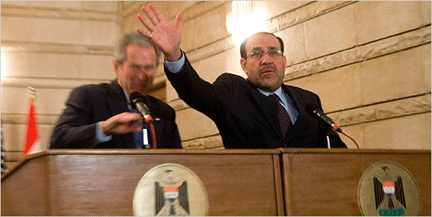
Iraq’s prime minister, Nuri al-Maliki, tried to block President Bush when a man threw his shoes at the president during a news conference in Baghdad on Sunday.

There is not a lot of humor coming out of Baghdad these days. So leave it to a surprise visit by our lame duck President Bush to lighten things up. Snuck into Iraq with the secrecy of a Harry Potter sequel plot, the joint press conference deep in the Green Zone with Nouri Al-Maliki would seem to be a safe venue. Yet the moment Bush was introduced to the Baghdad press corps, the shoe leather hit the fan. A local television reporter stood up, shouting “This is a goodbye kiss, you dog.” Well, it sounds a bit more sinister in Arabic. But this was not the sole agenda of the media heckler. He threw both his shoes at Bush, who ducked both. There was a bit of confusion and seemingly no secret service agent paying attention. Bush stood his ground, waving off the double shoeing with a joke that all he knew was that they were size 10. Continue reading If the shoe fits…

Tariq Ali, Pashtun Nationalism, and Taliban


By Naeem Wardag, Indus Asia Online Journal, December 3, 2008

Since the Afghan War, important power quarters in Pakistan have been propagating a particular interpretation of the security situation in Afghanistan through a variety of means ranging from the vociferous propaganda of the religious right to the more subtle works and ways of the allied experts strategically deployed here and there. Joined the campaign lately have also some ideologues of the liberal left-in particular from Punjab – whose paradigm of the class-struggle fully converge with the “cosmic struggle metaphysics” of the extreme religious right at this point of time as far as their analysis of the problem is concerned. Continue reading Tariq Ali, Pashtun Nationalism, and Taliban

Mo of the Same


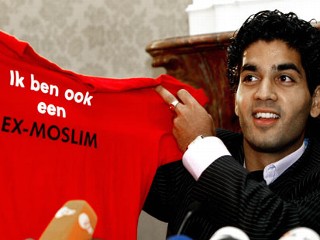
Ehsan Jami, member of the city council of Leidschendam-Voorburg on behalf of the Dutch Labour Party(PvdA) and one of the two founders of the Central Committee for Ex-Muslims

Islamophobia is as old as St. John of Damascus and the Venerable Bede, so it is not surprising that it should also have a youtube extension. One of the latest contributions has not been Piped in by an ardent jihad watcher nor obsessed by a horribly-witted and spent spinnermeister that robs truth to pay politics. Move over Ibn Warraq, hang on Ayaan Ali Hirsi, there is a new apostate on the video block going Dutch on Muslims. His name is Ehsan Jami and he has recently released an “Interview with Muhammad.” So if you would like to hear what someone who has rejected Islam would like the Prophet Muhammad to say on camera after more than fourteen centuries, here is a chance. An earlier prophet, Solomon the Wise, complained that there is nothing new under the sun. Applied to this film I would have to say it is Mo of the same. Continue reading Mo of the Same

Down the wrong chimney


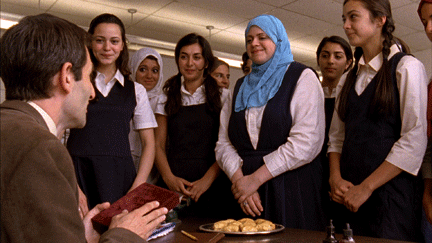
Classroom scene from “Santa Claus in Baghdad.” The book in the professor’s hand is a red velvet volume on Kahlil Gibran, published in 1984. In the film it contains an inscription from the professor’s professor dated 1949. Mixing dates is not the only cinematic sin of this problematic “educational” film.

Last week I received an email as an “educator” about a new, award-winning short feature film called Santa Claus in Baghdad. The announcement came from the filmmaker, an Egyptian named Raouf Zaki, who provided a free preview on a website called vimeo.com. The film is based on a short story of the same name, now part of a series of short stories for young adults by author Elsa Marston. I must admit that I found the title a bit strange, so I decided to look at the preview Tuesday night. But, as the old Christmas song expresses so well, “When, what to my wondering eyes should appear?” A turkey; nothing to give thanks for in battling stereotypes of Iraqis. I realize that the film intended to humanize Arab children, but it tells an emotional “what a great kid” story unrelated to the realities of living in Iraq. Iraqi children, including the thousands who died during Saddam’s regime and during the American occupation, deserve better. Continue reading Down the wrong chimney

Connecting Histories in Afghanistan


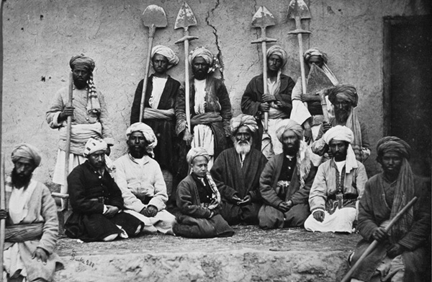
Landowners and Laborers in Kabul from the Burke collection that comprises the first series of photographs relevant to the market region and period of our concern that were taken in the context of the second Anglo-Afghan war. Image courtesy of the the National Army Museum, London.

Connecting Histories in Afghanistan: Market Relations and State Formation on a Colonial Frontier by Shah Mahmoud Hanifi. New York: Columbia University Press, 2008.

Preface

This book situates nineteenth-century Afghanistan in the context of British Indian colonialism. The general focus is commerce, mainly how local actors including Afghan nomads and Indian bankers responded to state policies regarding popular and lucrative commodities such as fruit and tea. Within those broad commercial concerns, specific attention is given to developments in and between the urban market settings of Kabul, Peshawar, and Qandahar. The colonial political emphasis on Kabul had significant commercial consequences for that city and its economic connections to the two cities it displaced to become the sole capital of the emerging state. The Kabul hypothesis therefore represents a colonial political strategy, and its effects on Kabul-Peshawar and Kabul-Qandahar economic relations are the subject of this book. Continue reading Connecting Histories in Afghanistan

Art Against Reason

M.Y. ART PROSPECTS is pleased to present Against Reason, a solo exhibition by Emna Zghal.

December 11 – January 17, 2009 | Opening Reception December 11, 6-8PM

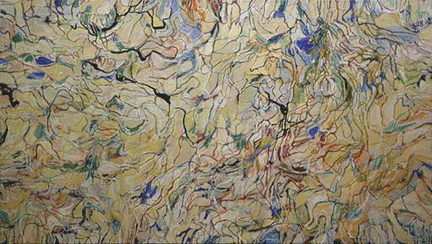
Against Reason features Zghal’s latest oil paintings with a smaller selection of prints and watercolors. Drawn from lyrical forms found in nature, she uses a wide spectrum of tones and minute strokes to create highly conceptual, abstract pieces. Turning away from contemporary conventions, she rigorously pursues her idiosyncratic themes of abandonment, lostness, and bewilderment.

Zghal is moved by the brilliant colors of a garden, the subdued beauty of a forest, the reflections within moving water. Her work brings to mind the abstractions of Lee Krasner and Joan Mitchell, particularly in her use of repetitive, swirling strokes with careful but unstrained release of color. Continue reading Art Against Reason

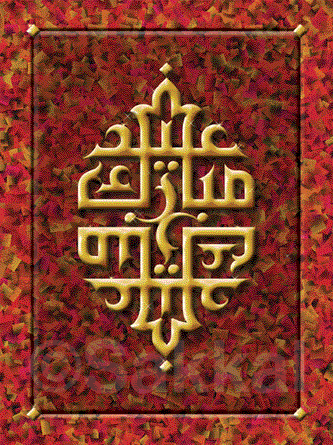
Eid Mubarak


Source: Sakkal Designs

Looking for online Eid e-cards? Here are a few sites worth looking at:

123 Greetings

Eid E-Cards

afary.com

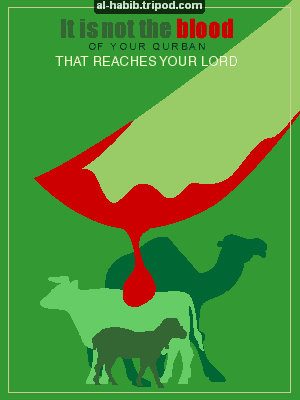
alhabib


Source: http://al-habib.tripod.com/islamic-greeting-card/card_adha.htm

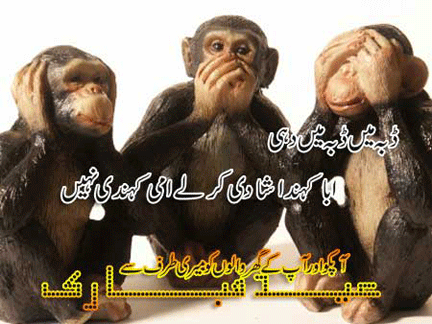
There are some fascinating eid cards available online, some of which go far beyond images of Mecca and roses. The strangest I have found thus far is at photofurl.com:

I am tempted to say that the artist was just monkeying around in Photoshop, but as an anthropologist I would have to stop myself and admit that these are in fact three apes…

If anyone has other interesting examples of eid e-cards, please send information about them along or post the urls here in the comment section.