Picturing Bethlehem

December eyes are fixed on Bethlehem, which has been an inspiration for artists over many years and indeed centuries. On this Christmas day, take a look at Bethlehem as it might have looked more than a century ago.
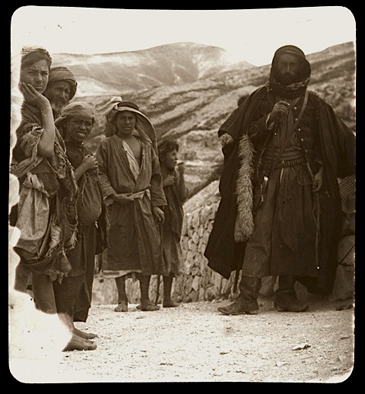

Left hand element of a stereoscopic photograph of the Bethlehem region circa 1900. Courtesy of Glenn Bowman.
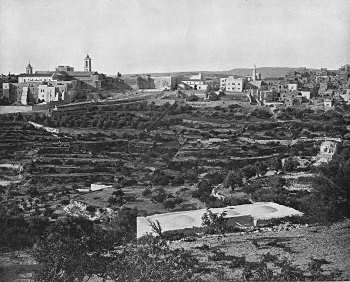

Approaching Bethlehem. Source: Earthly Footsteps of the Man of Galilee.

The following two illustrations of Bethlehem can be found on the website (Jerusalem in 19th Century Art) put up by James E. Lancaster.
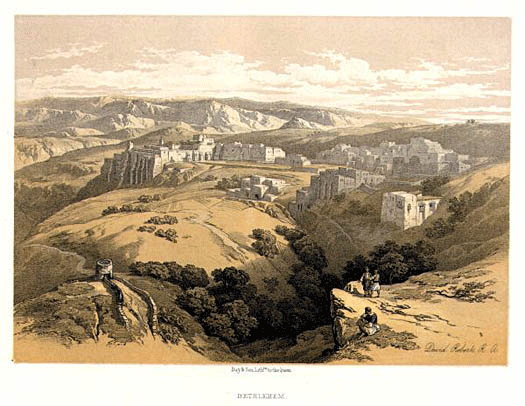

Bethlehem Tinted lithograph printed by Day & Son, after David Roberts, published about 1855.
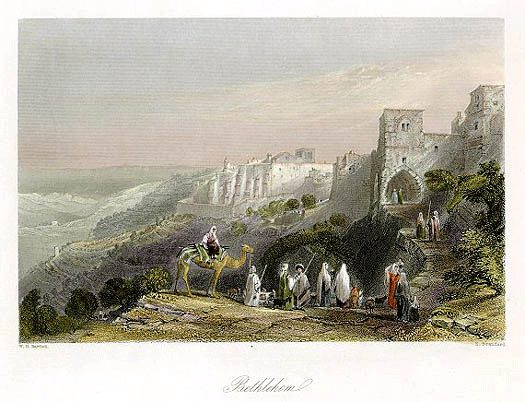

Bethlehem Engraved by S.Brandard after a picture by W.H.Bartlett, published in The Christian in Palestine, about 1840. Steel engraved print with recent hand colour.
Jerusalem Prosopography Project


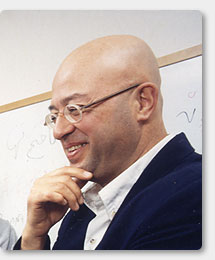
Michael Lecker, Professor of Arabic Language and Literature at the Hebrew University of Jerusalem

[Editor’s Note: The Jerusalem Prosopography Project (JPP) was created by Michael Lecker, Professor of Arabic Language and Literature at the Hebrew University of Jerusalem. This online resource will be a valuable tool for all scholars working on the formation of Islam and the early Islamic community.]

The Prosopography of Early Islamic Administration (PEIA) aims at recording judiciously all the biographical evidence available in Arabic primary sources about those who played a role in the state apparatus during the early Islamic period (ca. 622-800).

It is part of the Jerusalem Prosopography Project (JPP) that aims at recording the biographical evidence available in the Arabic primary sources about several well-defined groups of people who flourished during the first two centuries of Islam.

Future projects within the JPP include the CPM or The Companions of the Prophet Muḥammad, the JEA of The Jews of Early Islam, the MSP or The Muslim Settlers in Palestine and the TOH or The Transmitters of Ḥadīth.

Although the PEIA is still far from completion, it was felt that colleagues around the world might find it useful even at its present form. It is being updated on a daily basis. Continue reading Jerusalem Prosopography Project

Lithographica Arabica 1


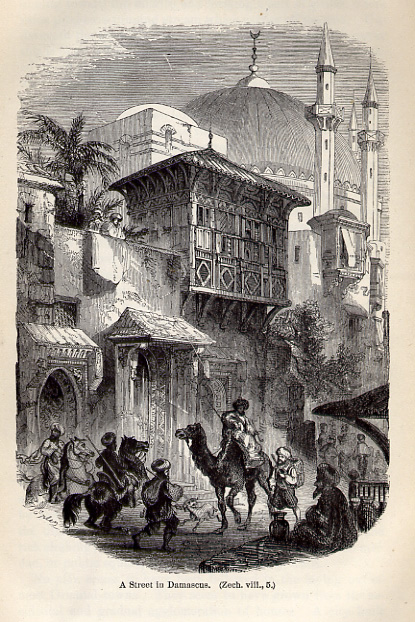
“A Street in Damascus” from Bible Lands by Henry Van-Lennep, 1875, p. 456

Watching vivid color, cable television on an HD screen obscures the art of old black and white movies, which were once able to conjure up fantasies in black, white and shades of gray. Glancing at glossy National Geographic photographs similarly buries further into the archived past all those simple lithographic line drawings storehoused in 19th century travel accounts, Orientalist writings and Bible Custom compendiums. I admire the fruits of progress, but the nostalgia for reaching back into the museum of my book-reading memories demands equal time.

For those who share the tactile thrill of fingers thumbing through brown-edged paper and caressing delicate bindings of century-plus-old books, I dedicate a new theme on Tabsir devoted to the art of lithographic representation of the Middle East. Lithographica Arabica — long live the line drawings and antiquated woodcuts of bibliophilic bliss. Continue reading Lithographica Arabica 1

Saving ISIM

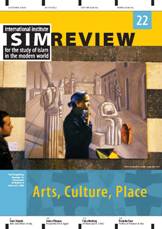
If you are in any way involved in the academic study of Islam, the acronym ISIM is no stranger. This International Institute for the Study of Islam in the Modern World, based in The Netherlands, has served as a welcome resource for information on Islam, especially in contemporary contexts. The free journal (ISIM Review), available online and in print, has been one of the most diverse, interesting, informative and accessible forums on Islam. The institute itself has sponsored conferences, workshops and fellows. Yet, if you click on to the main website today, here is what you see:

ISIM to be closed as per 1 January 2009

The International Institute for the Study of Islam in the Modern World (ISIM) will be closed as per 1 January 2009, due to the lack of adequate funding. ISIM was set up ten years ago by the universities of Leiden, Amsterdam, Utrecht and Nijmegen, and the Netherlands Ministry of Education, Culture and Science. The objective of the institute has been to carry out innovative research into the social, political, cultural and intellectual trends and movements in present-day Muslim communities and societies worldwide. Continue reading Saving ISIM

Rebooting America


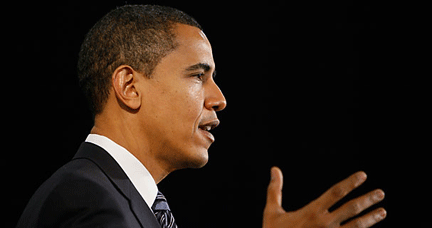
President-elect Barack Obama gestured during a news conference in Chicago, Thursday. He plans to deliver a major speech in an Islamic capital, perhaps within the first 100 days of his presidency. (Charles Dharapak/AP)

Obama plans major speech in Muslim world to ‘reboot’ America’s image abroad

How Obama addresses sensitive issues of democracy and human rights could help set the tone for efforts to distinguish himself from President Bush’s administration.

by Howard LaFranchi, Christian Science Monitor, December 11, 2008

Washington

During the campaign, President-elect Obama put the goal of repairing America’s image abroad – and in particular in the Muslim world – at the top of his foreign-policy agenda. Mr. Obama began defining how he intends to do that this week by discussing his plans to deliver a major speech in an Islamic capital, perhaps within the first 100 days of his presidency.

Obama’s plan, still in the formative stages, immediately set off speculation over where the new American president would choose to deliver his message and what he would say. Continue reading Rebooting America

The Mothers Of The Lashkar

The Mothers Of The Lashkar

by C.M. Naim, Outlook India, Dec 15, 2008

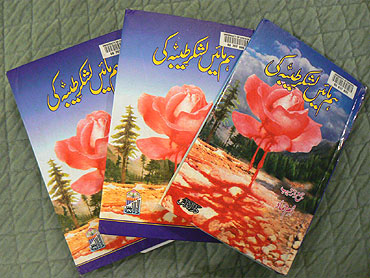
The book is titled Ham Ma’en Lashkar-e-Taiba Ki (‘We, the Mothers of Lashkar-e-Taiba’); its compiler styles herself Umm-e-Hammad; and it is published by Dar-al-Andulus, Lahore. Its three volumes have the same garish cover, showing a large pink rose, blood dripping from it, superimposed on a landscape of mountains and pine trees The first volume, running to 381 pages, originally came out in November 1998, and was reprinted in April 2001. The second and third volumes, with 377 and 262 pages, respectively, came out in October 2003. Each printing consisted of 1100 copies. Portions of the book—perhaps much of it—also appeared in the Lashkar’s journal, Mujalla Al-Da’wa.

Here is how the publisher, Muhammad Ramzan Asari, describes the book’s contents and purpose. Continue reading The Mothers Of The Lashkar

Surfs Up Da’wa

Sydney art fuses surf with Islam

By Nick Bryant, BBC News, Sydney, December 6, 2008

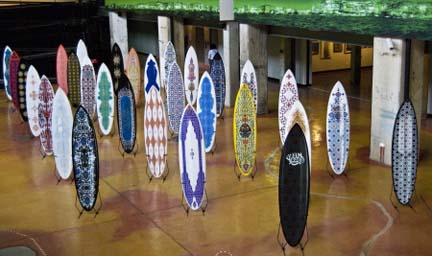
An Australian artist has produced a range of Islamic surfboards in an attempt to create a greater understanding between East and West.

Phillip George was inspired by his trips to the Middle East and by riots in 2005 when Lebanese Australians were targeted on a beach in Sydney.

He has called the range the Inshallah – or God Willing – surfboards and has put them on exhibition in Sydney.

There are 30 surfboards in all, each adorned with intricate Islamic motifs. Continue reading Surfs Up Da’wa

Virtual Ummah

Virtual world for Muslims debuts

BBC News, 2008/12/09

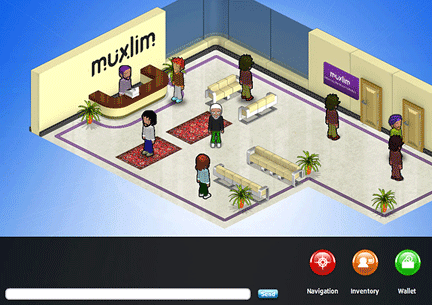
A trial version of the first virtual world aimed at the Muslim community has been launched.

Called Muxlim Pal, it allows Muslims to look after a cartoon avatar that inhabits the virtual world.

Based loosely on other virtual worlds such as The Sims, Muxlim Pal lets members customise the look of their avatar and its private room.

Aimed at Muslims in Western nations, Muxlim Pal’s creators hope it will also foster understanding among non-Muslims.

“We are not a religious site, we are a site that is focused on the lifestyle,” said Mohamed El-Fatatry, founder of Muxlim.com – the parent site of Muxlim Pal.

“This is for anyone who is remotely interested in the Muslim culture and the Muslim lifestyle,” he said. Continue reading Virtual Ummah