People in Muslim Nations Conflicted About UN

People in Muslim Nations Conflicted About UN

Favor More Active UN With Broader Powers, But See US Domination and Failure to Deal With Israel-Palestinian Conflict

Press Release, WorldPublicOpinion.org, December 3, 2008

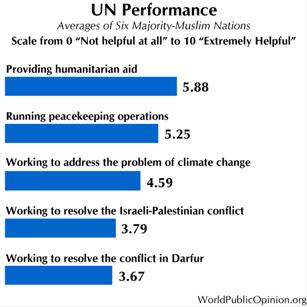
College Park, MD—A poll of seven majority Muslim nations finds people conflicted about the United Nations. On one hand there is widespread support for a more active UN with much broader powers than it has today. On the other hand, there is a perception that the UN is dominated by the US and there is dissatisfaction with UN performance on several fronts, particularly in dealing with the Israeli-Palestinian conflict.

These are the findings from a WorldPublicOpinion.org survey in Egypt, Turkey, Jordan, Iran, Indonesia, the Palestinian Territories, and Azerbaijan. Muslims in Nigeria (50% of the general population) were also polled. The survey was conducted in two waves in 2008. Overall, 6,175 respondents were interviewed in the first wave and 5,363 in the second; a total of 11,538 respondents participated in the study. The first wave was conducted January 12-February 18, 2008 though in two nations it was completed in late 2006. The second wave for all nations was completed July 21-August 31, 2008. Margins of error range from +/-2 to 5 percent. Not all questions were asked in all countries. Continue reading People in Muslim Nations Conflicted About UN
In Memoriam Elizabeth Fernea

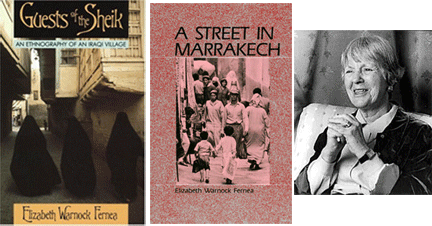
Webshaykh’s Note: For the many people whose lives crossed those of BJ Fernea this is a sad note from the University of Texas, where she taught for many years.

It is with great sorrow that we report that Elizabeth Warnock Fernea, Professor Emerita of Comparative Literature and Middle Eastern Studies at the University of Texas at Austin, passed away on Tuesday afternoon, December 2, 2008, at the home of her daughter, Laila Stroben, in La Canada, California. She is survived by her husband, Robert A. Fernea (Professor Emeritus of Anthropology and Middle Eastern Studies), daughters Laura Ann and Laila and son David, and several grandchildren. Continue reading In Memoriam Elizabeth Fernea

Is the Hummer a Dinger?


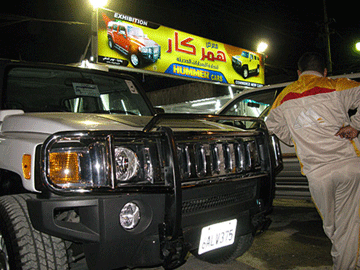
Hummers are on display at Safa Selmen Menjed’s car dealership in an upscale Baghdad neighborhood. Photo by Ivan Watson, NPR

Test-Driving A Hummer H3, In Baghdad

by Ivan Watson, All Things Considered, December 4, 2008

Security. Militia. Badge. Apache. These are just a few of the English words Iraqis have adopted over the course of a military occupation that has lasted more than five years.

The most common catchphrase of all is Hummer. That’s the word Iraqs now use to describe just about anything military on wheels.

The Hummer has become one of the most ubiquitous symbols of the U.S. military presence in Iraq. Continue reading Is the Hummer a Dinger?

Enough is Enough

Enough is Enough
Says who to whom?

By Badri Raina, ZNet, November 30, 2008

Epigraph:

The Light of the body is the eye: if therefore thine eye be single, thy whole body shall be full of light.(Gospel, Matthew, 6:22)

I

My skimpy acquaintance with the Taj hotel in what was then Bombay goes back to 1962.

I had been selected as a rookie sales executive by the then world’s largest corporate house, Standard Oil, whose Asia division was called ESSO.

Our offices, also then the only air-conditioned building in Bombay, was at Nariman point.

Such was the nature of my job that on two or three occasions I had to be inside the Taj, full of smiles and business.

Some three years later I decided I wasn’t going to sell oil for the next forty years, and I quit cold turkey to return happily to an academic life, liberally enlivened with activist involvements.

In short, the Taj hotel is truly a magnificent structure, although those days it made me happier to look at its magnificence from the outside than wheeling-dealing inside.

Like every other Indian, therefore, I am deeply saddened both by the insane loss of life, notable and ordinary, and by the damage done to this edifice. Especially when I recall that the Taj was the result of a laudable anti-colonial impulse, since Jamshedji had been refused entrance to another hotel reserved exclusively for the British. Continue reading Enough is Enough

Rape in the Iraq War


Khalida: The mother of two, shown in silhouette, was raped during the war.

Rape’s vast toll in Iraq war remains largely ignored

By Anna Badkhen, The Christian Science Monitor, November 24, 2008 edition

Amman, Jordan – As though recoiling from her own memories, Khalida shrank deeper into her faded armchair with each sentence she told: of how gunmen apparently working for Iraq’s Interior Ministry kidnapped her, beat and raped her; of how they discarded her on a Baghdad sidewalk.

But her suffering did not end when she fled Iraq and became a refugee in Jordan’s capital, Amman. When Khalida’s husband learned that she had been raped, he abandoned her and their two young sons.

Rumors spread fast in Amman; soon, everyone on her block knew that she was without a man in the house. Last month, her Jordanian neighbor barged into her apartment and attempted to rape her. Continue reading Rape in the Iraq War

Reclaiming my Religion


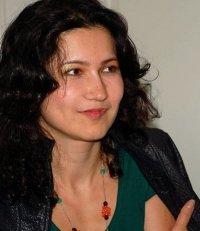
Nadira Artyk

Reclaiming my Religion

By Nadira Artyk, International Herald Tribune, November 28, 2008

My relationship with Islam has never been straightforward. I grew up in Soviet Uzbekistan, hearing my grandfather recite the Koran on a daily basis. Sometimes he would translate a few verses for us. I was drawn to the beauty of the prose. I sensed a strong connection and especially admired the values of social justice, equality and generosity of human spirit.

On the other hand, I was a Soviet Young Pioneer and later a Komsomol activist. Despite all my respect and love for my pious grandfather, I saw a mismatch between his words and my reality, at least in one area – there was no equality or justice to be found in Muslim families. The superiority of men over women was deeply entrenched and never questioned. Continue reading Reclaiming my Religion

Mixing Dall with Scottish Oats


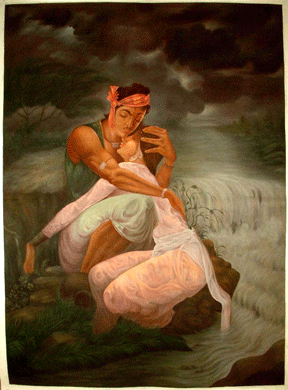
Heer Ranjha (Grieving Emotions of Two Desperate Hearts) by Giri Raj Sharma.

Lovers, Religion and Inhumanity

by Amanullah De Sondy, BBC Radio Scotland, Thought for the Day, Monday 1st December 2008

‘Porridge for my breakfast and Dall for my lunch, I’m a typical Scots-Asian’ said the main character in the Glasgow adaptation of the famous Punjabi love story, Heer Ranjha. I went to watch the play at the Tramway in Glasgow at the weekend. It’s an interesting and tragic tale of a rich Sikh girl, Heer, and a poor Pakistani Muslim boy, Ranjha, who is given a job in one of Heer’s father’s Indian restaurants. Ranjha cannot be accepted by the Sikh family, because of his Pakistani Muslim roots, and he’s taunted by the Sikhs around him.

In the end, Heer is forced to marry a famous Bollywood movie star, Sikh of course, but at the final moment Ranjha re-appears and is killed by her uncle. In a tragic finale, Heer kills herself so that she can to be with Ranjha. Continue reading Mixing Dall with Scottish Oats

Terrorism That’s Personal


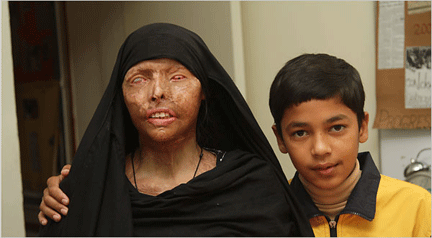
Acid attacks and wife burnings are common in parts of Asia because the victims are the most voiceless in these societies. Naeema Azar, above, was attacked by her husband after they divorced. Her 12-year-old son, Ahmed Shah, looks after her.

Terrorism That’s Personal

By NICHOLAS D. KRISTOF, The New York Times, November 30, 2008

ISLAMABAD, Pakistan

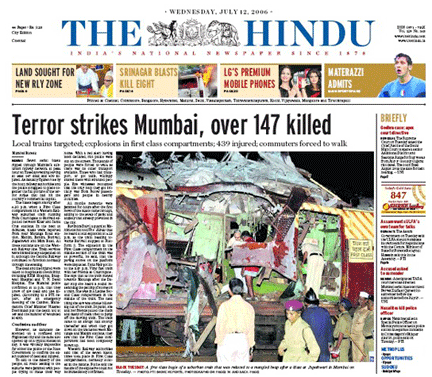
Terrorism in this part of the world usually means bombs exploding or hotels burning, as the latest horrific scenes from Mumbai attest. Yet alongside the brutal public terrorism that fills the television screens, there is an equally cruel form of terrorism that gets almost no attention and thrives as a result: flinging acid on a woman’s face to leave her hideously deformed.

Here in Pakistan, I’ve been investigating such acid attacks, which are commonly used to terrorize and subjugate women and girls in a swath of Asia from Afghanistan through Cambodia (men are almost never attacked with acid). Because women usually don’t matter in this part of the world, their attackers are rarely prosecuted and acid sales are usually not controlled. It’s a kind of terrorism that becomes accepted as part of the background noise in the region. Continue reading Terrorism That’s Personal