Towards Theocracy?


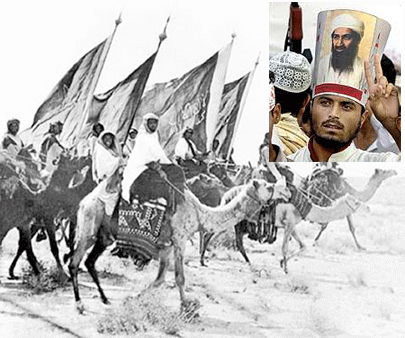
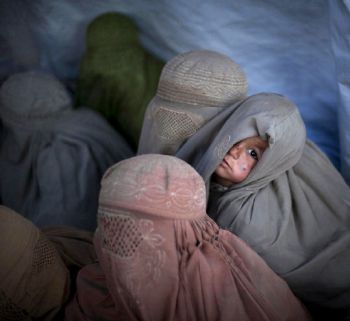
Women in burqas and children from the Bajaur and Mohmand agency areas wait to be registered at a refugee camp near Peshawar in January. Today a full-scale war is being fought in FATA, Swat and other “wild” areas of Pakistan, with thousands dying and hundreds of thousands of displaced people streaming into cities and towns. Photo by Emilio Morenatti/AP.


Towards Theocracy? State and society in Pakistan today.

by PERVEZ AMIRALI HOODBHOY, Frontline, March 14-27, 2009

FOR 20 years or more, a few of us in Pakistan have been desperately sending out SOS messages, warning of terrible times to come. Nevertheless, none anticipated how quickly and accurately our dire predictions would come true. It is a small matter that the flames of terrorism set Mumbai on fire and, more recently, destroyed Pakistan’s cricketing future. A much more important and brutal fight lies ahead as Pakistan, a nation of 175 million, struggles for its very survival. The implications for the future of South Asia are enormous. Continue reading Towards Theocracy?
Captain John Smith and the Turks


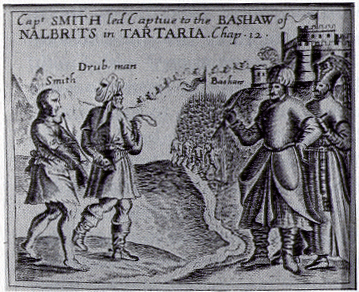
John Smith led into captivity to the Bashaw of Nalbrits by a “Drub-man” (interpreter). From The True Travels, Adventures, and Observations of Captaine John Smith, in Europe, Asia, Affrica, and America, from Anno Domino 1593 to 1629. London, 1630.

by Timothy Marr

Islam has figured in the fashioning of North American cultural definitions since as far back as the first years of European settlement. Inaugurating instances in colonial British America can be seen through brief biographical sketches of the Virginian leader John Smith and the Quaker preacher Mary Fisher.…

John Smith gained experience and credentials fighting Turks in Ottoman Europe well before he ventured across the Atlantic and he prided himself as a hearty crusader against the Muslims. After successfully launching incendiary devices against the Turkish armies in Hungary, for example, he reveled that “the lamentable noise of the miserable slaughtered Turkes was most wonderfull to heare.” Continue reading Captain John Smith and the Turks

Social Freedom for Turkish Women


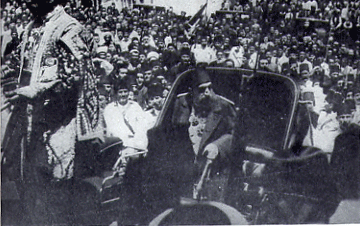
The sultan of the Ottoman Empire going to mosque the day after the constitution was announced.

Social Freedom for Turkish Women
by Mary Mills Patrick.

[The following excerpt is from “The Emancipation of Mohammedan Women,” published in the National Geographic Magazine, January 1909 (Volume XX, No. 1, p.p. 61-62).]

Their past experience has been slowly preparing the Turkish women for the larger opportunities that the constitution gives them. On the morning of the 24th of July all classes of the Turkish Empire entered into a new life, but the greatest change of all took place in the harems. Women everywhere threw off their veils. A prominent woman in Salonica openly assisted her husband in the political celebration.

One woman went so far as to have her picture published in a Paris paper. At this the members of the Reactionary party rose up in common protest and said, “If this be the result of freedom, that our women display their faces to the public with such brazen immodesty, we do not wish a constitution.”

The turkish women are true patriots, and when they saw that the question of freedom for women appeared to have such deep significance to the nation, not only from a political and social, but also from a moral point of view, they said with one accord, “Of what consequence is so small a matter as the veil! We will continue to wear our veils, and will seek the larger opportunities that the new constitution gives us.” Turkish women everywhere have accordingly resumed their veils; but it is a very different thing to wear a veil voluntarily from being obliged to do so, and eventually they will probably appear in the streets without them.

The moral freedom that the revolution has brought the Turkish women is showing itself in many different lines. The freedom of the press has been offered to women. They are writing for the papers openly and without fear of censorship, and their voices are being heard in regard to the affairs of the nation.

Mary Mills Patrick was President of the American College for Girls at Constantinople.

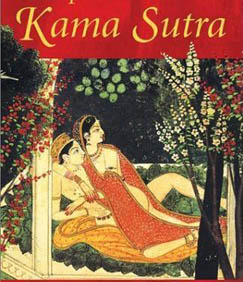
Kama Sutra, Indian Islam and Missionaries

Sex and the country: Islamic rule did not disturb the long Indian tradition of erotic writing
By William Dalrymple, New Age Islam, August, 2008

There is nothing new about India being perceived as a place of great and growing wealth: for much of the pre-colonial period, the west was the eager consumer of the spices, silks, and luxuries of the subcontinent, while India was the prosperous supplier. You can still get a flavour of the intoxicatingly rich and sophisticated classical India that supplied these luxuries at the once-great port of Mamallapuram on the Coromandal coast. Here massive relief sculptures faced onto the port where, according to a seventh-century poet, “ships rode at anchor, bent to the point of breaking, laden as they were with wealth, with big-trunked elephants, and with mountains of gems of nine varieties”. The reliefs cover one side of a hill: at the right are two huge elephants, trunks swinging; nearby, warrior heroes and meditating sages stand below flights of gods and goddesses, godlings, nymphs, and tree spirits. There is a breezy lightness of touch at work: a flute is playing, there is dancing, and the heavenly apsara fertility spirits and goddesses are whispering fondly to their consorts. Continue reading Kama Sutra, Indian Islam and Missionaries

Who is the Enemy?

Wahhabism, Salafism and Islamism: Who Is The Enemy?

by Ahmad Moussalli, Conflicts Forum, January, 2009

This essay constructs and deconstructs three main discourses created by different and opposing trends in modern Islamic thought that are normally and mistakenly lumped together as Islamism, fundamentalism, salafism, neo-salafism, Wahhabism, jihadism, political Islam, Islamic radicalism and others. I will compare and contrast between them by developing a typology of major ideologies of active Islamic trends that centers specifically on Wahhabism and neo-Wahhabism, salafism and neo-salafism, and Islamism, both moderate and radical. Understanding these trends and their discourses will allow world powers, policymakers, academicians, intellectuals, terrorism experts, journalists, and many others to distinguish between and understand the logic of the radical and the moderate, the active and the inactive, the jihadi and the peaceful, the takfiri and the tolerant, the modern and the traditional, and the rational and irrational. This essay will also clarify the terminology used chaotically by different policy-makers, analysts, journalists, academicians, and intellectuals. Although all Islamic trends use similar literal doctrines and concepts such as jihad, Islamic state, al-shari‘a or prophetic traditions, their connotations and discourses differ importantly from one trend to another. This makes their implications serious in action, massive in repercussions, and fundamental for understanding. Continue reading Who is the Enemy?

Muslim in America: a ‘voyage of discovery’


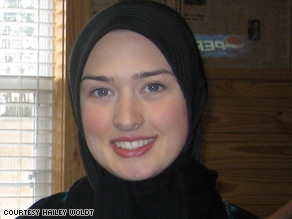
Hailey Woldt, in a traditional Muslim head scarf, studied how people react to her garb in Arab, Alabama.

Muslim in America: a ‘voyage of discovery’

ATLANTA, Georgia (CNN) February 9, 2009 — Hailey Woldt put on the traditional black abaya, expecting the worst. Hailey Woldt, in a traditional Muslim head scarf, studied how people react to her garb in Arab, Alabama.

The last time she’d worn the Muslim dress that, with a head scarf, covered everything but her face, hands and feet, she was in Miami International Airport, where the stares were many and the security check thorough.

This time, she was in a small town called Arab. Arab, Alabama, no less. Continue reading Muslim in America: a ‘voyage of discovery’

Ahmad Fathi in Washington, DC

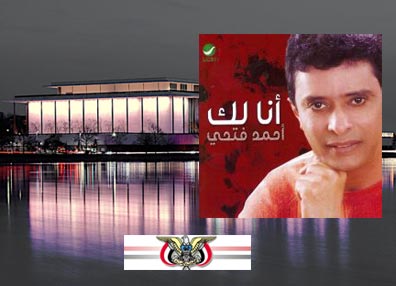
The renowned Yemeni singer, composer and oud player, Ahmad Fathi (أحمد فتحي), is coming to Washington and will be performing this Friday at 6 pm at The John F. Kennedy Center for the Performing Arts. The event is free, sponsored by the Yemen Embassy. Fathi is well-known in the Arab world, but less so here in the United States. He has several albums, and his work is readily seen on Youtube (for example http://www.youtube.com/watch?v=mFBdbVnRvbU&feature=related).

Fathi was influenced early on with traditional Yemeni music. He joined the musical institute of Cairo in the late 70’s and earned a diploma in harmonic music with a focus on the lute (oud) instrument. He enriched the Yemeni artistic movement with his distinguished creativity and his brilliance in playing the lute. Fathi obtained an MA with honors from the Cairo higher musical institute December, 1998 for his thesis on the “lute (Oud) and its role in Yemeni songs.”

The Yemeni Culture affairs Ministry decorated Fathi the “Arts Medal” for his role in promoting traditional Yemeni music globally. In 2008, The Arab Creative Association honored composer and singer Ahmed Fathi for his contribution to Arabic Music. Fathi was named an Ambassador of Yemeni Music. Yemeni and Arab fans have enjoyed two decades of modern and classic songs composed by Fathi.

In Pursuit of the Exotic

Museum Exhibits

January 29 to March 29, 2009: Napoleon on the Nile: Soldiers, Artists and the Rediscovery of Egypt

March 24 through April 30, 2009: In Pursuit of the Exotic: Artists Abroad in 19th Century Egypt and the Holy Land

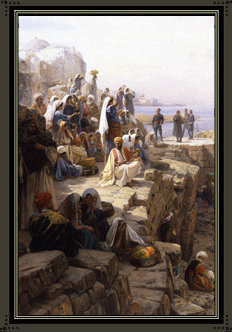
New York, New York – The Dahesh Museum of Art and Syracuse University Art Galleries today announced the formation of a partnership, which will include the Museum’s organizing several exhibitions annually from its own collection of 19th-century art in the academic tradition, complemented by works in the University’s rich collection, for presentation at the SU Art Galleries in Syracuse, as well as The Palitz Gallery/ Lubin House, located on 11 East 61st Street, off Fifth Avenue. The Palitz Gallery has recently attracted artworld attention with the exhibition Michelangelo: the Man and the Myth on view through January 4th 2009. Continue reading In Pursuit of the Exotic