Reflections on Gaza


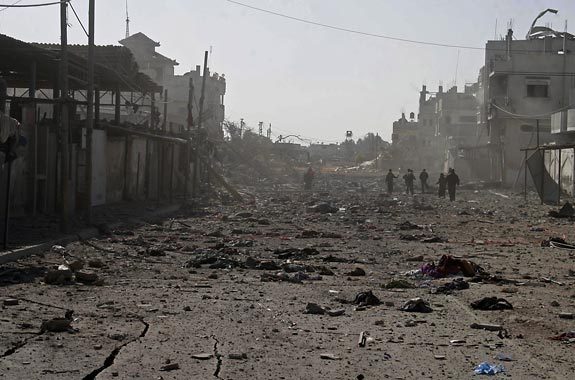
Palestinians walk in the rubble following an Israeli airstrike Wednesday in Rafah refugee camp in the southern Gaza Strip. Photo by Khaled Omar, The Associated Press.

Why did Israel start this War?
by Amr al-Azm, Brigham Young University

There are several answers to this question depending on which angle you look at it from.

The facts on the ground (Time Line) run as follows:

June 19 – An Egyptian brokered truce begins between Hamas and Israel. It calls for Hamas to stop cross-border rocket fire and for Israel to gradually ease its embargo on Gaza.

July 27: Israel kills Shihab al-Natsheh, a senior Hamas fighter, in his house in the West Bank city of Al-Khalil. Hamas protests action and Israel claims that the West Bank is not covered by the ceasefire.

November 5: Israel raids supposed smuggling tunnels in the Hamas-controlled region. Six Palestinians killed in the attack. Hamas responds by firing several dozen rockets and mortar shells at western Negev in Israel in retaliation. No casualties or property damage is caused, but three women are treated for shock. Continue reading Reflections on Gaza
Beating Swords into Ouds

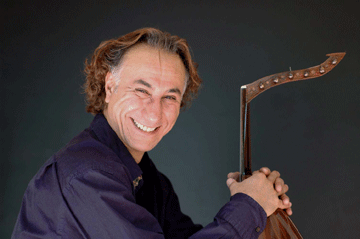
Last night I had the privilege of listening to the Iraqi musician and composer, Rahim AlHaj, who performed a number of his own compositions for solo oud. This was held at Symphony Space in Manhattan as part of the World Music Institute season. AlHaj is not only a talented contemporary artist, but a natural showman. His playful, and at times tearful, interaction with the audience framed his virtuosity. I say “tearful” because the passion in his music spoke to the disharmony in Iraq’s recent history. One of the pieces was named in honor of a cousin, Qasim, who along with four friends was killed by American soldiers while waiting for a cab in Baghdad. Another poured out his sadness at witnessing the tragedy of 9/11 soon after arriving in America. Throughout the show, Rahim asked if we in the audience wanted him to play something “fun” or “tragedy.” Both were present in the theater last night; both pervade Iraqi culture today.

For more information on Rahim AlHaj, check out his superb website. A video of his recording for a Smithsonian cd is available on Youtube. His biography, copied from his website, is provided below. Continue reading Beating Swords into Ouds

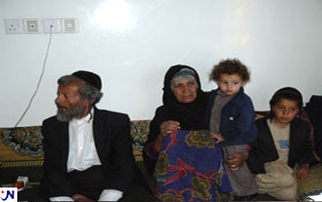
Blood money for Killing Yemeni Jew


Yemeni Jews: source: Yemen Observer

by Nasser Arrabyee, Yemen Observer, March 3, 2009

A Yemeni primary court in Amran, north of the country, ruled on Monday a payment to be made of 5.5 million YR (US$ 27,500) in blood money for the murder of a Jewish man by Yemeni, Abdul Azeez al-Abdi, last December.

The court, chaired by Judge Abdul Bari Aqaba, also ordered that the convict should be placed in a psychotic sanatorium. The father of the Jew refused the sentence and asked for an appeal to be made to demand the death penalty against the convict.

“As long as there is no justice for us, then (they should) deport us to Israel, it’s better for us.” Continue reading Blood money for Killing Yemeni Jew

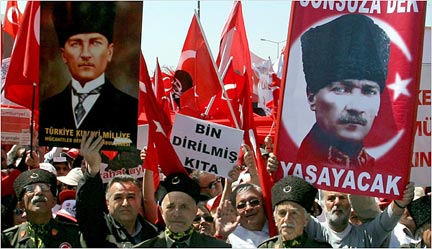
Democracy, Islam, and Secularism: Turkey

Conference: “Democracy, Islam, and Secularism: Turkey in Comparative
Perspective”

Date: March 6-7, 2009
Location: International Affairs Building 1501, Columbia University

Turkey, as a Muslim-majority country, is the only member of NATO and only
candidate member of the European Union. Assertive secularism, multiparty
democracy, and military interventions are other puzzling aspects of Turkish
politics. With its rising activism in the Middle East, Caucasus, and Central
Asia, Turkey has also become an influential actor in world politics. This
conference aims to present an integrated picture of Turkey by bringing
together comparative perspectives on its past, present, and future, and
delving into such issues as the legacy of the Ottoman Empire, secularism,
religion, democracy, civil-military relations, and the European Union
membership. Continue reading Democracy, Islam, and Secularism: Turkey

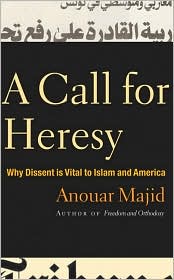
A Call for Heresy

[Note: The following excerpt is from Anouar Majid’s “A Call for Heresy: Why Dissent is Vital to Islam and America” (Minneapolis: University of Minnesota Press, 2007), pp. 1-2, 47]

by Anouar Majid, University of New England.

“A Virtuous heretic shall be saved before a wicked Christian.” Benjamin Franklin

“The atheist from his attic window is often nearer to God than the believer caught up in his own false image of God.” Martin Buber

This book is both an attempt to treat Islam over and above the confines of the familiar extremist/moderate dichotomy and an extension of my reflections on ways to divert Muslim and other cultures toward more progressive formulations. In the past I called for a progressive interpretation of Islam and its canons, urged both Muslims and Westerners to question their orthodoxies, and argued for a polycentric world of ‘neoprovincials’ questioning dogmas at home, reaching out to progressive elements in other cultures, and forging global alliances in the building of a genuinely multicultural human civilization, one in which economics are integrated into the broader aspirations of nations, not ruling over them like ruthless, insatiable deities. Here I am taking the discussion to its outer limits, calling on both Muslims (who consider their religion to be God’s final word in history) and Americans (who often think of themselves of having received a special dispensation from the Creator) to embrace heretical thought, or freethinking, as the only life-saving measure left to avoid an apocalyptic future. Continue reading A Call for Heresy

No need for Anglican Angst

79 per cent of Muslims say Christianity should have strong role in Britain

by Nick Allen, The Guardian, Feb 2009

Nearly 80 per cent of Muslims say life in Britain should be guided by Christianity, according to a poll.

People were asked to agree or disagree with the statement “Our laws should respect and be influenced by UK religious values”.

The proportion of Muslims who agreed (79 per cent) was higher than for Christians themselves (70 per cent).

The ComRes poll for the BBC appeared to contradict calls by some politicians to remove faith from the public arena.

Hindus (74 per cent) also gave more support than Christians to a strong role in public life for the UK’s traditional, Christian religious values. Continue reading No need for Anglican Angst

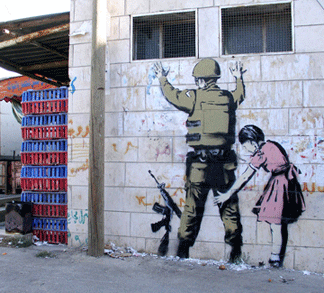
Occupying more than our minds

American minds these days are occupied with the financial crisis. The increasingly distant Iraq War, ever expanding military muscle in Afghanistan and recent loss of life and massive destruction in Gaza have been knocked off the front page and main story of daily newscasts. Problematic as the economy worldwide is, we will survive. It is not wealth that has disappeared, nor the ability to make money, but confidence in a system that by its very nature rewards with one hand and takes away with the other. As in economics, so in politics, it seems. And “occupation” is the main problem. In a short interview on FORA TV, Dr. Abdul Mawgoud Dardery (Assistant Professor of Cultural Studies and Critical Discourse at South Valley University, Egypt) brings this point into focus. Of course occupation has been the rule of history with “to the victor go the spoils” a mantra of civilization’s domination of those not considered sufficiently civilized. But unless the occupier empties the land of those already occupying it, as all the American continents’ countries have attempted to do, problems necessarily remain. In fancy we think of getting along with others as a melting pot; for much of the Middle East it has been more of a smelting and pelting pot … and the beating goes on.

Daniel Martin Varisco

Lithographica Arabica 6: Rev. Wood’s Bible Animals, 3

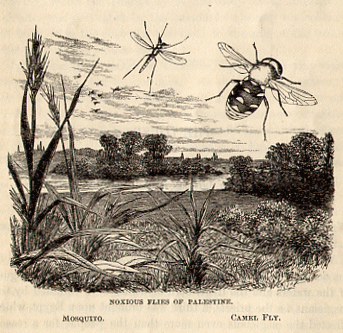
This is the third in a series on the illustrations in Rev. John George Wood’s Story of the Bible Animals. What do you get if you strain at a gnat? Read on…

Gnats

It has already been stated that only one species of fly is mentioned by name in the Scriptures. this is the Gnat, the name of which occurs in the familiar passage, “Ye blind guides, which strain at a ghat and swallow a camel” (Matt. xxiii. 24).

I may again mention here that the words “strain at” ought to have been printed “strain out,” the substitution of one for the other being only a typographical error. The allusion is made to a certain custom which is explained by reference to the preceding article on the fly. In order to avoid taking flies and other insects into the mouth, while drinking, a piece of thin linen stuff was placed over the cup, so that if any insects, as was usually the case, had got into the liquid, they would be “strained out” by the linen. Continue reading Lithographica Arabica 6: Rev. Wood’s Bible Animals, 3