A DenMarked Cartoonist


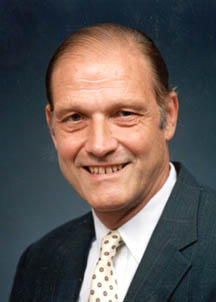
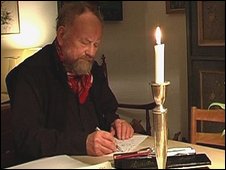
Kurt Westergaard says he is too old to be afraid.

Danish cartoonist remains defiant

BBC News, April 5, 2009
The row over publication of cartoons of the Prophet Muhammad in a Danish newspaper resurfaced this week as Turkey held up the appointment of Danish prime minister as the new Nato secretary general. But as the BBC’s Malcolm Brabant reports from Denmark, the impact of that 2006 controversy has never gone away for those closely involved.

Dusk was falling, the curtains were open and the house was hyggelig – a Danish word that means cosy, welcoming and enticing – with scores of candles flickering around the open-plan sitting room.

Dressed in his favourite “anarchist” colours of red and black, Kurt Westergaard sat down to a nourishing Nordic repast of black bread, plaice and prawns.

Unwinding after a day at the coalface of his profession, the bohemian grandfather with a seadog’s beard and Father Christmas trousers appeared to be the epitome of Scandinavian tranquillity. Continue reading A DenMarked Cartoonist

Yemen’s Alabaster Windows

Moonglow from Underground

Alabaster, one of the rarest and most ancient of lighting materials, has now been reinterpreted in a contemporary idiom.

Used to illuminate Arabian palaces and tower-houses since 2,000 years ago, the subtle glow of alabaster – ‘moonlight stone’ – has been brought to light again by Abdulwahhab al-Sayrafi, master alabaster craftsman. His unique, hand-made range of alabaster windows, lamps and candleholders are perfect for today’s architecture and today’s interiors. Continue reading Yemen’s Alabaster Windows

Will Obama’s words matter to the Muslim world?


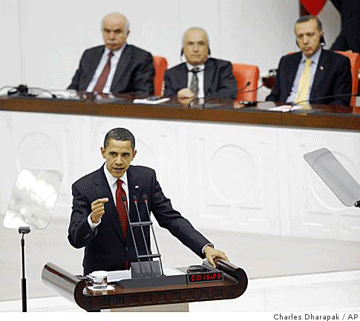
President Obama speaking in Turkey, photograph by Charles Dharapak/AP

by Munir Jiwa, San Francisco Chronicle, Tuesday, April 7, 2009

President Obama has been roundly criticized for his approach thus far to the Muslim world, so it will be interesting to see how the Muslim world receives the words he delivered in Turkey on Monday.

Some critics see Obama’s promise to open a dialogue with the Muslim world as being soft on terrorism. Others wonder why the president would waste time on words, when, they say, now is the time for policies. Others (including Alaa Al Aswany, an Egyptian whose op-ed, “Why the Muslim World Can’t Hear Obama,” was published in February in the New York Times) point to the disappointment felt by Egyptians and others in the Muslim world that President Obama did not take a stand against Israel’s war on Gaza. The criticisms are variations on a theme: Actions speak louder than words.

Many are asking: Will his words matter? And, how might the world benefit now from his words to the Muslim world?

The operative word is “now.” Actions may speak louder than words, but proverbial wisdom also has it that you can’t get there from here. In this case, we can’t get to effective action without words. Continue reading Will Obama’s words matter to the Muslim world?

Repairing American public diplomacy

Repairing American public diplomacy

by William Rugh, Arab Media and Society, Winter, 2009

It is widely believed among academics who study the subject, and among former practitioners, that public diplomacy has not achieved its full potential,[1] and we are hopeful that the Obama Administration will now solve some of its problems. This essay focuses on the most important challenges, which in many ways concern broadcasting to the Arab world.

Public diplomacy is of course not a panacea. America’s foreign policy decisions such as the Iraq war, or its policies at home such as the Patriot Act and Guantanamo detentions, have been strongly criticized abroad, undermining our international reputation and respect. Public diplomacy by itself cannot eliminate all criticism of our policies. It can only help to mitigate objections by explaining the U.S. government’s reasons for these policies, and by reminding foreign audiences of the aspects of America they still admire, in its society, culture and political system.

It is also true that the election of Barack Obama, which has generated a generally positive reaction around the world, will not by itself burnish America’s tarnished image abroad. His new policies may help, but misunderstandings of the United States will continue, out of ignorance or deliberate distortion. Public diplomacy programs can help present an accurate picture of America to foreign audiences, a task more important than ever in this age of 24/7 information proliferation.

What are the systemic problems hindering U.S. public diplomacy and how can the Obama Administration fix them? Continue reading Repairing American public diplomacy

Hajj on Second Life


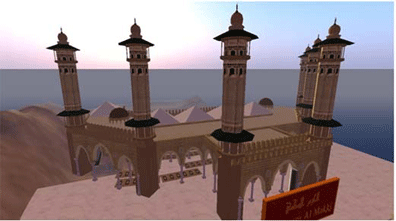
Aerial View of the Masjid Al-Haram, Second Life

Hajj on Second Life

by Krystina Derrickson, excerpt from Second Life and The Sacred: Islamic Space in a Virtual World, Digital Islam, 2008. For the full article, click here.

Mecca is the holiest site in the Muslim world, the literal nexus of the Islamic universe, the direction towards which Muslims worldwide pray and are buried facing, and the figurative, spiritual, and philosophical nexus, flattening history, faith, practice, and praxis[41]. It is the home of the Ka’baa, a large cubical structure believed to have been built by Ibrahim and Isma’il. The Hajj is the pilgrimage, one of the five pillars of the Islamic faith, required at least once by all able-bodied Muslims undertaken during the month long Hajj period.

The Hajj sim is sponsored by IslamOnline.net (IOL), a popular and comprehensive Islamic website run by Egyptian Islamic scholar Yusuf Al-Qaradawi which offers a multitude of services, from e-fatwas, halal business directories, news, and multimedia to matrimonial services and a “cyber-counselor”.[42] Continue reading Hajj on Second Life

Reading Orientalism on Rorotoko

Rorotoko? Yes, Rorotoko. Forget about the name, but enjoy a relatively new website which allows authors to describe their books. As the site suggests:

• Rorotoko is an online venue for engaging the ideas and elaborations serious books are made of.
• Rorotoko is exclusive authors’ interviews on some of the most fascinating books coming out of some of the finest nonfiction and scholarly presses.
• But Rorotoko is not about books, it is about what books are about.

The April 3 edition of Rorotoko features an article I wrote about my Reading Orientalism: Said and the Unsaid, published by University of Washington Press in 2007.

Reading Orientalism is literally a re-reading of the late Edward Said’s Orientalism. Said’s powerful critique remains a milestone in the critical theory of academic bias three decades after its first publication. As the years go by, Orientalism survives more as an essential source to cite rather than a polemical text in need of thorough and open-minded reading. Read by academics as well as the general public in almost three dozen translations, Said’s text analyzes novels, travelogues and academic books to argue that a dominant imperialist discourse of West over East has underwritten virtually all past European and American representation of a so-called “Orient.” The debate over these views of Edward Said, a prominent intellectual of Palestinian heritage, continues unabated even after his passing in 2003. Continue reading Reading Orientalism on Rorotoko

Reforming Islamic family law

Reforming Islamic family law within the religious framework: the « best practices » strategy
by Khalid Chraibi

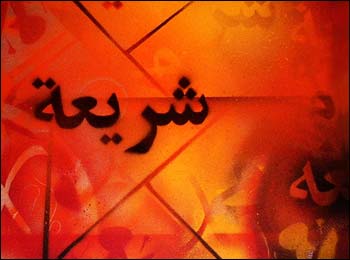
Many people in the Muslim world believe, wrongly, that shari’ah is a compilation of legal rules which are uniformly applied in all Muslim countries. But, the facts are otherwise: these rules vary significantly from one country to another, as well as over time. As a result, the status of women in Muslim countries, which is ruled by shari’ah, differs in many ways from one country to another. On any given issue, some national “personal status codes” grant more rights to women or better protect their interests than other codes.

According to feminine NGOs working in the field of Muslim women’s rights, if Governments accepted to apply the more favourable rules on any Islamic family law issue (designated as the “best practices”), this would contribute significantly to the reform of family law “within the religious framework”, bringing it closer to contemporary international standards. Continue reading Reforming Islamic family law

April through March Fools

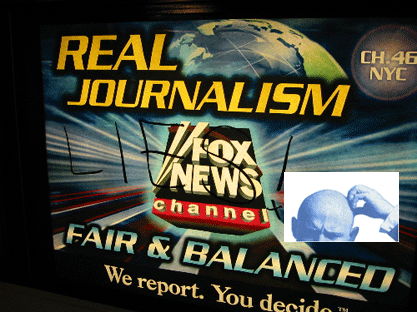
Most of us probably passed April Fools Day with only minor irritations. After all, fooling in jest is sort of fun. Then there are those fools who seem to operate 365 days a year and stream into our consciousness non stop. Take, for example (and it is a very foolish example that unfortunately fools quite a few people) Fox News Facts (and please forgive the oxymoron but remember the moron part). On April 1 anchoress Alisyn Camerota interviewed one Nonie Darwish about the appointment of Harold Koh, a former dean at Yale, to be the State Department legal advisor. The following is the transcript, and you can watch the video here.

ALISYN CAMEROTA (Fox anchor): The White House is defending its nominee to be State Department Legal Adviser. Now, some of the criticism of this nominee, Harold Koh, is based on remarks that he reportedly made saying that Islamic Sharia law should apply in U.S. courts, even though those laws are used in some countries to justify stripping women of basic rights and even worse, frankly. Continue reading April through March Fools