Hariri Lives on in Lebanon


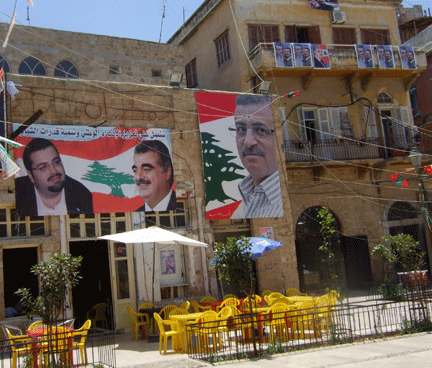
Political posters in a major square in the old city of Saida, the birthplace of former Prime Minister Rafiq Hariri.

Hariri Lives on in Lebanon

The recent election in Lebanon on June 7 was a surprise for Hezbollah and General Michel Aoun. A number of pundits thought this unlikely alliance would come to power and set Lebanon on a new and dangerous path. But, after all, this is Lebanon, one of the most unlikely spots for a conservative Islamic takeover anywhere in the Middle East. No doubt underestimated as a shadow of his famous father, Saad Hariri led his March 14 coalition to victory, actually gaining a seat in Parliament. The United States, Saudi Arabia and Israel are no doubt pleased that Hezbollah was denied bragging rights. Iran and Syria presumably are not. Continue reading Hariri Lives on in Lebanon
Rocking The Vote Not Easy For Iranian-Americans


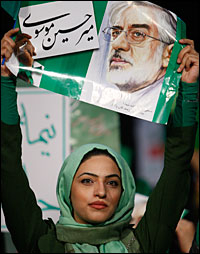
A supporter of the leading reformist Iranian presidential candidate, Mir Hossein Mousavi, holds his poster during a campaign in Tehran, Iran. Photo by Vahid Salemi, AP.

Rocking The Vote Not Easy For Iranian-Americans

by Melody Moezzi, NPR, June 11, 2009

On the eve of the Iranian presidential elections, people are pouring into the streets of Tehran in support of the reformist opposition candidate Mir Hossein Mousavi. Mousavi is the leading candidate opposing incumbent Mahmoud Ahmadinejad, and this election promises to be a close one. Should Mousavi win, it would be the first time in the history of the Islamic Republic that an incumbent failed to win a second term. But people are comparing this election to a revolution, and the enthusiasm around Mousavi has extended far beyond Iran’s borders. Even Iranian-Americans are trying to get in on the action. That is, we’re trying to vote. Continue reading Rocking The Vote Not Easy For Iranian-Americans

Final Solution

Is there a ‘Final Solution’ to the Muslim Question?

by Tareq Fatah, The Muslim Question, Wednesday, May 20, 2009

On the weekend I came across an article by Hugh Fitzgerald of Jihad Watch in which he mocked Senators John Kerry and Richard Lugar for daring to suggest that Pakistanis “are like us.”

This mild exhibition of empathy towards Pakistanis so riled up the good Mr. Fitzgerald that he blasted not just the two senators for having the the temerity to equate Americans and Pakistanis, he suggested we not trust any Muslim until he or she renounces Islam.

The fact that Americans and Pakistanis are both human beings governed by democratically elected governments who seek to wipe out the scourge of Jihadi terrorism, and that both admit to having played a role in creating these monsters, was lost on Fitzgerald. The fact that two countries have been allies–militarily and politically–for two generations, mattered little to the writer. The fact that nearly a million Americans have Pakistani ancestry did not matter either. For him, since Pakistanis are Muslim therefore they cannot be “like us”. Continue reading Final Solution

Re-Writing Muslim Political History

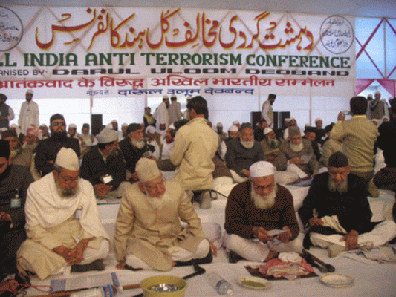
Based in New Delhi, Maulana Waris Mazhari is a leading Indian Deobandi scholar. He is a graduate of the Dar ul-Uloom at Deoband, and is the editor of Tarjuman Dar ul-Uloom, the official organ of the Deoband Madrasa’s Graduates’ Association.

In this interview with Yoginder Sikand, Maulana Mazhari talks about his views on Islam, historiography and politics.

Q: Muslim history has generally been written in the form of a series of battles and a succession of rulers and military generals. This, in turn, has had a deep impact on the way Muslims imagine their past and their identity and on the way they relate to people of other faiths. What do you feel about this way of presenting Muslim history?

A: I have major problems with the traditional approach, including the traditional way of presenting the sirat, the history of the Prophet Muhammad, who Muslims consider as the model for all humankind. Typically, sirat-writing has taken the form of a narration of events that focus mainly on the maghazis or military confrontations and victories of the Prophet. This tradition goes back to early times. In fact, one of the first available sirat texts that we have, by Ibn Ishaq, is also known as Maghazi Ibn Ishaq. This is a reflection of how Ibn Ishaq portrayed the Prophet’s life. Ibn Ishaq was by no means an isolated case. In fact, many other sirat writers followed in that mode, and still continue to do so. Continue reading Re-Writing Muslim Political History

Postcards from Beirut

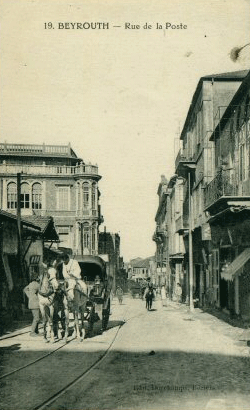
Since I am currently in Beirut and I am not sure what my internet access will be on a regular basis, here are some old postcard views of Beirut, starting with the image above of the Beirut Post Office from about a century ago.

Conference on Said’s “Orientalism”

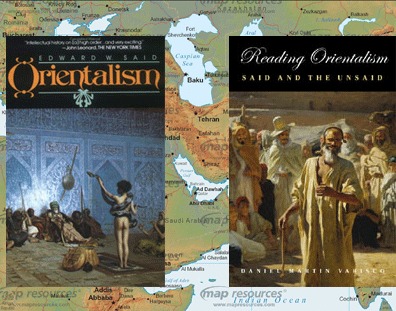
Today I am at the American University of Beirut for a one-day conference looking back on the impact of Edward Said’s seminal and polemical Orientalism, first published in 1978. The conference, “Orientalism and its Critics,” is sponsored by The Center for Arab and Middle Eastern Studies and the Department of Philosophy. Here is the line-up, for those who want to pseudo-twitter the event.

9:30 Basim Musallam (Cambridge University)
A First Reading of Orientalism

10:30 Daniel Varisco (Hofstra university)
Orientalism’s Wake: The Ongoing Politics of a Polemic

12:00 Ahmad Dallal (Georgetown University)
Cultural History and the Persistence of Orientalism: The Case of the 18th Century

1:00 Robert Irwin (University of London)
Pulp Orientalism

4:00 Robert Spencer (University of Manchester)
The War on Terror and the Backlash against Orientalism

5:00 Sadiq Jalal al-Azm (University of Damascus)
Political Said

My talk will be published this fall in a special issue of Viewpoints, an online forum of the Middle East Institute. It is a follow-up to my 2007 book, Reading Orientalism: Said and the Unsaid, published by the University of Washington Press.

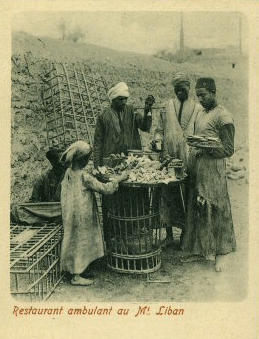
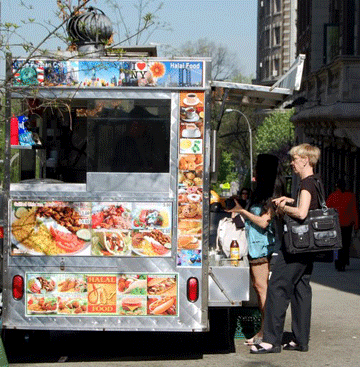
Streetwise Halal


Little Persian Cafe, on the corner of Broadway and W116th Street

by Dagmar Riedel
Street vendors in midtown Manhattan, between 5th and 6th Avenue, often play Arab music and wear vaguely Muslim head dresses. Some time ago, their advertisements began focusing on all-beef hot dogs and burgers. But now they are advertising their food as halal. The photos of the halal carts were taken between the end of March 2009 and the beginning of May 2009. It seems that both Arab-Americans and Iranian-Americans are jumping on the bandwagon, though dress and cart names may also be the result of marketing strategies. Continue reading Streetwise Halal