Islam and the Power of Kindness

[Note: The following excerpt by a Muslim intellectual is perhaps the best antidote for the ongoing violence of mosque bombings, Taliban and Basij brutality towards Muslim women and vitriolic sermons.]

Islamic Perspectives of Inter-Community Relations

by Maulvi Yahya Nomani (Translated from Urdu by Yoginder Sikand) TwoCircles.net

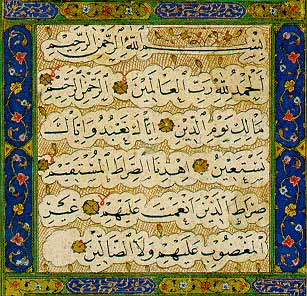
The issue of what Islam has to say about inter-community relations is one about which much misunderstanding exists. Anti-Muslim propagandists claim that Islam preaches hatred for non-Muslims, and that the Quran is a menace to world peace. They go so far as to argue that world peace is simply impossible as long as the Quran exists. In order to back their propaganda, they have deliberately twisted and misinterpreted certain verses of the Quran. Many people with little knowledge have fallen prey to this poisonous propaganda, which has been aggressively spread on an enormous scale through the media. Continue reading Islam and the Power of Kindness
Obama’s Trifecta … So Far, So Good

by Donald K. Emmerson, Stanford University

[A trivially different version of this essay appeared in AsiaTimes Online on 6 June 2009, reposted on the East Asia Forum on June 11]

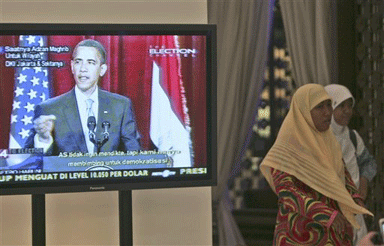
US President Barack Hussein Obama’s speech on 4 June 2009 in Cairo, the second of three planned trips to Muslim-majority countries, was outstanding.

First, it opened daylight between the US and Israel. Israeli settlements on the West Bank are impediments to a two-state solution and a stable peace with Palestine. Obama did not split hairs. He did not distinguish between increments to existing settler populations by birth versus immigration with or without adding a room to an existing house. The United States, he said, does not accept the legitimacy of continued Israeli settlements. Period.

The American Israel Political Affairs Committee, which advertises itself as America’s pro-Israel lobby, cannot have been pleased to hear that sentence. But without some semblance of independence from Israel, the US cannot be a credible broker between the two sides. It is not necessary to treat the actions of Israeli and Palestinian protagonists as morally equivalent in order to understand that they share responsibility for decades of deadlock. New settlements and the expansion of existing ones merely feed Palestinian suspicions that Israel intends permanently to occupy the West Bank. Nor did Obama’s criticism of Israeli settlements prevent him from also stating: Palestinians must abandon violence. Period. Continue reading Obama’s Trifecta … So Far, So Good

Calm, not conflict, on Tehran’s streets

by Abbas Barzegar, The Guardian, June 18, 2009

Since the Iranian government has barred foreign journalists from recording the massive rallies in Tehran in the last two days, news outlets in the world have instead been forced to rely almost exclusively on video feeds from mobile phones, YouTube, and Twitter.

The images have splashed across the screen with the intensity of a horror film. Most of these feeds are sent without confirmation of where the events took place, who is responsible for recording them or even when they occurred. Nonetheless, their gratuitous display by some of the largest and most respected news broadcasters has left the impression that Iran is either under nationwide martial law or experiencing a bloodbath under complete darkness.

But, had the authorities here allowed open coverage of the rallies in the last 48 hours, they would have done themselves a favour. Since the announcement of seven deaths two days ago every gathering here has increasingly taken a more peaceful tone. Likewise the initial overreaction by the security apparatus seems to have been corrected. Continue reading Calm, not conflict, on Tehran’s streets

Unblocking the Blockers

Introducing, “The Circumventer”

By ALEXANDRA SANDELS, Menassat, May 20, 2009

At a Kamal Adham Journalism Institute “Blogging for the Future” conference in Cairo, the Al-Kasir made its first public appearance.

A tool that allows Internet users to access blocked websites, developer Walid Al-Saqaf, a Sweden-based Yemeni, is using the device to respond to government web censorship.

“I realized that the authorities are getting so sophisticated that they need a similarly sophisticated response that could match up to their level that would limit their control over what users can access from within their countries,” he said.

The tool also performs periodic checks on censored sites to track whether they remain constantly blocked or if the filtering is lifted at times. Meanwhile, users of the program can report information about filtering and blocking in their respective countries. The data gets stored in a centralized unit in the software.

Al-Saqaf, who also launched Yemen’s first independent news search engine a few years ago, has been a target of Yemeni government censorship. In the spring of 2008, the five different domains of Yemenportal were shut down, making the site inaccessible in Yemen, except through the use of proxy sites. Continue reading Unblocking the Blockers

Iran Twitters at the Brink


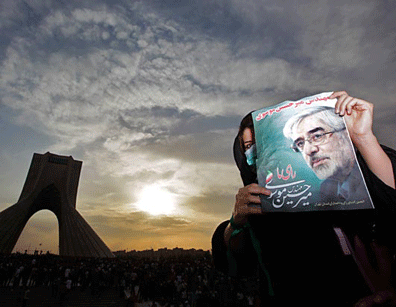
A female demonstrator holds up a poster of leading opposition presidential candidate Mir Hossein Mousavi, who claims there was voting fraud in Friday’s election, as she and hundreds of thousands of others turn out to protest the result of the election at a mass rally in Azadi (Freedom) square in Tehran, Iran, Monday, June 15, 2009.
(Ben Curtis/AP Photo)

Extraordinary scenes: Robert Fisk in Iran

ABC News, June 16, 2009

The long-standing Middle East correspondent for The Independent, Robert Fisk, is defying the government crackdown on foreign media reporting in Iran.

As he explains, he has been travelling around the streets of Tehran all day and most of the night and things are far from quiet:

I’ve just been witnessing a confrontation, in dusk and into the night, between about 15,000 supporters of Ahmadinejad – supposedly the president of Iran – who are desperate to down the supporters of Mr Mousavi, who thinks he should be the president of Iran.

There were about 10,000 Mousavi men and women on the streets, with approximately 500 Iranian special forces, trying to keep them apart. Continue reading Iran Twitters at the Brink

No Honor among Election thieves

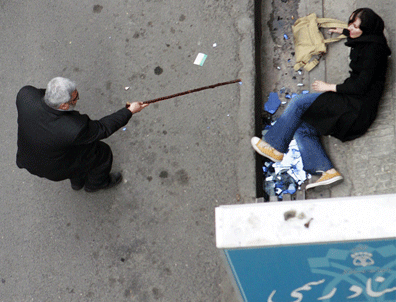
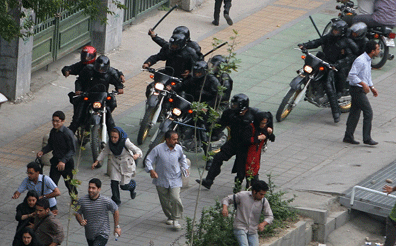
The instant forms of communication that cyberspace creates may spell the demise of rule by dictatorship. Had there been no email, youtube or twitter, the events unfolding in Iran after the rigged election of Ahmadinejad would largely go unnoticed. But instead the brutality of the police and armed vigilantes against ordinary Iranians are being seen around the world. There is a gallery of images, some quite graphic, compiled by the Boston Herald. Whatever the ruling mullahs decide, the deep divisions within Iranian society are exposed to the world. The Islamic Republic is now more clearly seen as an Islamic Dictatorship, increasingly out of touch with the youth and educated members of the society.

Consider the two pictures here of men taunting and manhandling Iranian women. It goes to show that in Iran there is no honor among election thieves. Has anyone stopped to ask: WWMD (What would Muhammad do?)

On God and Obama: When Wright is Wrong

A new book with the promising but pathetically journalistic title The Evolution of God has just appeared with media fanfare. The fanfare I have seen thus far is an op ed piece and a Time Magazine article by the author, Robert Wright. In both the author’s lack of knowledge brands the work fiction from the start. Let’s start with the Time Magazine article, which is entitled “Decoding God’s Changing Moods.” As a veteran journalist, Wright knows that Bible codes sell well, even though there is nothing to decode in his supposed code. Continue reading On God and Obama: When Wright is Wrong

AhmadineBush

Color Iran today in black; it is not yet ready for a greening. The smiling face of Mahmoud Ahmadinejad is in victory mode. What was thought would be a close election turned out to be a seeming mandate for the man who would make Iran a nuclear power. The people have spoken or have they? Critics contend that the voting was rigged, that counting was being done before the polls closed (they had been extended up to six hours in some places), that there were not enough ballots and that Ahmadinajad even beat his main challenger Moussavi in the latter’s home town of Tabriz, an unlikely scenario. No matter, the Supreme Cleric has spoken, and in Iran that is the true nature of democracy, a theocracy that tolerates a parliament.

So do not expect the recent friendly overtures of President Obama to go very far in the second term of Ahmadinejad, whose tainted victory brings to mind the Florida recount that promoted George Bush into the White House in 2000. Indeed, there is a case for renaming the returning President AhmadineBush. Continue reading AhmadineBush