Bringing al-Zabîdî to Light and to Life


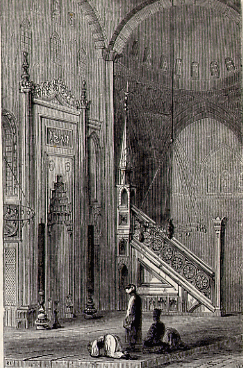
19th century Cairo mosque illustration from Henry Van-Lennep’s Bible Customs.

Those of us who spend hours using Arabic lexicons would be at a loss without the massive Tâj al-‘Arûs min jawâhir al-qâmûs of Muhammad Murtadâ al-Zabîdî. Completed by this consummate Muslim scholar in 1188/1774 after fourteen years of diligent research, the recent Kuwait edition comprises 40 volumes. Ironically, what took al-Zabîdî fourteen years to write and dictate seems a rapid turn-around, given that the Kuwait edition began in 1960 and was not completed until 2002 [There is a copy available for only £2,463 from Abe Books…, but I suggest you go to Lebanon, where the 40 volume set is only $325 from Fadak Books I am not aware of any online version of Tâj, although Lisân al-‘Arab is available online in searchable format.] Those of us who could never afford to house the 40 volume edition have managed to get by with reprints of the 19th century Cairo edition, funky font presence that it sheds. I remember buying my copy of the thick black-cover volumes in 1981, filling a suitcase with the hefty weight, paying the porter a handsome bakshish for his back-breaking effort at Cairo airport, and then having the suitcase implode from the weight as I crossed the threshhold of my home back in New York. I like to think that my own account would have made its way into al-Zabîdî’s inquisitive notes. Continue reading Bringing al-Zabîdî to Light and to Life

We Are All Moors

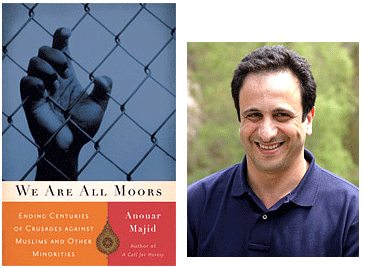
[Note: The latest book by Anouar Majid, We Are All Moors: Ending Centuries of Crusades against Muslims and Other Minorities (University of Minnesota Press, 2009) provides a provocative thesis, suggesting that we examine the issue of Muslim minorities in contemporary Europe through the prism of history, specifically the treatment of the Moors (los Moros) in Spain. Here is a sample of his argument (from pp. 3-4).]

Indeed, anyone watching the events unfolding in Europe and the United States in recent years cannot help but be struck by the confluence of the two overriding concerns of these two continental states: the mounting anxiety over coexisting with Muslims and the seemingly unstoppable waves of illegal and nonassimilable immigrants. All sorts of explanations have been offerd about these twin elements fueling the global crisis — bookshelves are filled with books about Islam, minorities, and questions of immigration — but no one seems to be reading the intense debate over immigration and minorities who resist assimilation as the continuation of a much older conflict, the one pitting Christendom against the world of Islam. We are often being asked to ponder “what is wrong with Islam” and “what is wrong with the West,” as if these two abstract, ideological entities suddenly bumped into each other in their travels and were jolted by the shock of discovery. The West encountered an archaic Islam stuck int he primitivism of pre-modern cultures, whereas Muslims discovered a dizzying, fast-dissolving secular West that is guided by the fleeting fantasies of materialism. All of this is by now amply documented. Yet what I propose in this book is that a secular, liberal Western culture and Islam were never really parted, that they ahve been traveling together since (at least) 1492, despite all attempts to demarcate, first, zones of Christian purity and , later, national homogeneity. Continue reading We Are All Moors

Going (after) Muslim


A picture making the news rounds of Major Hasan on the day of the shootings.

[Note: I have just published a commentary on a commentary in Forbes Magazine in which Major Nidal Hasan is said to have “gone postal” in his frenzy. This is published on Religion Dispatches. I excerpt the first couple of paragraphs here, but please go to the Religion Dispatches site, where you can post comments as well.]

If the media frenzy over the Fort Hood killings is any gauge, the ugly specter of 9/11 has again taken its psychological toll. This time, instead of the “bad Muslim” being a bearded terrorist called bin Laden, there is a US Army psychologist who was trained to be a healer of military personnel. He happens to have an Arabic ancestry and is Muslim.

Prominent American Muslim organizations issued statements right away condemning the murders. Debate in the media is now focused on his motivation. Was he a fifth-columnist wolf in military dress? Did his sympathies for innocent victims in our ongoing wars in Iraq and Afghanistan overwhelm his common sense of decency? Should the FBI and security arms of the US military have pounced on him when they uncovered his initial links to a radical imam?

One result that I have noticed among those who study Islam, especially my Muslim colleagues, is a growing fault line over the dubious “good Muslim/bad Muslim” binary. As Mahmood Mamdani has eloquently argued, the choice is not between good and bad individuals or citizens, but about being Muslim. Major Hasan is a man who looked very much like a “good Muslim”: a military officer providing therapy to returning veterans. But, now, it seems that at some tipping point he became the “bad Muslim,” the kind who places mosque above state.

For the rest of this commentary, click here.

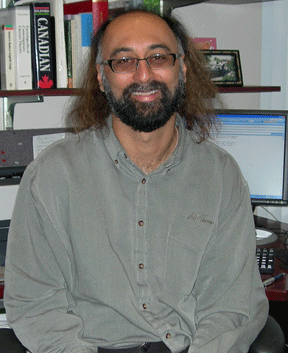
Daniel Martin Varisco

Amir Hussain at Fordham

Loyola Marymount Professor Amir Hussain will be responding to the inaugural lecture of Rev. Patrick J. Ryan at Fordham this coming Thursday. Details below for all those in the New York Metropolitan area.

Annual Fall McGinley Lecture: “Faith and the Possibility of Jewish-Christian-Muslim Trialogue”

Inaugural lecture of Rev. Patrick J. Ryan, S.J., as Fordham’s Laurence J. McGinley Professor of Religion and Society.

Thursday, 19 November 2009 | 8 p.m.
Keating First Auditorium | Rose Hill Campus

The inaugural lecture of Rev. Patrick J. Ryan, S.J., as Fordham’s Laurence J. McGinley Professor of Religion and Society, is titled “Faith and the Possibility of Jewish-Christian-Muslim Trialogue.” The lecture will be followed by responses by Professor Amir Hussain of Loyola Marymount University in Los Angeles and Rabbi Daniel F. Polish, spiritual leader of Congregation Shir Chadash in Poughkeepsie, New York. A reception will follow the lecture, which is open to the public without charge.

For more information, contact Sister Anne-Marie Kirmse, O.P., Ph.D., at (718) 817-4746 or kirmse@fordham.edu.

Contesting Islamism

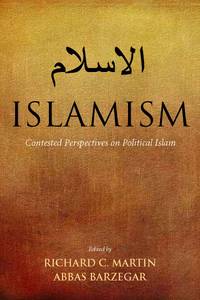
Stanford University Press has just published Islamism: Contested Perspectives on Political Islam, edited by Richard C. Martin and Abbas Barzegar. In this book Political Scientist Donald Emmerson argues for an inclusive use of the term “Islamism” in order to rescue the term from its misappropriation in the media. This is followed by my essay, in which I argue that the term “Islamism” is as tainted as “Mohammedanism” and should be avoided as a replacement for fundamentalist and political Islam. Our two essays are followed by twelve short responses from a variety of perspectives, Muslim and non-Muslim. The contributors include Feisal Abdul Rauf, Syed Farid Alatas, Hillel Fradkin, Graham Fuller, Hasan Hanafi, Amir Hussain, Ziba Mir-Hosseini and Richard Tapper, M. Zuhdi Jasser, Bruce Lawrence, Anouar Majid, Angel Rebasa and Nadia Yassine. Given the range of perspectives on one of the hot topics of the day, this volume will be a great addition to courses on Islam or the Middle East.

The publisher’s description is presented below: Continue reading Contesting Islamism

The Sixth War

by Gregory D Johnsen, The National, November 12, 2009

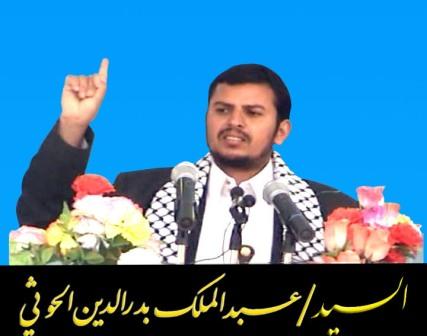
Last week, the sporadic five-year long war between the Yemeni government and Houthi fighters in the country’s north finally spilled over the border into Saudi Arabia. The conflict has been steadily escalating since the Yemeni government resumed fighting in August after more than a year of fragile calm. Leaving no doubt as to its intentions, the government calls the present campaign “Operation Scorched Earth”: the fighting has already produced thousands of internal refugees and spread outward from the northern governorate of Sadaa, where the Houthi rebels are based.

Like much of the conflict, the clashes that began on November 4 are clouded by conflicting and contradictory reports. The Houthis claim that they were responding to repeated strikes by the Yemeni military, which was using Saudi territory as a rear base to launch flanking manoeuvres into Sadaa. Saudi Arabia contends that it was responding to incursions by the Yemeni rebels, and both sides insist that the other fired the first shots.

But whatever the sequence of events, the skirmishes mark a major escalation in the messy and murky guerrilla war that has only become more intense – and drawn in an increasing number of players – since its start in 2004. The Saudis deployed troops to their southern border, where they launched air and ground assaults on pockets of Houthi fighters, purportedly to drive them back into Yemen. The intervention was meant to be a limited one – and the Saudis claim they only attacked positions on their side of the border – but it is doubtful, having joined the fray, that they will be able to extricate themselves easily. Continue reading The Sixth War

Talal Asad and the Anthropology of Islam


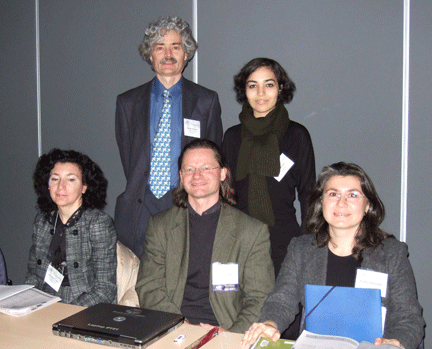
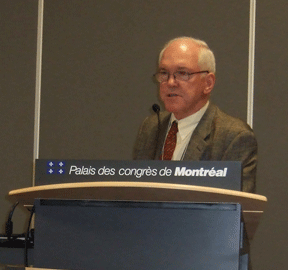
Left to right, Jocelyne Cesari, Dan Varisco, Jens Kreinath, Nadia Fadil, Refika Sarionder at AAR in Montreal

Last Saturday at the annual meeting of the American Academy of Religion I had the privilege of serving in a “responding” role on one of the first panels on the program. This was a session entitled “Talal Asad and the Anthropology of Islam,” organized by Jens Kreinath (Wichita State University), presided over by Refika Sarionder (University of Bielefeld) and with presentations by Jocelyne Cesari (Harvard University), Nadia Fadil (Katholieke Universiteit, Leuven), Jens Kreinath and Bruce B. Lawrence (Duke University). [Abstracts of the panel and papers are posted at the bottom of my comments.]

Following a typically powerful presentation by Bruce Lawrence and placed in the difficult role of representing Talal Asad (who was not present), I began my remarks by noting that I felt myself between a rock (a solid one at that) and a hard place. Drawing on my anthropological roots, I offered myself in the metaphorical role of Thomas Henry Huxley to Darwin, dubbing my wrapping-up task as akin to Asad’s Bulldog. This is not to say that the papers were overtly critical of Dr. Asad’s work; on the contrary, all expressed appreciation of his work as formative in their own ideas. Yet, in reading over the individual papers I detected several criticisms that stem more from dealing with isolated comments than considering the impressive and expanding corpus of Asad. I decided the best approach was to sum up what I see as some of the reasons the continuing intellectual trajectory of Dr. Asad is useful for those of us interested in something that might be called an “anthropology” of Islam.


Bruce Lawrence at AAR in Montreal

Continue reading Talal Asad and the Anthropology of Islam

Tarim Journal


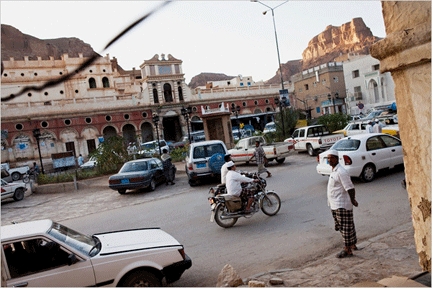
Tarim, a remote desert valley in Yemen with towering bluffs and ancient mud-brick houses, is probably best known to outsiders as the birthplace of Osama bin Laden’s father. Photo: Bryan Denton

Tarim Journal
Crossroads of Islam, Past and Present

By ROBERT F. WORTH, The New York Times, October 15, 2009

TARIM, Yemen — This remote desert valley, with its towering bluffs and ancient mud-brick houses, is probably best known to outsiders as the birthplace of Osama bin Laden’s father. Most accounts about Yemen in the Western news media refer ominously to it as “the ancestral homeland” of the leader of Al Qaeda, as though his murderous ideology had somehow been shaped here.

But in fact, Tarim and its environs are a historic center of Sufism, a mystical strand within Islam. The local religious school, Dar al-Mustafa, is a multicultural place full of students from Indonesia and California who stroll around its tiny campus wearing white skullcaps and colorful shawls.

“The reality is that Osama bin Laden has never been to Yemen,” said Habib Omar, the revered director of Dar al-Mustafa, as he sat on the floor in his home eating dinner with a group of students. “His thinking has nothing to do with this place.”

Lately, Al Qaeda has found a new sanctuary here and carried out a number of attacks. But the group’s inspiration, Mr. Omar said, did not originate here. Most of the group’s adherents have lived in Saudi Arabia — as has Mr. bin Laden — and it was there, or in Afghanistan or Pakistan, that they adopted a jihadist mind-set. Continue reading Tarim Journal