On the honor of being dissed

About two and a half years have passed since my Reading Orientalism: Said and the Unsaid was published by the University of Washington Press. Being an academic book, as opposed to a short-life trade paperback written for anyone who might have failed Middle School English, the reviews have come in a trickle rather than due to a publisher’s promotional media torrent the week of launch. One of the first reviews came in the TLS from Robert Irwin, one of the most qualified reviewers and an astute student of Orientalism himself. Irwin found that my book is “closely argued” and “makes for exhilarating reading,” despite the annoying (intentionally so) stream of puns. I appreciate a thorough German review by Siegfried Kohlhammer, who was kind enough to remark: “Jede Verteidigung von Orientalismus wird sich mit dieser sorgfältigen und präzisen Summa der Said-Kritik auseinandersetzen müssen.” In Common Knowledge, David Cannadine continues sweet music to an author’s ear by concluding that my book “is an important and impressively documented work, which deserves a wide audience.”

But now along comes a review that is breathtaking (I tend not to breathe when I am convulsed in laughter), however, one that I am honored to receive. The venue is telling: the Middle East Forum, which is affiliated with the websites of Campus Watch, Daniel Pipes and Islamist Watch. Were I to receive a favorable review from this forum-idable group, I could only conclude that my book was an utter failure and would be tempted to buy back all the existing unsold copies for a large Obsession-triggered book burning. I can now breathe a sigh of relief that a site defending the offensive opinions that I set out to counter has seen fit to dismiss my book as an uninformed and witless screed. Continue reading On the honor of being dissed

Ramadan: Slow not fast justice


Mirror, mirror on the terrorist list wall,
Whose the most likely terrorist of them all?

In the post 9/11 world it is not easy to have a Muslim name. Just because your name is Khan, does not mean you are a terrorist. Just because your university (Harvard, for example) has a fellowship paid for by the Bin Laden family does not mean it is an academic haven for suicide bombers. But if you have a last name of Ramadan, you are not going to be put in the fast lane for an entry visa. Literally. In 2004 the distinguished Islamic scholar Tariq Ramadan was appointed to a tenured professorship at the University of Notre Dame. One would think having a major contemporary voice for Islam, especially Muslims living in secular societies, at an acclaimed Catholic university would help break down or at least counter the hatred that fueled the Twin Towers bombers. Such thinking was not on the agenda of the Bush administration, which was more attuned to the slimy interrogation technique of water boarding than interfaith dialogue. Continue reading Ramadan: Slow not fast justice

Sinan Antoon on Poetry

The Iraqi poet Sinan Antoon, attending the Split This Rock Poetry Festival in Washington, D.C. last weekend, was interviewed along with two other poets on NPR on March 10. Here is a brief excerpt, but there is more at the website.

CONAN: Careful listeners can hear another person there in the studio with you at the Radio Foundation in New York City. That is Sinan Antoon, a poet and novelist originally from Iraq, and it’s good of you to be with us today, too.

Mr. SINAN ANTOON (Poet; Novelist; Assistant Professor, New York University): Thank you for having me.

CONAN: And in your tradition, we just heard about that “Poet’s Millions” program broadcast in the Gulf area. Poetry is revered in the Arab world.

Mr. ANTOON: Yes, it is. I should say about this “Million’s Poets” program, it’s not necessarily the best phenomenon we have nowadays because it supports and promotes a certain kind of populist poetry, which is important, and it has its audience. But yes, the tradition of poetry in the Arab world is 14 centuries old, and it’s been integral for the collective identity of people.

But in the modern, contemporary period, it was a very important forum for the anti-colonial struggle, for liberation and for a lot of people in expressing their resistance against dictatorships. So being a poet in the Arab world and saying what poets should say and defending the public and truth meant that, you know, poets are taken to court and are put in prison and are exiled, so… Continue reading Sinan Antoon on Poetry

Mocha Musings #3: Turkey and Persia


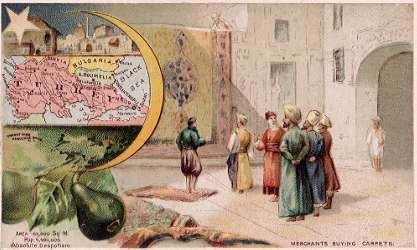
Area: 63,800 sq. mi
Population: 4,490,000
Government: Absolute Despotism
Scenes: Merchants Buying Carpets

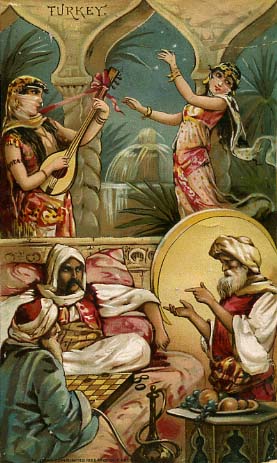
previous post I began a series on coffee advertising cards with Middle Eastern themes. One of the most colorful collections is that provided by the Arbuckle Coffee Company. In my great, great aunt’s album there were several Middle Eastern and North African nations represented, but from a different series than in the Arbuckle’s 1889 series. The 1889 version of Turkey is shown above, but my aunt’s version of Turkey is decidedly more imaginative:

Continue reading Mocha Musings #3: Turkey and Persia

Gallup on Taliban Popularity

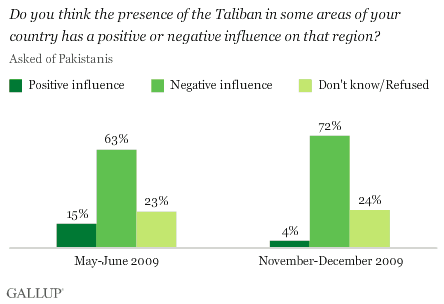
Taliban Increasingly Unpopular in Pakistan
Four percent say Taliban’s presence is positive influence

by Julie Ray and Rajesh Srinivasan, gallup.com, March 12, 2010

This article is the first of a two-part series that looks at Pakistanis’ and Afghans’ views of the Taliban’s influence and their respective countries’ efforts to combat terrorism.

WASHINGTON, D.C. — The Taliban’s presence on either side of the Afghanistan-Pakistan border is largely unwelcome, but increasingly so in Pakistan, where Gallup surveys show they have lost much of the little appeal they had. Four percent of Pakistanis in a November-December 2009 poll, conducted prior to Pakistan’s current push to rout the Taliban within its borders, said the Taliban’s presence in some areas of the country has a positive influence, down from 15% in June. Continue reading Gallup on Taliban Popularity

Picturing Yemen’s History


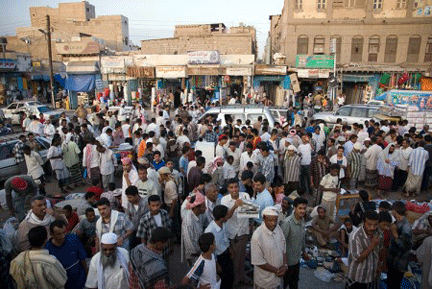
View of a busy marketplace in Aden. Staggering unemployment rate of around 35% hampers serious socio-economic development of the nation. People finishing high school and possessing university degrees are affected the most and according to a government survey published in 2008, 54% of graduates are unemployed/under employed. (Photo: Swiatoslaw Wojtkowiak)

There is an interesting historical study of Yemen through photographs on the Foreign Policy Journal website. Click here to see the full article and pictures. Here is the opening explanation:

Recent events in Yemen have brought the country into limelight again. While Houthi rebels in the north and northeast of the country have an on-off political agreement with the government in Sanaa, al-Qaeda affiliated groups are flexing their muscles by attacking the authorities across the country. Political forces in southern Yemen are also unhappy with the economic development the region has seen since its union with the north two decades ago and talk of secession is ripe.

Though strategically located at the junction of the world’s most important waterways, the Red Sea and Gulf of Aden, the channel that connects world’s western shipping lines to the east, Yemen has failed to capitalise on its potential and emerge as a regional powerhouse. Instead, the country is at the brink of political mayhem and stands at #18 in the Failed States Index 2009 [1].

This photo story sheds light on Yemen’s ancient as well as recent history and discovers the factors that have hampered the country’s economic and socio-political development and brought it to the brink of disintegration.

A Muslim in the House and Praying


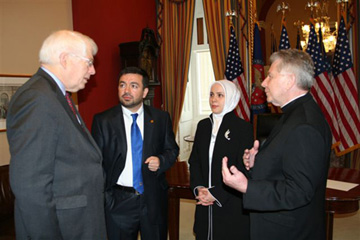
U.S. Rep. David Price, left, meets with Duke Muslim chaplain Abdullah Antepli, his wife Asuman, and U.S. House chaplain Rev. Daniel P. Coughlin

Antepli Delivers Opening Prayer at US House

Duke Muslim chaplain begins Wednesday session (video)

Duke University Press Release, Wednesday, March 3, 2010

Durham, NC — Duke Muslim chaplain Abdullah T. Antepli delivered the opening prayer for the U.S. House of Representatives in Washington, D.C., this morning. Antepli served as guest chaplain at the invitation of Congressman David Price, D-N.C.

Antepli, who joined Duke in July 2008, is one of only a handful of full-time Muslim chaplains at U.S. colleges and universities. He is the founder and executive board member of the Muslim Chaplains Association and a member of the National Association of College and University Chaplains. He also serves as an adjunct faculty member in the Duke Divinity School and Duke Islamic Studies Center, where he teaches courses on Islam.

Following the prayer, Rep. Price took to the floor for a short address praising Antepli as a leader who helps to bridges faiths across the campus. Video of the session is embedded below: (The prayer begins five seconds into the video; Price’s comments immediately follow the Pledge of Allegiance.)

To see the video on the Duke site, click here. Continue reading A Muslim in the House and Praying