If your name is Khan…


Kajol Devgan and Shah Rukh Khan

On Sunday I finally saw the new Bollywood film with Shah Rukh Khan, “My Name is Khan.” It is well worth seeing, although the minimalist dancing and singing in the film make it more Hollywood (not Fred Astaire’s) than Bollywood. Add to this the fact that many parts of the film were made in San Francisco and California and the Bollywood connection is even more estranged. The plot of the film has gaping holes, but it is not meant as a documentary. I walked away feeling good about two aspects of the film. First, it is a stirring educational lesson in Asperger’s Syndrome. One of Bollywood’s most glamorous male stars provides a moving performance of this disability, disabling those critics who dismiss the victims of the syndrome as dumb or retarded (neither of which they are).

Second, given all the Islamophobic films out there, where jihad is the only plot associated with Islam, it is refreshing to see the tables turned. While most Americans did not use 9/11 as an excuse to go out and beat up Muslims (or Sikhs or anyone who was not “white” enough), a number of prejudicial people did. The hate was real and most Muslims have felt it, even if only the cold stare. Finally here is a fantasy that goes the other way, while making Muslims heroes and lovers of peace. Continue reading If your name is Khan…
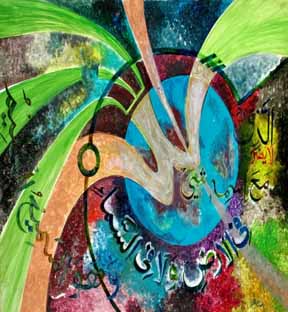
Pakistaniaat: New Journal


Current cover illustration by Amar Raza, “A Prayer for Protection”

There is a new online journal for anyone interested in Pakistan studies. The first issue of the second volume is now available. Here is the journal description of focus:

Pakistaniaat is a refereed, multidisciplinary, open-access academic journal offering a forum for a serious scholarly and creative engagement with various aspects of Pakistani history, culture, literature, and politics.

Though several existing journals do pay a fair degree of attention to the issues of South Asia and Postcoloniality, we feel that under the current climate of high capital and war on terror, Pakistan, often subsumed under the larger registers of South Asia or Postcolonial Studies, needs a particular space of its own in our academic and creative undertakings. Thus, Pakistaniaat aims to provide a public space on the Internet to introduce and discuss hitherto neglected aspects of Pakistani cultural and literary production and to make this knowledge available to a worldwide audience. Continue reading Pakistaniaat: New Journal

Mocha Musings #2: Egypt

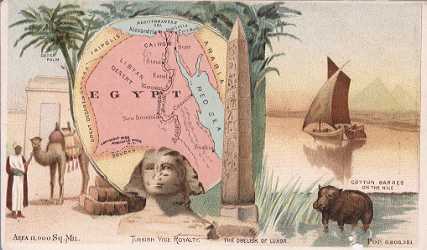
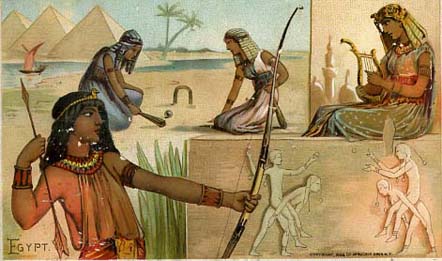
previous post I began a series on coffee advertising cards with Middle Eastern themes. One of the most colorful collections is that provided by the Arbuckle Coffee Company. In my great, great aunt’s album there is a card depicting ancient Egypt, which is shown above.

In the 1889 series depicting the nations of the world, Egypt also appears:


Area: 11,000 sq. mi
Population: 6,806,381
Government: Turkish Vice Royalty
Scenes: Date Palm; The Obelisk of Luxor; Cotton Barges on the Nile

Islamic Folk Astronomy #4


Modern photograph of the Pleiades

The Pleiades in Arab Folklore

The most famous star in Islamic folklore is undoubtedly the Pleiades. Commentators regard the reference in surah al-Najm (#53) of the Quran as the Pleiades; in fact the Arabs often referred to the Pleiades simply as al-najm (the star par excellence), a usage parallel to that in Sumero-Akkadian (Hartner 1965:8). In a well-known tradition, Muhammad links the early summer heliacal rising of the Pleiades with the beginning of the heat, crop pests and illnesses. In another tradition, more political than weather-related, Muhammad is supposed to have told his uncle Abbas (for whom the Abbasid caliphate was later named) that kings would come from his descendants equal to twice the number of stars in the Pleiades. This would imply that Muhammad thought there were 13 stars in the asterism, since the Abbasid caliphs numbered twenty-six (Ibn Mâjid in Tibbetts 1981:84). Continue reading Islamic Folk Astronomy #4

My name is Khan

Anyone who is interested in issues of Islam in America must certainly go see the new Shahrukh Khan film My Name is Khan. Despite all of its Bollywood silliness and melodrama, the film is surprisingly discerning on the experiences of Muslims in American society. Though it is set almost entirely in the U.S. (beginning in San Francisco and ending in Georgia), this film will go down as one of the most important Bollywood movies Shahrukh Khan has ever done.

Most obviously of course, the film reminds audiences all around the world that Bollywood’s biggest star ever is in fact a non-violent Muslim (the film’s most repetitive line is “My name is Khan, and I am not a terrorist”). But it also does a number of other absolutely fascinating things, such as performing a reinterpretation of the Qur’anic Abraham-Ishmael story, and in a surprising turn, it spotlights the U.S.’s government abandonment of poor African-American communities. Continue reading My name is Khan

Warren’s Geography #2: Mirage in the Desert

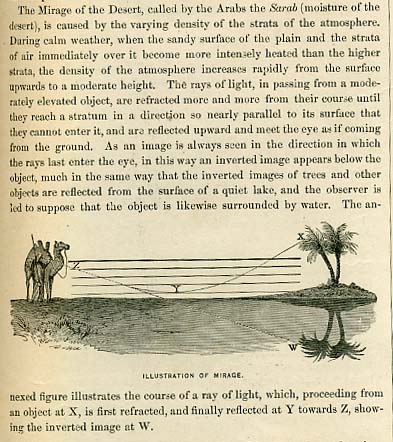
In a previous post I discussed two lithographs from the 1873 edition of Warren’s geography. One of the more fascinating illustrations is one explaining the desert mirage. Here is the discussion and image from the text.

Excerpt from D. M. Warren, An Elementary Treatise on Physical Geography. Revised by A. von Steinwehr. (Philadelphia, Cowperthwait & Co., 1873), p. 67.

to be continued …

Exercises in Struggling with Loneliness


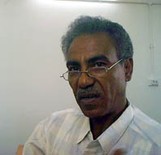
Shaqi Shafiq, Adeni poet

Exercises in Struggling with Loneliness

by Shawqi Shafiq, Translated by Sinan Antoon, Banipal

Rub the heart’s ring

rub it well

to erase the dust of depression

Rub it again carefully

so that the wall of forgetfulness shines

or

draw a circle/put a dove, or two, inside it/watch the wings move (that is if there are any)

You will ask: What if the circle crumbles?

What if the dove flies away

or if I am bothered by the wings’ noise

I will say to you: erase the circle

for all the traces to disappear

or put a fresh woman

instead of the dove

to seek revenge

for the aridity of an apartment

devouring your mouth

Diversity and Perversity


Dr. Jamil Khader, Stetson University

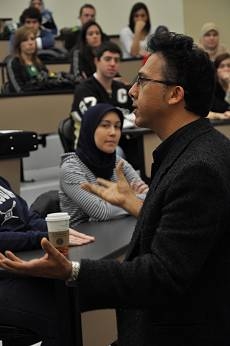
A little more than a week ago a story was reported about an experiment at Stetson University by Professor Jamil Khader. The idea was for 15 coeds to wear veils and see the reactions of their fellow students. But that is only part of the story. First read the story, then check out the comments by the readers. The comments are somewhat chilling, demonstrating once again the extraordinary extent of Islamophobia out there.

Stetson students don veil for diversity experiment
By MARK HARPER, Dayton Beach News Journal Online, February 11, 2010
Education writer

DELAND — For five days, Andreana Mangie wore a pink veil on and around campus.

At the student union, people stared at her. Another student in line near her told another, “Muslims aren’t worth anything.” She was denied entrance to a party.

“This needs to be thought about,” she told a group of about 150 students Wednesday. “This is a big deal.”

Mangie was one of about 15 Stetson University women to participate in the experiment dubbed “Veil for a Day” by Jamil Khader, a professor of English and gender studies. The women discussed their experiences as part of the DeLand school’s Town Meeting on Diversity.

The university canceled classes Wednesday so students could, for one day, go outside their comfort zone and learn about others. Other sessions touched on residence hall life, environmental justice and “How We Live Homophobia.” Continue reading Diversity and Perversity