Ann Dunham and Indonesia

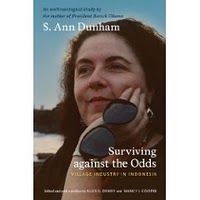
Last fall Duke University Press published the Ph.D. thesis of S. Ann Dunham, President Obama’s mother, who just happened to be an anthropologist. I can certainly sympathize with the editors, as my own dissertation also bordered on the 700 page level (which may be one reason it was never published as a book). Details on the book can be found at Duke University Press. But I attach here a valuable account by Michael Dove for the New York Times last August.

Dreams From His Mother

By Michael R. Dove, The New York Times, August 10, 2009

PRESIDENT OBAMA’s late mother, Ann Dunham Soetoro, was famous for the good cheer and optimism that she preserved in the face of a complex and challenging world. Her personality went hand-in-hand with her career as an anthropologist in Indonesia and Pakistan, where she studied and worked with village craftsmen, slum-dwellers and countless others. I knew Dr. Soetoro as a friend and colleague for many years before her death from cancer in 1995. Though I only met her son once, briefly at her memorial service, I’ve watched him as he’s taken on the hardest job in the world, and often found myself wondering how her worldview might have shaped him. Continue reading Ann Dunham and Indonesia

Blame it on Lady Gaga

Why is the “Muslim world” angry with America, asks columnist Bret Stephens in the Wall Street Journal? Well here are your two choices:

Pop quiz—What does more to galvanize radical anti-American sentiment in the Muslim world: (a) Israeli settlements on the West Bank; or (b) a Lady Gaga music video?

If your answer is (b) it means you probably have a grasp of the historical roots of modern jihadism. If, however, you answered (a), then congratulations: You are perfectly in synch with the new Beltway conventional wisdom, now jointly defined by Pat Buchanan and his strange bedfellows within the Obama administration.

Of course, how could it be Israeli policy. It must be the loose women and jazz singers that really upset Muslims, because that is what Sayyid Qutb said way back in 1951 after visiting Colorado (if only they had shut down those speak-easys in Boulder, who knows!). Yes, here is what Qutb, the “intellectual godfather of al Qaeda,” said:

“The American girl,” he noted, “knows seductiveness lies in the round breasts, the full buttocks, and in the shapely thighs, sleek legs and she shows all this and does not hide it.” Nor did he approve of Jazz—”this music the savage bushmen created to satisfy their primitive desires”—or of American films, or clothes, or haircuts, or food. It was all, in his eyes, equally wretched.

Qutb, notes the columnist, was also anti-Semitic, and blamed the Jews for being at war against Islam. And, to seal the argument for Stephens, here is the real beef (or cheesecake or kosher wine) because: Continue reading Blame it on Lady Gaga

Jihad for Jesus?

Those Americans who feel compelled to rewrite our collective history as the emergence of an avowedly Christian nation are fond of quoting scripture. Take the seemingly noble sentiment in John 15:13, where Jesus said, “Greater love hath no man than this, that a man lay down his life for his friends.” I say “seemingly noble” because even the Devil is good at quoting scripture. Consider the fringe Christian apocalyptic group called the Hutaree; there this motto blazes their website just above the image shown above. Yesterday, the U.S. Attorney General announced the arrests of nine individuals accused of “plotting to kill law enforcement officers in hopes of inciting an antigovernment uprising, the latest in a recent surge in right-wing militia activity,” as the New York Times reports. The plan is right out of what is often called the Al-Qaeda playbook, one played out in Pakistan, Iraq and Afghanistan on almost a daily basis: kill a police officer and then when there is a funeral procession, set off an i.e.d. Were these Muslim extremists, the word “jihad” would be on every television newscast. But, no, these are individuals who claim to be following a commandment of Christ. So why not face the fact that rhetorically it is possible to jihad for Jesus?

Speaking of those who believe in a literal Devil and do not recognize they are doing his work, earlier today I happened to be leafing through The Devil’s Dictionary by the Ohio-born American journalist Ambrose Bierce. Here is what Bierce had to say a century ago about the real-world definition of “Scriptures”:

“The sacred books of our holy religion, as distinguished from the false and profane writings on which all other faiths are based.”

Continue reading Jihad for Jesus?

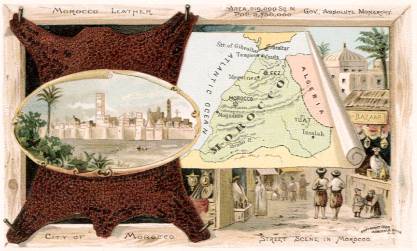
Mocha Musings #4: Morocco to Afghanistan


Area: 219,000 sq. mi
Population: 2,750,000
Government: Absolute Monarchy
Scenes: Morocco Leather; City of Morocco; Street Scene in Morocc
o

previous post I began a series on coffee advertising cards with Middle Eastern themes. One of the most colorful collections is that provided by the Arbuckle Coffee Company. In my great, great aunt’s album there were several Middle Eastern and North African nations represented, but she did not have all the cards. Here is a final potpourri from Arbuckle’s 1889 series, starting with Morocco above. Continue reading Mocha Musings #4: Morocco to Afghanistan

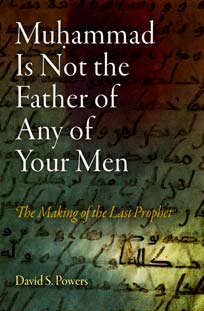
Muhammad Is Not the Father of any of Your Men


David Powers
of Cornell University has recently published what is sure to be a controversial analysis of early redaction of the Qu’ran. This is his
Muhammad is Not the Father of any of Your Men: The Making of the Last Prophet, published by the University of Pennsylvania Press. He provides a discussion of the book on Rorotoko, the first part of which I attach here.

Muhammad Is Not the Father of any of Your Men is about the Islamic assertion that Muhammad was the last in a series of prophets sent by God to mankind in order to facilitate human salvation. This assertion is mentioned once in the Qur’an, in verse 40 of chapter 33 (“The Confederates”). Here, addressing an unidentified audience, the voice that controls the text announces, “Muhammad is not the father of any of your men but the Messenger of God and the Seal of Prophets.”

The meaning of the phrase “Seal of the Prophets” (in Arabic, khatam al-nabiyyin) is equivocal. Some early Muslims understood this phrase as signifying that Muhammad confirmed the revelations sent previously to Moses and Jesus, while others understood it as signifying that Muhammad brought the office of prophecy to an end, that is to say, he was the last prophet. By the end of the first century AH, the latter understanding had come to prevail.

The assertion that prophecy ends with Muhammad is central to the claim that Islam supersedes Judaism and Christianity. It is understandable that this doctrine is taken for granted by Muslim scholars. Less understandable is the general neglect of this doctrine by students of Islam.

In Muhammad Is Not the Father of any of Your Men, I attempt to shed light on the emergence of this key theological doctrine and to show how the Islamic foundation narrative was constructed in order to assure its integrity. Specifically, I focus on the intersection between the theological assertion, on the one hand, and the collective memory of the early Muslim community, key legal institutions, and the text of the Qur’an, on the other.

For the full article, click here.

Human Rights Report on Yemen released

On March 11, 2010 the Bureau of Democracy, Human Rights, and Labor in the U.S. Department of State released its 2009 Country Report on Human Rights Practices for Yemen. The full report can be accessed online here, but I include below the preliminary paragraphs:

Yemen, with a population of approximately 23 million, is a republic whose law provides for presidential election by popular vote from among at least two candidates endorsed by parliament. In 2006 citizens reelected President Ali Abdullah Saleh to another seven-year term in a generally open and competitive election, characterized by multiple problems with the voting process and the use of state resources on behalf of the ruling party. Saleh has led the country since 1978. The president appoints the prime minister, who is the head of government. The prime minister, in consultation with the president, selects the council of ministers. Although there are a number of parties, President Saleh’s General People’s Congress (GPC) party dominated the government. Civilian authorities generally maintained effective control of the security forces, although there were instances in which security forces acted independently of government authority. Continue reading Human Rights Report on Yemen released

Veiled Voices

Veiled Voices

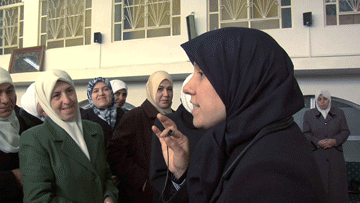
Women across the Arab world are redefining their role as leaders in Islam. Veiled Voices investigates the world of Muslim women religious leaders through the eyes of three women in Lebanon, Syria and Egypt. Filmed over the course of two years, Veiled Voices reveals a world rarely documented, exploring both the public and private worlds of these women. The stories featured in the film give insight into how Muslim women are now increasingly willing to challenge the status quo from within their religion, promoting Islam as a powerful force for positive transformation in the world. Each triumphs over difficult challenges as they carve out a space to lead—both in Islam and in their communities.

For air dates, click here.

The Petraeus briefing

The Petraeus briefing: Biden’s embarrassment is not the whole story

by Mark Perry, Foreign Policy, March 13, 2010

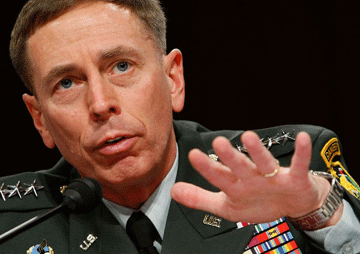
On Jan. 16, two days after a killer earthquake hit Haiti, a team of senior military officers from the U.S. Central Command (responsible for overseeing American security interests in the Middle East), arrived at the Pentagon to brief Joint Chiefs of Staff Chairman Adm. Michael Mullen on the Israeli-Palestinian conflict. The team had been dispatched by CENTCOM commander Gen. David Petraeus to underline his growing worries at the lack of progress in resolving the issue. The 33-slide, 45-minute PowerPoint briefing stunned Mullen. The briefers reported that there was a growing perception among Arab leaders that the U.S. was incapable of standing up to Israel, that CENTCOM’s mostly Arab constituency was losing faith in American promises, that Israeli intransigence on the Israeli-Palestinian conflict was jeopardizing U.S. standing in the region, and that Mitchell himself was (as a senior Pentagon officer later bluntly described it) “too old, too slow … and too late.” Continue reading The Petraeus briefing