Arabian Idol: for better and for verse

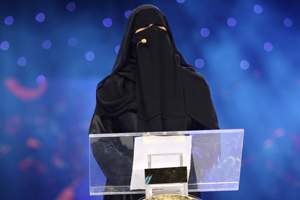
The BBC has an interesting video available online on the popular Emirates television show take-off on “American Idol” but for poets speaking Arabic. Among the final contestants was Hissa al-Hilal, whose frank response to sexist clerics has made her a household name despite being under almost a full hijab. If you think poetry does not pay in this part of the world, think again. The winner walked away with about 1.4 million dollars and Hissa earned 817 thousand dollars. She apparently won the votes of the panel of critics, but lost out to the audience.

May you never be uncovered


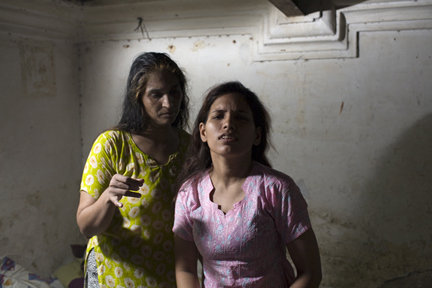
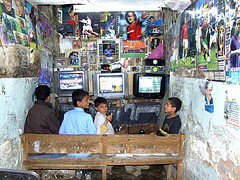
Photograph in a brothel in Pakistan by Kate Orne

Prostitution in Pakistan? Yes it exists, despite the most dire consequences if discovered. Photographer Kate Orne has been documenting the underworld of Pakistani prostitution since 2005 and has formed a website to bring attention to the plight of these women. Prints can be purchased at the website with benefits going to two schools for children and a clinic. Check out the presentation and gallery at http://www.mayyouneverbeuncovered.org/

Fruitful Picks at the Pomegranate Gallery


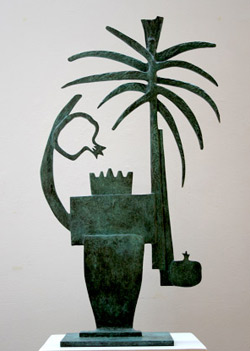
Drinking Juice, 2003
Bronze Cast by Oded Halahmy

The following upcoming events are scheduled for the Pomegranate Gallery in Manhattan:

WHITE MASKS: Elias Khoury’s remarkable novel of the Lebanese civil war
Book signing and Reception
Thursday, April 15th, 2010, 6:30 to 8:30 p.m.
“No Lebanese writer has been more successful than Khoury in telling the story of Lebanon…Khoury is one of the most innovative novelists in the Arab world.” Washington Post Book World

SWEET DATES IN BASRA: A new novel by Jessica Jiji
Book signing and Reception, with live Middle Eastern music
Thursday April 29th, 2010, 6:00 to 9:00 p.m.
“In this story of love and search for identity, Jessica Jiji succeeds fully in capturing passions, depth of feeling, and strong relationships beyond ethnic and religious differences.” – Naim Kattan, author of Farewell Babylon

REMEMBERING BAGHDAD: An Evening of Iraqi Music, with Yair Dalal, Omar Bashir and Erez Mounk
Saturday, May 1st, 2010, 7:00 p.m. Continue reading Fruitful Picks at the Pomegranate Gallery

Islamic Folk Astronomy #5

The Pleiades Conjunction Calendar

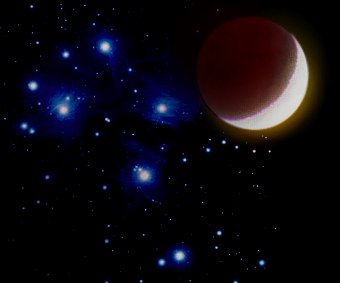
One of the indigenous calendars from the Arabian Peninsula is based on the monthly conjunction of the Pleiades with the moon. The moon conjuncts with the Pleiades about once every 27 1/3 days. This conjunction was visible monthly from autumn through spring and occurred about the same time each year; thus it coincided with the main parts of the pastoral cycle on much of the Arabian Peninsula. According to Abû Laylî (in al-Marzûqî 1914:2:199), these conjunctions began at the time of the autumn wasmı rain. This observation is still found among contemporary Sinai Bedouins (Bailey 1974:588). Ibn Qutayba (1956:87) noted that when the moon conjuncts with the Pleiades on the fifth day of the lunar month, winter goes away. The new moon coincides with the Pleiades during the month of Nîsân or April during the naw’ of simâk. This was considered to be one of the most fortunate star movements in the sky, perhaps because of its unique annual character. Shortly thereafter the Pleiades disappears from view at the start of the heat. Continue reading Islamic Folk Astronomy #5

Nutrition in Colonial Aden, #1

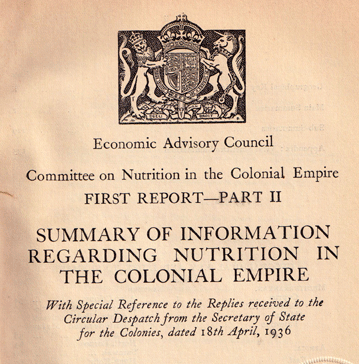
Say what you will about colonial empires, but at least they generate reports. I recently came across a British report to Parliament in 1939 entitled “Summary of Information Regarding Nutrition in the Colonial Empire.” Four pages are devoted to Aden Colony, which is said to have an area of 75 square miles, a population in 1931 of 45,992, a birthrate in 1937 of 32.07 per 1,000, an infant mortality rate in 1937 of 196.61 per 1,000, and a death rate in 1937 of 31.72 per 1,000. I attach excerpts below:

“1. General. – …This survey deals primarily with the 75 square miles of volcanic rock and sand which constitute the Colony of Aden; a detailed review of the nutritional affairs of the Protectorate has been postponed until a later date. The Colony is almost entirely urban and so cosmopolitan in make-up as to complicate the task of reviewing the nutritional conditions as a whole. Arabs, Jews, Somalis and Indians of various races predominate, and a preponderance of males is occasioned by the fact that those who come to Aden for varying periods of time to seek livelihood as coolies or tradesmen leave their womenfolk behind in the interior or in India. The natural division is to classify Arabs, Jews and the poorer classes of Indian Mohammedans as the indigenous population and it is to these, particularly the middle and lower classes, that the present nutritional considerations apply.

2. Composition and Nutritive Value of Dietary. – All the chief articles of diet are, with the exception of fish, imported from overseas or from Arabia. They are: rice, flour, sugar,; fish, mutton, beef, goat’s milk, eggs, ghee; fruits, vegetables, dates, lentils, simsim oil, tea, coffee and spices. Continue reading Nutrition in Colonial Aden, #1

Plant Diversity in Saudi Arabia


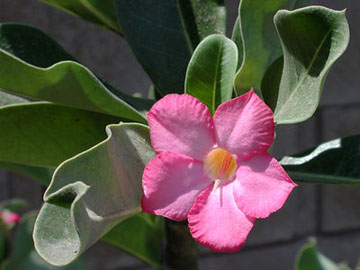
Adenium from Saudi Arabia

While preparing a talk for a conference in October on camels, I came across a very useful website maintained by Professor Jacob Thomas of the Herbarium in the Department of Botany & Microbiology at King Saud University in Riyadh. This is Plant Diversity in Saudi Arabia, with sections on topography, vegetation, flora, the history of botanical studies, conservation, and a major bibliography. There is also a checklist of species recorded.

Surfing in Sanaa

Internet cafes offer more to Yemen’s youth
by Teresa Gedi, Yemen Observer, April 3, 2010

Al-Mortazah internet cafe, located at the foot of the Friendship Bridge near Tahrir square, takes the meaning of internet café to another level. In addition to its 20 computer stations, it has a full service sheesha bar and cafe from which I enjoyed a glass of fresh mango juice courtesy of the soft-spoken poet and journalist Abdul Rahman Ghelan.

Mr. Ghelan, age 30, has frequented the café since his personal computer broke down some months ago. As the place is close to his home and affordable (1 riyal per minute), he takes his time exploring various literary and journalistic websites across the Arab world. Being a poet, Ghelan finds the web to be an effective means of spreading his work and developing it through feedback from the online literary community. Feeling I had stumbled on a budding international artist, I listened intently as he humbly explained his work which focuses largely on politics, women and children. “My poetry has benefited greatly from web exposure in both the Arab world and outside. Literary personalities in Europe for example have contacted me requesting to translate my work into other languages, specifically, French and Italian.” Ghelan is also currently working on a translation of a book into English entitled “Memoirs of the Victim,” the victim being women in Yemen. Another poem “hams al-abir” or “The Whisper of Perfume” has caused quite a stir in the online Arabic poetry community. “I am amazed by the support I receive online,” says Ghelan. “As long as you are appropriate and respectful, it feels like people are right next to you supporting you.” Continue reading Surfing in Sanaa