A fable, dedicated to Mark Twain and all who really understand what it means to suffer
Abraham was sitting just inside his tent flap near the oaks of Mamre. He was getting on in years and his son Ishmael would soon have to take over the family herds. So it was time to think about buying a burial site, perhaps the cave that Hittite had offered over near Hebron. Then he lifted up his eyes and three men stood before him. And though he did not realize it at the time, these were angels sent from God.
“Abraham,” said one of the angels, “God wants you to know what is going to happen to your descendants over the next three or four thousand years. So we are here to tell you. Are you sitting down?” Abraham was used to the flamboyance of this One God, so he made sure he stayed close to the ground.
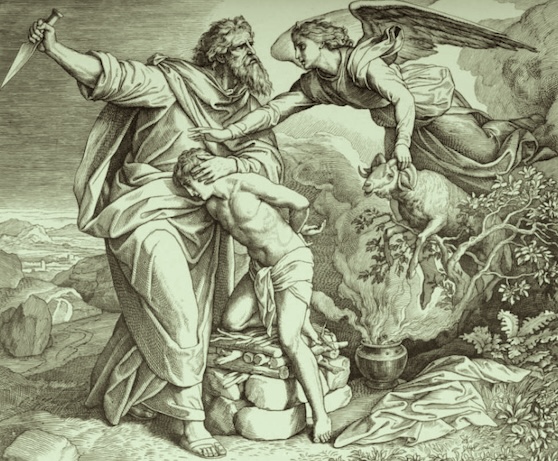
“First of all,” said another angel, “your wife Sarah is going to have a son. I know she is a hundred years old and will probably think this is some kind of joke, but let me tell you that God doesn’t fool around when it comes to sex. You have to call this son “Isaac” and then just when you think things are going alright, God is going to ask you to take Isaac up on a mountain and kill him as a sacrifice.”
Abraham decided to keep quiet. Maybe there was more.
The second angel continued, “Now God doesn’t really want you to kill Isaac, he just wants to test you, so don’t worry, the boy will grow up and have two sons who will fight like hell over their inheritance. The younger son, whose name is going to be Jacob, will trick his brother and go on and give you great and not-so-great grandsons who will become the twelve tribes of Israel, which people will start calling Jews. They will be slaves in Egypt for awhile and then wander around in the wilderness for forty years. But eventually they will come back here to Canaan, blow their horns and slaughter the locals with my blessing. Are you with me?”
Abraham nodded, but was not sure what to say yet.
“Alright, let’s get on with it then. There will be a few good years with a couple of kings named David and Solomon. These guys will be household names for years afterward. But because most of your your children will be stubborn and rebellious, God will send several prophets to tell them to shape up. When they worship other gods, then he has no coice but to have barbaric hordes of Assyrians and Babylonians destroy the whole kingdom of Israel. People will be trying to figure out what happened to some of the twelve tribes until the end of time. A few of the exiled Jews will come back and rebuild the temple — God has plans to settle down in a real house sometime you know — but basically things will go from bad to worse. After a few centuries, the Romans will knock down the temple again. Before this one of your descendants named Jesus will say he is God’s only son and start a whole new religion called Christianity. The Jews will hate the Christians and try to kill them for awhile, and then the Christians will get the upper hand and get back at the Jews for killing Jesus. Some half-crazed actor named Mel Gibson will even make a film about it.
Abraham stared straight ahead, afraid to say what he was thinking.
The third angel now took over. “But that’s not all. About 600 years after Jesus a desert prophet called Muhammad will come along and start another religion in your name. Only this time he will say that Ishmael is your true heir and not Isaac, who of course isn’t born yet, but will be soon. The followers of this new religion will call themselves Muslims. Sometimes they will get along with the Jews and Christians, sometimes they won’t. At some point there will be a big war with lots of people killed crusading to gain control over this land we sit on right now. Historically speaking, this real estate you were promised is going to skyrocket in value. More blood will be spilled over this land than any other piece of the earth. Just think of it.”
It was hard to tell exactly what Abraham was thinking at this point.
“But there’s more. The descendants that are related to you through Isaac will have a tough time of it wherever they go. Everyone will persecute them. In another three thousand years or so a nasty Nazi called Hitler will come along and try to exterminate all the Jews. After a big-time world war, Israel will once again become a state. The only problem is that the people living there and all around won’t get along very well. Muslims will kill Jews. Jews will kill Muslims. Christians will kill Druze. Turks will kill Kurds. Everyone will basically try to kill everybody else until they pretty much forget why they wanted to kill each other in the first place. You know, the whole world will be tuned in as bombs go off in crowded market places, airplanes strafe villages, tourist busses are blown up, prisoners are tortured, women are raped and children are shot dead in cold blood. And then, believe it or not, on one day in February of 1994 a guy from Brooklyn will walk into a mosque built over the site of your tomb and shoot over 40 men and boys as they pray and then…”
“Enough! Enough! ” shouted the old patriarch, rising unsteadily to his feet. I’ve heard enough to know you can’t be angels. You certainly don’t come from the God I worship. This is a pack of lies from the Devil himself. If I thought for one split second that even a part of what you three just said could ever happen, I would kill myself and all my family on the spot. Get out of my sight, damn you!”
The angels disappeared and suddenly Abraham awoke under the harsh afternoon sun streaming in through the tent flap. “Sarah,” he cried, “please come. I’ve just had the worst dream, a nightmare so awful I can’t bear to repeat it. It was something so terrible. It just couldn’t be true.”
“Abe,” said Sarah calmly, you can tell me about your dream later, because I have exciting news for you. Abe, it’s finally happened. I don’t know how, but I’m pregnant, Abe. I’m going to have my own son. It has to be a miracle. God has finally answered our prayers. Abe? Abe? Abe, speak to me? Abe, what’s the matter?”
The patriarch lay motionless on the ground, no longer breathing. The family assumed he had died peacefully in his sleep. And he was laid to rest in a cave near Hebron. History, of course, would never be the same.