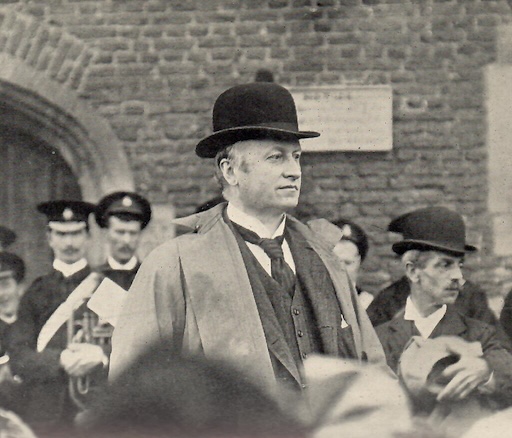
“The world is very troubled, and while peace is supposed to have been secured, active and murderous warfare is going on in at least a quarter of the recent areas of struggle. And, if this is the case in Europe, the situation in Asia is worse, and will not subside for a generation.”
This comment could be from a current political figure about the ongoing conflict in the Middle East, but it was actually written by the British diplomat Lord Curzon in September, 1919, only a few months after the signing of the Treaty of Versailles which officially ended World War I. His reference to Asia was really about the future of Persia, where he had traveled extensively in 1889-1890.
His two-volume Persia and the Persian Question (1892) reveals his fascination for Persia, ruled at that time by the Qajar Shah Nasir al-Din. Britain held imperial control over India, then Persia’s neighbor, but Curzon thought strategically about a future alliance with the Shah. As he wrote near the end of his first volume:
“Persia can never become a rich, or a producing, or a manufacturing country: but it will doubtless be turned to great account some day or another as a nursery for soldiers. The Persian, considered as a mere animal, is so very superior to any other Asiatic, to an Indian, or Turk, or even Russian, that it is impossible tom avoid foreseeing that, as any European war becomes developed in the East. the military resources of Persia must be called into action.”
I doubt that any of the war planners in Israel or the U.S. read anything by Lord Curzon, who died a century ago, before launching the war/non-war on Iran four weeks ago. Some may not have been aware that Persia is in fact Iran. Curzon was Orientalist to the core, admiring the quaint cultural aspects he saw from his carriage ride, but disdainful of the people he actually met. He can be forgiven for not realizing a future in which oil overturned the fate of the entire region, but at least he warned about the ability of Persian soldiers.
In 1919 Curzon was advocating for British involvement in Persia, although the Persian tribes would not have appreciated British soldiers on their soil even though the Shah welcomed British money to fill his empty coffers. Curzon’s desire to woo Persia was not kosher to a number of the British diplomats who advised on the Eastern issue; some argued to “leave Persia to go to the devil in her own way.” Curzon persevered and reached a treaty with Persia, which had been rebuffed at a peace conference in Paris. The treaty would send British expert advisors for the government, British officers, munitions and equipment to create a national army and a loan of 2 million pounds. Here is how Curzon described the treaty…
“What they mean in practice is this: not that we have received or are about to receive a Mandate for Persia; not that Persia has handed over to us any part of her liberties; not that we are assuming fresh and costly obligations which will place a great strain on us in the future; but that the Persian Government, realizing that we are the only neighboring great Power closely interested in the fate of Persia, able and willing to help her and likely to be distinterested in that object, have decided of their own free will to ask us to assist Persia in the rehabilitation of her fortunes.”
At the dinner in London celebrating the treaty, Curzon added his praise:
“I have always been a sincere and outspoken friend of Persian nationality. I regard Persia as a country with a great history and a romantic past, one of the few surviving independent Muhammaden Stares of the world, which it is of vital interest not only to ourselves, but to Asia to keep alive. I know that country and the people to be possessed of marked individuality and national spirit, too ardent to be suppressed, too valuable to be submerged. Was it not natural that Persia, seeking to establish and stabilize her future, should turn to us?”
The treaty did not last long, in part because the Persian Cossacks that maintained the Shah had Russian officers. In 2021 the Shah, out of fear of Russia, made an agreement with the new Soviet Communist government. Curzon bemoaned the fact that Persia was now “marching of its own accord.”
There is a much used, and often abused, notion that history repeats itself. Given the incessant wars in the area now called the Middle East and previously hoped to be a Holy Land, war has followed war after war after war. Today it is indeed Persia once more. And Persia, with a resilient array of armed forces, is marching of its own accord.
[Quotations from Lawrence John Dundas Zetland, The Life of Lord Curzon. London: Ernest Benn Ltd, 1928.