Voltaire on Islam


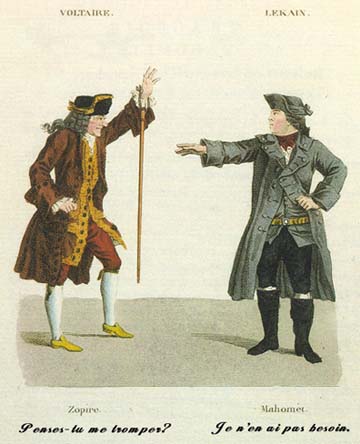
For many Muslims the name Voltaire is one held in anathema. His rationalism is not the issue, but he is forever scarred as the author of a play in which Mahomet is the icon of fanaticism. While it is obvious that the real target of the play was Catholicism and not Islam, the mere fact that Muhammad becomes the scapegoat is a difficult trope to accept for quite a few Muslims. But Voltaire often praised Islam in contrast to the blood-crazed Christianity of his day. Consider the following comment:

The legislator of the Muslims, a powerful and terrible man, established his dogmas with his arms and courage; however his religion became indulgent and tolerant. The divine institutor of Christianity, living in peace and humility, preached pardon, and his holy, sweet religion became, through our fury, the most intolerant and barbaric of all.

Continue reading Voltaire on Islam →

Covering Afghanistan


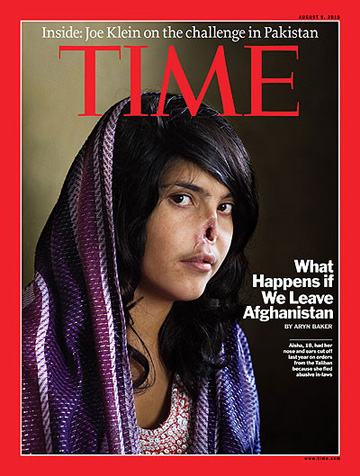
August 9, 2010 cover of Time Magazine

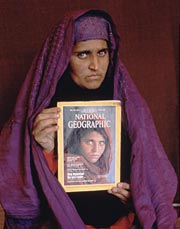
As usual for the end of the week, my Time arrived yesterday. It seems a bit unusual that I should receive the August 9 issue a week early, but then Time is not always accurate. The cover photograph is startling, haunting, disturbing and an unfortunate example of sensationalized news reporting. I cannot help but compare this to the widely traveled National Geographic photograph of an Afghan woman. I have no objection to covering a human tragedy etched in the face of young Aisha, the 18 year old girl whose nose and ears were cut off by self-righteous extremists who practice a brand of Islam that would make the Prophet Muhammad roll over in his grave. But the cover’s prominent announcement of the article inside by Aryn Baker is in fact not the title of the article, nor the main message of the author. “What happens if we leave Afghanistan” is a lot more sensational than “Afghan Women and the Return of the Taliban,” which is why it graces the cover. Tragedies, like sex scandals, sell. The issue for me is how they should be reported responsibly.


Afghan woman holding 1985 National Geographic issue with her picture on the cover

Continue reading Covering Afghanistan →

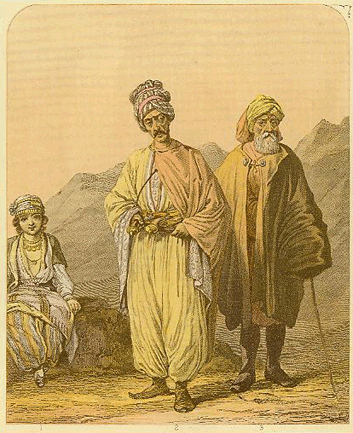
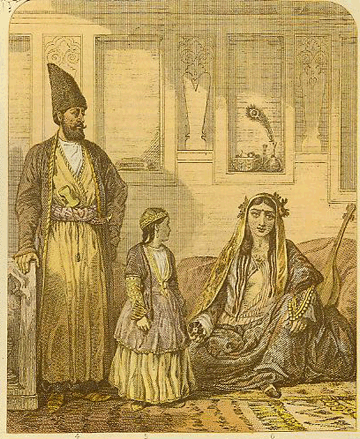
Colorful Lithographic Orientalism #6: Kurds and Persians


Kurds

As noted in a previous post, I recently went through a late 19th century scrapbook that belonged to my great, great aunt. She had cut out pictures that interested or amused her. Several of these have Orientalist themes. Sometimes a picture is worth a thousand words; other times the picture says enough for itself. In this series, I leave the image to speak for itself. If you would like to comment on what you see or imagine, please do so in the comments section.


Persians

For #5, click here

Islam’s Beginnings

Islam’s beginnings

Mohammed’s early movement was a surprisingly big tent, says historian Fred M. Donner

By Thanassis Cambanis, The Boston Globe, May 2, 2010

The first followers of Christ didn’t consider themselves ’’Christians’’; they were Jews who believed that a fellow Jew named Jesus Christ was the long-awaited messiah. It took centuries for Christianity to evolve and solidify as a distinct faith with its own doctrine and institutions.

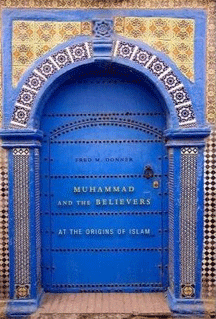
In ’’Muhammad and the Believers: At the Origins of Islam,’’ University of Chicago historian Fred M. Donner wants to provide a similar back story for Islam — a religion which, in the popular imagination, sprang wholly formed from the seventh-century sands of Arabia. Mohammed preached at the juncture of the Roman and Sassanian empires, winning support from Christians, Jews, Zoroastrians, and various deist polytheists. According to Donner, Mohammed built a movement of devout spiritualists from many faiths who shared a few core beliefs: God was one, the end of the world was near, and the truly religious had to live exemplary lives rather than merely pay lip service to God’s laws. It was only a century after Mohammed founded his ’’community of believers” and launched the great Islamic conquest that his followers started to define their beliefs as a distinct religious faith. Continue reading Islam’s Beginnings →

Images from the Hadramawt

Note: The following images were taken in the early part of the 20th century when the British were in control of the Aden Protectorate.


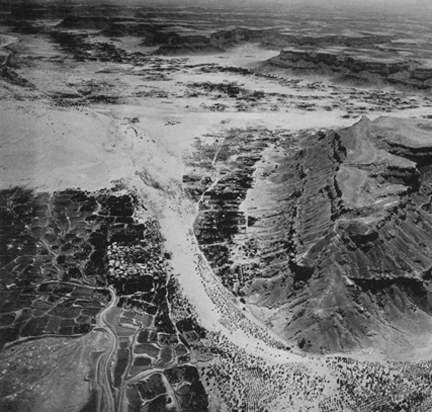
Shibam, looking down the Wadi Hadhramaut towards Seiyun. Shibam is built on a low hill at the tip of a plateau spur and, for lack of space, grew upward; the buildings are eight to ten stories high. The landlord occupies the upper stories and these parts are whitewashed; the more whitewash, the wealthier the owner. Note the abandoned fields embanked to prevent runoff of water. The upper right-hand margin shows the plateau topography in the direction of the sea, a hundred miles distant.

Continue reading Images from the Hadramawt →

Fallujah Fallout


Genetic damage and health in Fallujah Iraq worse than Hiroshima

Brussels Tribunal, Press release
July 2, 2010

Results of a population-based epidemiological study organized by Malak Hamdan* and Chris Busby are published on 03 July 2010 in the International Journal of Environmental Studies and Public Health (IJERPH) based in Basle, Switzerland. They show increases in cancer, leukemia and infant mortality and perturbations of the normal human population birth sex ratio significantly greater than those reported for the survivors of the A-Bombs at Hiroshima and Nagasaki in 1945.

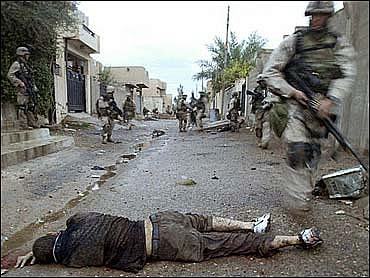
Results of a survey in Jan/Feb 2010 of 711 houses and more than 4000 individuals in Fallujah show that in the five years following the 2004 attacks by USA-led forces there has been a 4-fold increase in all cancer. Interestingly, the spectrum of cancer is similar to that in the Hiroshima survivors who were exposed to ionizing radiation from the bomb and uranium in the fallout. By comparing the sample population rates to the cancer rates in Egypt and Jordan, researchers found there has been a 38-fold increase in leukemia (20 cases) almost a 10-fold increase in female breast cancer (12 cases) and significant increases in lymphoma and brain tumours in adults. Continue reading Fallujah Fallout →