Born Free, unless you are female

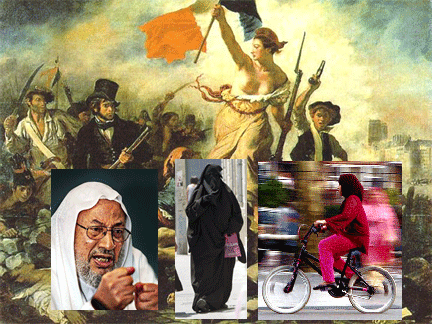
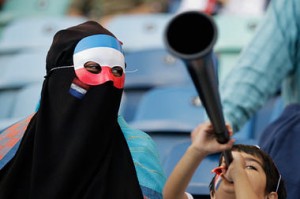
I opened my email this morning and back-to-back there was instant conflict: a posting about a new Indian Deoband fatwa ruling that veiled Muslim women should not ride bicycles and another about a female French lawyer who ripped the face covering off a young Muslim girl in a shopping mall near Nantes, the latter a pre-emptive strike for the pending anti-niqab law in the French parliament. Both rulings strike me as silly, both as overtly political. So now instead of the standard “Death to America” vs. “Muhammad is a child molester” chant wars we have entered the era of dueling over social mores through Fatwa Wars. Although not as erotic as the recent tit-illating fatwa controversy, also involving women’s bodies, the battle lines are still drawn over the same resource: what males do to control women’s bodies and minds.

Let’s start with the Deoband bicycle banning. The commentary by Nigar Ataulla, an Indian Muslim who happens to be female as well as a journalist who enjoys bike riding, called “Cycle Fatwa  Rides into My Re-Cycle Bin” reads:
Continue reading Born Free, unless you are female

Viagra for Aladdin Lovers


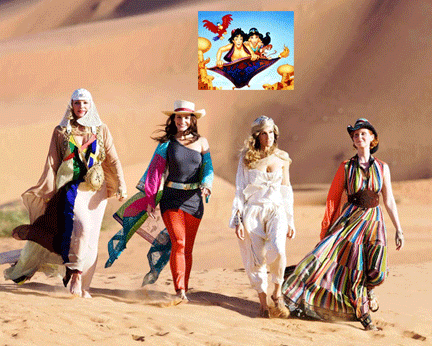
“Sex and the City 2’s” stunning Muslim clichés
It’s hard to overstate the offensiveness of the fabulous four’s exquisitely tone-deaf trip to Abu Dhabi

By Wajahat Ali, Salon, May 26

I’m a heterosexual, Muslim dude who until recently thought pleated khakis and loafers were “hip” and mistook Bergdorf Goodman for an expensive Swiss chocolate. So it is not surprising that 40 minutes into “Sex and the City 2,” a 150-minute cotton candy fantasy accessorized with materialism and fashion porn, I was comatose with boredom.

But I was defibrillated by the film’s detour into Abu Dhabi (really Morocco and studio sets) and what can only be described as an Orientalist’s wet dream. After discovering they will visit the Middle East, the ladies whip out hall-of-fame Ali Baba clichés: References to “magic carpet” (a double entendre, naturally), Scheherazade and Jasmine from “Aladdin” come in rapid succession. Upon hearing a stewardess give routine flight instructions in Arabic, Samantha behaves like a wild-eyed child hearing a foreign language for the first time. “I wonder what she’s saying. It sounds so exotic!”

Michael Patrick King’s exquisitely tone-deaf movie is cinematic Viagra for Western cultural imperialists who still ignorantly and inaccurately paint the entire Middle East (and Iran) as a Shangri La in desperate need of liberation from ignorant, backward natives. Continue reading Viagra for Aladdin Lovers

The Fifth Annual Arab-American Heritage Park Festival

The Fifth Annual Arab-American Heritage Park Festival

Sunday, July 18, From 1-6pm

Prospect Park West, Brooklyn, NY

15th Street Entrance

Presented By: The Arab American Family Support Center & Alwan for the Arts

Bring Your Family & Friends of all ages to Celebrate Arab Heritage

Directions:

F Train to 15th Street/Prospect Park B-68, B-69, or B-75 Buses to Prospect Park West & 9th Street

Enjoy music, cultural performances, savory Arabic food, traditional Arabic shisha, professional henna artists, heritage arts and crafts, face painting, bouncy house, plus enter the raffle to win lots of great prizes!

For more information contact Bret Denning at bret@aafscny.org

Worth a Response: Why Yemen is not Afghanistan


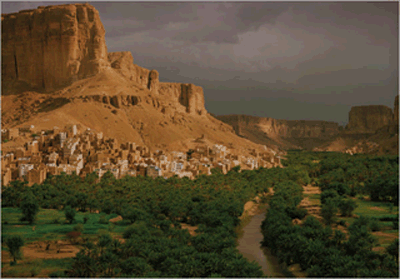
“The village of Rihab in Wadi Dawan, a valley that is the ancestral home of Bin Laden”; Simon Norfolk/Institute, for The New York Times

Yemen hardly ever makes the news unless a journalist wants to rail against the green-dribbling khat habit of grown men who wear skirts or trump with the terrorism card. In the Sunday Magazine of The New York Times, Robert F. Worth asks the provocative question: “Is Yemen the Next Afghanistan?” For an article that begins with a photograph of the valley “that is the ancestral home of Bin Laden” and mentions an American cruise missile in the first line, it hardly takes a Ph.D. to figure out what the answer is most likely to be in the mind of the reader. Worthy reporter that he is, The New York Times Middle East correspondent does not directly answer the question. He does not need to, since the Al Qaeda-laced narrative itself hinges on the comparison. The article ends with a visit to an “old man with a deeply lined face” and who walks with a cane. When asked if his son, an Al Qaeda figure described in the story, was really part of the plot in the 2000 bombing of the U.S.S. Cole, the father responds:

‘No,’ he said, ‘ I don’t believe this.’ He was silent for a long time, staring at the closed door of the house, which was illuminated at its edges by a bright rectangle of afternoon sunlight. then he spoke again.
‘He is a mujahid,’ he said, or holy warrior. ‘He is fighting those who occupy Arab lands. He is fighting unbelievers.’

I have read a number of articles by journalist Worth, usually with a favorable view of his ability to introduce nuance into what is generally a black-and-white portrayal of things Arab and Islamic. For this article, he contacted diplomats (former Ambassador Hull) and scholars (Gregory Johnson) who are knowledgable about recent political events in Yemen. He is also to be commended for learning some Arabic, although I am not sure his year-long training in classical will be of much help in casual conversation in dialect. Yet he visited Yemen and actually talked to local people and not just the other reporters in the pool. In this sense, the reporting is not bad, certainly not like The Daily News or Fox News engineering. The problem is that neither is the article very good. The question in the title, which perhaps was not the journalist’s choosing given the control of editors, is blatantly rhetorical, not a genuine search for an answer that goes beyond the verbal War on Terror jousting on all sides of the aisle in Washington and in much of the media. Continue reading Worth a Response: Why Yemen is not Afghanistan

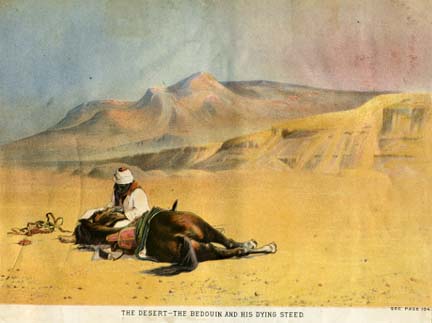
Colorful Lithographic Orientalism #5: Steed

As noted in a previous post, I recently went through a late 19th century scrapbook that belonged to my great, great aunt. She had cut out pictures that interested or amused her. Several of these have Orientalist themes. Sometimes a picture is worth a thousand words; other times the picture says enough for itself. In this series, I leave the image to speak for itself. If you would like to comment on what you see or imagine, please do so in the comments section.

For #4, click here

Damn the Vuvuzelas


For those of us watching the World Cup in South Africa the din of the vuvuzelas is muted by the voices of the announcers. I can only imagine the deafening roar experienced by those attending the games in what has to be the noisiest World Cup ever. Now, courtesy of a fatwa from the United Arab Emirates, Muslims no longer need to put up with the noise. In Fatwa #11625 of July 6, the verdict is in. All this noise really is haram. The fatwa quotes Imam Malik as saying he disapproved of a festivity with loud horns, a handy precedent for the current noise pollution in the sporting world. Of course, Imam Malik did not measure decibels, but we sure can today.

For those who are interested, here is the argument: Continue reading Damn the Vuvuzelas

Payback for No Pay


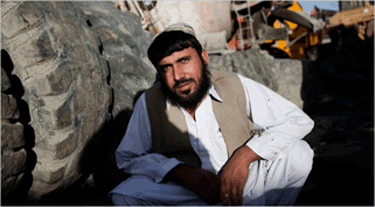
Haji Layeq says an American company failed to pay a construction company he has ties to; photo by Adam Ferguson for The New York Times

Much of the world, despite what many Americans think, does not trust the United States intentions in either Afghanistan or Iraq. Both countries have seen corruption and favoritism at the highest levels. In theory “America” stands for citizens’ rights and equal treatment under the law, but in practice such principles may conveniently be ignored in war zones. Such a case was reported on yesterday in The New York Times by Carlotta Gall. She writes:

The failure of American companies to pay for contracted work has left hundreds of Afghan workers unpaid in southern Afghanistan, and dozens of factories and small businesses so deep in debt that Afghan and foreign officials fear the fallout will undermine the United States-led counterinsurgency effort to win the support of the Afghan people.

Continue reading Payback for No Pay

Divorcing fundamentalism


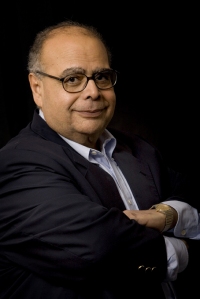
Nasr Abu Zaid was a brave and honest scholar disgracefully persecuted for his attempts to read the Quran historically

by Brian Whitaker, The Guardian, July 6

The divorce case was what made him famous, though it wasn’t the usual kind of celebrity divorce and Nasr Abu Zayd was still in love with his wife.

Abu Zayd, the liberal Muslim thinker who died yesterday, first came to the attention of Islamists while teaching Arabic literature at Cairo university in the early 1990s. They decided that his research contained “clear affronts to the Islamic faith” and accused him of apostasy.

That in turn inspired a group of Islamist lawyers to file a third-party (“hesba”) case, seeking to divorce him from his wife on the grounds that a Muslim woman cannot be married to an apostate – and after a series of court hearings his marriage was declared null and void.

Such was the controversy after the verdict that Cairo university was “turned into a military fortress” to protect him the next time he made an appearance there. Realising that it was impractical to continue teaching under those conditions, and after one of his guards was heard describing him as “the infidel”, Abu Zayd and his “ex-wife” left Egypt and settled in the Netherlands. Continue reading Divorcing fundamentalism