Plot of the day


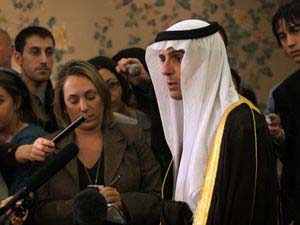
The Saudi ambassador to the US Adel al-Jubeir speaks during Middle East peace conference in Maryland in 2007

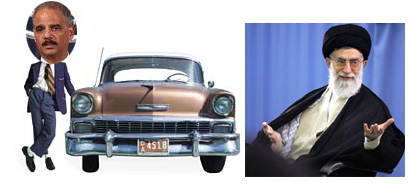
The news dominating coverage of the Middle East today catapults Iran and the Palestinians over the ongoing Arab Spring. Even the fact that tens of thousands of Syrians turned out in Damascus to support the Asad regime pales in relation to the James Bond scenario of Iranians, drinking tequila with Mexican drug runners in order to set up the assassination of the Saudi ambassador in Washington. It sounds like a movie plot, but then so does the whole Arab spring since February. American officials are acting as though they have slam-dunk proof, which is a dangerous sign when no one has seen even an iota of that proof apart from the allegations given by Attorney General Holder. And it seems the culprit has confessed, so what more needs to be said? The plot is plausible to most Americans, I suspect, because one expects Iran to engage in terrorism and the government officials in Iran despise the Saudis as much as they do the United States. It sure makes Eric Holder, who has come under blistering attack by Republican hawks, smell like a rose.

Also headlining the news today is the agreement between Israel and Hamas in which some 1,027 Palestinians being held in Israel jails will be exchanged for one Israeli soldier, Gilad Shalit, captured some five years ago. And the plot thickens, because the exchange of 1000/1 is taken as a victory by both sides. The dark side is that such a deal reinforces the notion that Israel lives are more valuable than Palestinian lives at the same time as individuals are being freed rather than blown up. Given previous hard-line rhetoric of Netanyahu, the idea of such a trade also seems something dreamed up in a novel.

There are serious plots in which people die every day, such as more bombs in Iraq. And there are, in biblical terms, rumors of plots. These two events today would be earth-shaking on any day, but are especially ripe for punditry at this juncture in the region. What will the impact of this release mean on the Palestinian quest for statehood in the U.N.? What new sanctions can be brought out against Iran? And if the Saudi ambassador had been killed, along with a number of Americans, what would have been the response of the Obama administration? I can only imagine the re-election landslide if Obama and the Israelis were to successfully launch an attack to destroy Iran’s nuclear plant. He would be drinking tea all the way to a second term in the White House.

Let’s see what new plot unfolds tomorrow…

Lane’s Lexicon Online

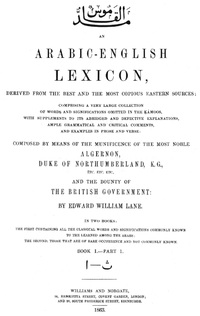
The indispensable, even though incomplete, Arabic-English lexicon of Edward Lane is available several places online. You can download online here. Or check out http://www.tyndalearchive.com/tabs/lane/ and http://www.studyquran.co.uk/LLhome.htm

I find it unfortunate that this Victorian era lexicon, valuable as it is, has never been completed in English. Many of the meanings that Lane provides are somewhat archaic and he is also quite arbitrary in what he chooses to record. So it is always advisable to use his text more as an index and then go to Lisan al-Arab, Taj al-Arus or one of his other important sources to see what the original says. The French variant by Kazimirski is also 19th century but at least is complete. Lisan al-Arab and several other lexicons are available and searchable online at http://www.baheth.info/ There are also several earlier Arabic-English lexicons available in pdf at archive.org. But the mother of all Arabic dictionaries, al-Zabidi’s Taj al-Arus is available either online or in pdf for the valuable Kuwait edition at http://www.archive.org/details/alhelawy09

Tea break


“Tea, made up from the blossoms of this fragrant tree [Linden] serves as an alternative to the caffeinated regular stuff. It’s supposed to be good for you, especially if you’re sick. Here, at this fancy cafe near Istiklal, it is served up in style.” Photo by Deniz.

Looking daily at the news about the Middle East has become frustrating because there is simply too much to digest. Take today, for example. Will more Copts be killed in riots in Egypt? Is Salih leaving Yemen or not? What about the young protester shot in Bahrain? Will Qaddafi be found in a bunker in Sirte? How many Syrians were arrested and will never be seen again? Is Palestine really going to be a state? And Tunis? Iran? And I have yet to mention Iraq, not to mention Afghanistan or Pakistan. There are times when it is nice to sit down with a calming cup of tea. The photo above is from a splendid website by the Turkish photographer Deniz. Enjoy.

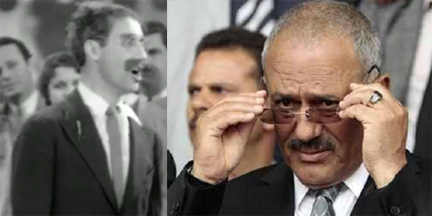
Salih and Groucho: “Hello, I must be going”


Get ready to roll the dice again. The almost off-again, persistently on-again Ali Abdullah Salih has once again signaled his stage exit. After some seven months of his citizens shouting “Irhal, ya Ali,” the embattled president of Yemen is once again on the ropes. When he announced yesterday that he would be handing over power, most Yemenis were somewhat skeptical. The old phrase “three times and you are out” rings true in American baseball but hardly in contemporary Yemeni politics. Nor does “the third time’s the charm” charm the majority of Yemenis who want a major change at the top. Does he mean it this time?

There is something about the roller coaster politics in Yemen this year that makes a perfect Marx Brothers (and I don’t include Karl in this family) movie. When I heard Salih’s latest swan song, I could not help but think of the classic song by Groucho Marx as Captain Spaulding: “Hello, I must be going”:

Hello, I must be going.
I cannot stay,
I came to say
I must be going.
I’m glad I came
but just the same
I must be going. Continue reading Salih and Groucho: “Hello, I must be going”

Letter from Islah to Tawakkul Karman


Tawakkul Karman

Yesterday I wondered how the Yemeni party Islah would respond to the Nobel Prize being given to one of its members. Here is the official letter, congratulating her, sent to Karman from Muhammad Abdullah al-Yadumi,

بسم الله الرحمن الرحيم

الأخت المناضلة / توكل عبدالسلام كرمان

رئيس منظمة صحفيات بلا قيود, عضو مجلس شورى التجمع اليمني للإصلاح

تحية وتقدير وبعد :

بكل ابتهاج تلقينا في التجمع اليمني للإصلاح إعلان فوزكم بجائزة نوبل للسلام كأول امرأة عربية تحظى بهذا التكريم وأول شخصية يمنية تمنح هذه الثقة الدولية الهامة.

إننا ونحن نهنئكم بهذا الإنجاز التاريخي نعتبر هذا الفوز مكسبا للثورة اليمنية السلمية وللمرأة اليمنية المناضلة والواعية القادرة على صنع النجاح رغم عوائق التخلف وموروثات الإستبداد التي حالت بين شعبنا وبين الإبداع لعقود من الزمن.

كما أن تكريمكم اليوم بجائزة نوبل للسلام يعد تتويجا مستحقا لجهود سنوات من نضالكم السلمي الدؤوب وكفاحكم المرير ضد منظومة الجهل والظلم والفساد في مختلف الميادين الإعلامية والحقوقية والسياسية ونصرة المظلومين وغيرها من المجالات وصولاً إلى العمل الثوري السلمي الذي مازال شعبنا برجاله ونسائه وشبابه وشيوخه يخوضه دون استكانة أو لين حتى يتحقق له ما يصبو إليه من حرية وكرامة وعدالة وحكم رشيد .

كما أننا نرى في هذا التكريم شهادة أممية على حضارية شعبنا اليمني وعدالة مطالبه وسلامة نهجه السلمي في التغيير، متمنين في هذا السياق ان يرافق هذا الإعتراف من المجتمع المدني الدولي بعدالة المطالب اليمنية إعتراف سياسي دولي بهذه المطالب وان يسارع العالم بأسره الى الوقوف مع الشعب اليمني التواق للحرية والتغيير.

نكرر تهانينا الصادقة لكم ولكل ذوي المبادرات الرائدة في وطننا الحبيب ، مع تمنياتنا لكم بالتوفيق والنجاح ومزيداً من العطاء.

والسلام عليكم ورحمة الله وبركاته،،

أخوكم /

محمد بن عبدالله اليدومي

رئيس الهيئة العليا للتجمع اليمني للإصلاح

Yemeni woman shares Nobel Peace Prize


The Nobel Peace Prize for 2011 has just been released with three recipients: Ellen Johnson Sirleaf, Lehmah Gbowee and Tawwakul Karman. All three were chosen “for their non-violent struggle for the safety of women and for women’s rights to full participation in peace-building work.” Karman is Yemeni; but beyond this she is the first Arab woman to win a Nobel prize, a point proudly noted on the Yemeni media site Yemen Press. It will be interesting to watch the reaction to the choice. Here is an activist who took to the streets to promote a peaceful transition from the corrupt secular dynasty of Ali Abdullah Salih. She is one of many Yemenis sharing the same goal and not a principle organizer, although her superb English skills attracted attention in the foreign media. She is also actively involved in the powerful Islamic party of Islah.

As always there will be much second guessing as to why these particular individuals were chosen. I suspect that Karman was not near the top of any speculation list. The Nobel Peace Prize, however, is the most symbolic of these “dynamic” Swedish awards, with the aim of promoting an idea more than finding the “best qualified” candidate. The stated aim this year, however, was a focus on the role of women as peacemakers. Fortunately there are many women activists peacefully advocating against corrupt politics and prejudicial practices. The choice this year appears to be a consciously rounded decision, also including the Liberian president Ellen Sirleaf and Lehmah Gbowee, a social worker also involved in the peace movement in Liberia. If it had just been Sirleaf, one might have dismissed the choice as yet another politician, no matter how worthy, but including Gbowee and Karman may have more to do with inspiring more women to participate at the local level than their actual accomplishments or impact.

As a senior member of the prominent Yemeni Islamic party Islah, Karman does not fit the mold most Westerners hold of Muslim women. She covers her hair with a scarf, but without the extreme niqab or even the more ubiquitous Yemeni sharshaf ( a full-length black outer veil introduced to Yemen by the Ottoman Turks). While the media is for the most part fixated on the masculine culture of Al Qaida, the role of women in Yemen is either ignored or stereotyped. So this choice will draw attention to the fact that there are women who are proud to be Muslim and do not view themselves as servile slaves. But it will also, I suspect, result in detractors within Yemen who will be jealous of the attention she is receiving and perhaps even dismiss it as yet another “Western” intrusion. Will the leaders of Islah promote this honor to one of their members? Will rival Islamic groups use her as a wedge issue? Continue reading Yemeni woman shares Nobel Peace Prize

Walter Dostal (1928-2011)


Eduard Glaser (1855-1908), left; Walter Dostal (1928-2011), right

[In early August the academic community lost one of the pioneers of ethnographic study on the Arabian Peninsula, the distinguished Austrian scholar Walter Dostal. Here is the obituary from the Austrian Academy of Sciences website.]

With Walter Dostal’s passing away in Vienna on August 6th/7th 2011, the anthropological communities in Austria, Central Europe and the German-speaking countries lose one of their best-known representatives shaping the field throughout the latter quarter of the 20th century.
Dostal was best known for his ethnographic studies of Arabian and Middle Eastern societies, but he also contributed substantially to anthropological theory – with particular emphasis on the interplay between environment, society, and history. As a leading expert for the Arab peninsula at this Academy, Dostal continued a remarkable research record into the early 21st century which at the Academy of Sciences goes back to the late 19th century.

Dostal had belonged to the first generation of anthropology students trained after the second world war, and his scholarly work was committed to build a new and internationally oriented foundation for the discipline once called “Völkerkunde” in the German-speaking countries after 1945. Born on May 15th 1928 in Grulich near Brno (today: Czech Republic), Dostal and his family moved at the end of the war to Vienna where he began his studies in anthropology. His critical engagement with the so-called “Culture Circles” theory led him to reject any speculative historical models, and to appreciate the empirical archaeological and textual evidence. Formative influences during those early years of his career were Robert Heine-Geldern (a corresponding member of the AAS) and Joseph Henninger. After his dissertation on Semitic-speaking peoples he began a first sequence of ethnographic fieldwork in the Arab peninsula, which he combined with international research sojourns in Frankfurt and Rome, and his first position as Curator for the Middle Eastern section at Vienna’s Ethnology Museum. Continue reading Walter Dostal (1928-2011)