Traveling with Ibn Battuta


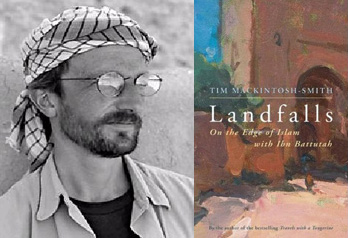
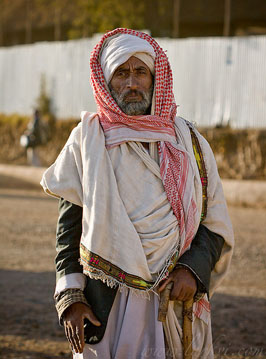
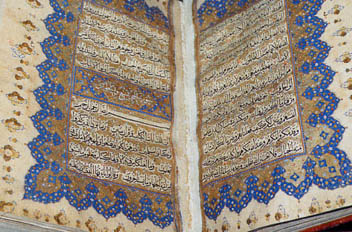
Tim, left; book, right

The superb travelsmith Tim MacIntosh-Smith has recently published the third volume of his fascinating trip in the footsteps and sailing lanes of the 14th century traveler Ibn Battuta. The book is called Landfalls: On the Edge of Islam with Ibn Battutah and is available in paperback or hardback. If you are looking for new year reading, here is a worthy volume to start with.

Here are some of the accolades:

‘The long-awaited and dazzling conclusion to the Tim Mackintosh-Smith trilogy . . . Again and again, this takes us into fascinating territory: into the company of dervish masters, soothsayers and magicians; towards the old rites of blood sacrifice, with demon ships of the Sea God blazing on the surface of the Indian Ocean; or on a quixotic hunt for a sacred musical instrument possessed by a royal dynasty of African kings. At such times, [Tim and Ibn Battutah] are united in a glow of wonder.’ Barnaby Rogerson, Country Life

‘Landfalls is a beautifully written account of Islamic life and culture in the 21st century . . . [and] a joyous celebration of cultural diversity. Just as Ibn Battutah did 700 years ago, Mackintosh-Smith helps make the alien familiar to his readers.’ Ian Critchley, Sunday Times Continue reading Traveling with Ibn Battuta

Babel: A New Post-Occupation Translation


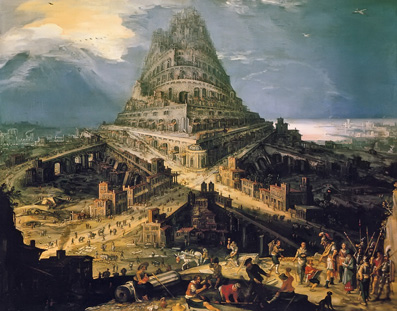
Tower of Babel artwork in Pinacoteca Nazionale in Bologna, c. 1500

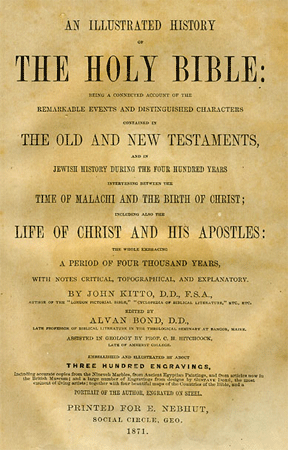
The beginning of a year that is yet again an apocalyptic venue is as good a time as any to quote from the biblical book of Genesis. Many of the events in Genesis took place in the legendary space that we now call Iraq, a space that the United States military is unoccupying after a prolonged mission that appears to have accomplished more mayhem than a lasting peace (at least in the recent holiday “peace on earth” spirit). Remember the story of the Tower of Babel; well here is my take of a new translation, being as faithful as I dare to the original King James English:

Genesis 11: The Tower of Babel
1 And the whole earth outside the Axis of Evil was of one mind, and of one resolve about the WMD of King Saddam.
2 And it came to pass, as the coalition troops journeyed to the east, that they found a plain in the land of Shinar, but no WMD; and they dwelt there for almost a decade.
3 And they said one to another, Go to, let us make bombs, and burn them thoroughly. And they had billions of dollars in weapons for battle, and slime had they in mind for talking about the party of the king.
4 And they said, Go to, let us build us a democracy, and a puppet regime, who will sell us oil that reaches unto the ports of Texas; and let us make us a name to be feared, lest we not have economic hegemony upon the face of the whole earth.
5 And the ones who lorded over came down to see the democracy and the puppet regime, which the children of the founding fathers builded.
6 And the ones who lorded over said, Behold, the people is one, and they have all one dangerous religion; and this they begin to do: and now nothing will be restrained from them, which they have imagined in their sharia to do.
7 Go to, let us go down, and there stoke their differences, that they may attack each other because of one another’s sectarian speech.
8 So the ones who lorded over scattered them with superior air power from thence upon the face of all the earth: and they left off to build the democracy.
9 Therefore is the name of it called Babel; because the ones who lorded over did there confound themselves, not knowing what they needed to know about Islam, Iraqi culture or the Arabic language.

A problem in the translation, you say? Continue reading Babel: A New Post-Occupation Translation

Tabsir Redux: Resolving the New Year


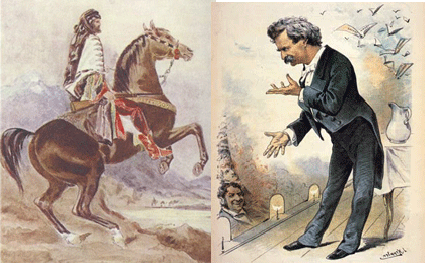
Wilfrid Scawn Blunt, left; Mark Twain, right

There is a curious annual custom inherited in many of our families, but one I am resolved not to take too seriously this year. I refer to the half-drunk notion of making resolutions for the new year (which I see no sound reason to capitalize, as my German blood is very far removed), as though the arbitrary turning of the calendar is a time to reflect on what went wrong over the last 365 days and pretend that things should go better in the next eighteen and a quarter score days. I have heard the rural urban tale that the pin-up 19th century cowgirl sharpshooter Annie Oakley started the custom of sending out Christmas Cards, but I am not sure which genius came up with penning new year’s resolutions, unless it was Johnny Walker in one of his more sober moments. Most people, and I surely fall into this anomalous category, do not remember the resolutions made a year ago. But then most godfearing redneck Americans could not repeat the 10 Commandments in order to save their souls, unless perhaps they were dead drunk. So my re-solution, since it is the defacto one I have been following for quite a few years, is to resolve to forget any resolution before I even make one. This saves me from having to make up a resolution, which is the same as making as silly a resolution as I can imagine.

I am not the first person to take aim at this impotent cultural pastime which has long since ceased to have any influence on what people really do. Mark Twain said it well over a century and a half ago:

New Year’s Day–Now is the accepted time to make your regular annual good resolutions. Next week you can begin paving hell with them as usual. Continue reading Tabsir Redux: Resolving the New Year

Muslim Hadramis in “Christian Ethiopia”


Muslim Hadramis in “Christian Ethiopia”: Reflections on Boundary Making Processes

by Samson A. Bezabeh, Bergen University

[Note: This is the Introduction to a recent article on the Hadrami experience in Ethiopia. The full article can be downloaded from the Journal of Muslim Minority Affairs.]

Introduction

Throughout recorded history sporadic population migration from Arabia to East Africa and Ethiopia has been a noted phenomenon. In the modern era Hadramis started to migrate and settle in Ethiopia at the end of the nineteenth century and the beginning of the twentieth century. Thus, by the beginning of the twentieth century, Ethiopia hosted a number of Arab families who were mainly Yemeni or Hadrami by origin. Although the exact population of the Hadramis at that time is not known, various statistical estimates and narrations, including narration of present day Hadrami families indicate that their number was substantial. This is particularly true in the case of major Ethiopian towns and trading centres such as Harar, Jimma and Asmara.

Despite their pronounced presence, however, their numbers, declined during the second half of the twentieth century as a result of negative factors that have forced them to leave the country. One such factor was the movement of pan-Arab nationalism which gained momentum in the 1960s. To be more specific, in 1969 Hadramis were expelled from Ethiopia for “supporting” the Eritrean Liberation Front (ELF), whom Arab nations, particularly Syrians and Egyptians, were supporting for fulfilling their goal of creating a united Arab land which in their vision also included the highlands of northern Ethiopia. In this scenario, Hadramis along with other Arabs were accused by the Haile Selassie regime4 in Ethiopia of sympathizing with the Arab backers of the Eritrean Liberation Front (ELF), and hence undermining Ethiopian unity. This has led many Hadrami families to voluntarily and involuntarily relocate themselves to Yemen and to oil reach countries in the Gulf such as Saudi Arabia. Continue reading Muslim Hadramis in “Christian Ethiopia”

The Zaydi manuscripts of Northern Yemen


Qu’ran manuscript in Western Library of the Great Mosque, Sanaa

by Arie Amaya-Akkermans, bikyamasr, 13 December 13, 2011

In recent articles on Bikyamasr.com, it was reported at length on the diversity of cultural sites, part of Yemen’s vast cultural heritage, that were threatened with neglect and destruction, partly because of the inability of the Yemeni authorities to preserve them and partly because of the state of unrest caused by the Yemeni uprising – namely the ancient cities of Sana’a, Shibam and Zabid, in which thousands of years of rich history are likely to become yet another casualty in Yemen’s struggle for freedom from the 33-years old dictatorial rule of Ali Abdullah Saleh.

It is fortunate however that these three ancient cities are considered UNESCO world heritage sites, due to the fact that they have received attention from international organizations – most prominently the government of Germany – and some degree of action has been taken in order to minimize the damage, or at least, that was the case until the beginning of the Yemeni uprising. The extent of the real damage done to the sites in the course of 2011 remains yet to be properly assessed in a post-revolutionary scenario.

More unfortunate is the fate not only of other sites but of something much more intangible but equally valuable: The rich intellectual Islamic heritage of the country embodied in over 50000 manuscripts held in many libraries and private holdings. The astounding numbers and the nature of the manuscripts make Yemen one of the most important archival collections in the world, easily rivaling similar holdings of Islamic manuscripts in the national libraries of Cairo, Istanbul and Teheran. Continue reading The Zaydi manuscripts of Northern Yemen

Welcome to America?


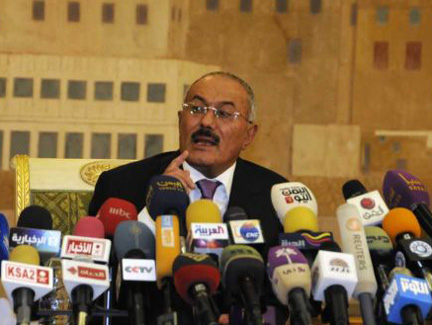
Photo credit: AP | Yemen’s President Ali Abdullah Saleh speaks to reporters during a press conference at the Presidential Palace in Sanaa, Yemen. (Dec. 24, 2011)

Yemen rarely makes the front page of The New York Times, but today it did. The seesaw political succession game underway in Yemen has seen President Ali Abdullah Salih’s head bobbing up and down in the power vacuum like a bobblehead doll in the hands of a Little Leaguer on opening day in Yankee Stadium. According to the article, Salih requested a visa to receive medical attention at New York’s Columbia Presbyterian hospital. Why it is not sufficient to return to Saudi Arabia, where he first underwent surgery and medical attention for major burns and other complications, is not clear. To complicate matters, and Salih has a knack for complicating matters, Salih told the Yemeni public in a recent televised address that he was not seeking medical treatment in the United States but simply wanted to allow the political process to evolve with him on the sidelines.

The Statue of Liberty still holds the beacon of hope aloft. So what does Salih hope to get from this visit. The Obama administration is keen to insist that Salih is welcome only for medical assistance, not for refuge. There is a glaring precedent that urges such caution: when Jimmy Carter allowed the former Shah of Iran entry to the United States for treatment, the pre-nuclear revolutionaries back in Iran went ballistic and stormed the U.S. Embassy. The rest, as they say, is history, but not the kind one likes to repeat. Continue reading Welcome to America?

The Islamic World’s Nude Spring


Aliaa Mahdy

by Joseph Mayton, bikyamasr, December 6, 2011

Egypt’s revolution has stalled. Islamists have taken the lion’s share of the first round of voting. In Tunisia and Morocco, large gains by the Islamists have seen women begin to question their future in conservative societies. Aliaa Mahdy changed the global perspective on how women are viewed in the Arab world, when she posted in November a full-frontal nude photo of herself on her blog.

The posting of her naked body left Egyptians and Arabs angry. Hate and condemnation quickly followed. Ironically, despite all the hatred purported in her direction, millions of people logged onto her blog to see her picture, with even lewd comments being posted.

For Mahdy, it was a symbolic protest against the status of women in Egypt and across the Arab world. She said enough to the centuries of male-domination meted out to women in the country and the region. It was the beginning of the Islamic world’s “Nude Spring” and launched a debate over women’s rights, or rather, “what is appropriate for women.” Continue reading The Islamic World’s Nude Spring

Doha Dèjá Vu


Skyscrapers dominate the modern skyline of Doha

In 1988-1989 I received a Fulbright Islamic Civilization Research Grant to carry out research on the Arab almanac tradition. Most of this time I was sponsored in Doha, Qatar by the Gulf States Folklore Center. Tempus fugit, to be sure. The folklore center no longer exists and Doha is quite a different city these days. A week ago I arrived in Doha to give two lectures at Qatar University, one on the sailing seasons around the Gulf and one on traditional agriculture in Yemen. In the two decades plus since I last visited Doha it is obvious that the city has changed dramatically. I do not remember any skyscrapers on my first visit. Doha was a sleepy little haven with the grand Doha Sheraton the eye candy. And quite an eyeful it was and remains.

I arrived at an auspicious moment, the evening of Qatar’s National Day. The entire day was devoted to celebration. Thus the trip that would normally take less than 20 minutes to go from the airport to the Sheraton was accomplished in six hours. The roads were blocked with SUVs and Mercedes colorfully marked and many with young boys on top waving the Qatari flag and sporting scarves with the image of the emir and his heir apparent. I missed the fireworks, but the enthusiasm of the throng made the long journey well worth it.


The majestic Doha Sheraton Hotel

The Doha Sheraton is a grand old place. Having been erected in 1982, such a luxury hotel is an architectural shayba. But it still inspires, with a pyramid exterior and inside right out of an arabesque garden from the 1001 Nights. Back then it stood alone, a harbinger of change; today it is almost dwarfed by a series of skyscrapers jutting out of the ground in various original shapes. Here is an architect’s paradise with almost every building sporting a unique design.


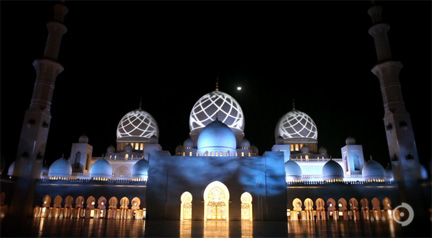
The Museum of Islamic Art at night

My last day I visited the Museum of Islamic Art, which houses a magnificent spread of Quranic manuscript pages, pottery, metalwork and jewelry from all over the region, especially from Iran. Their website has a number of impressive e-cards available. The main Qatar Museum is being renovated, but the Arab Museum of Modern Art has opened and one on Orientalism is in the works. Qatar’s wealth is making Doha a museum Mecca, one that is sure to draw a large number of tourists in the years to come.


Dunkin’ Donuts invades Suq Waqif

When I first visited the Doha suq, it was hardly worthy of the title; to put it mildly, it was quite miskin. But now it has been recreated as a tourist attraction (with paid parking) and live music. It has many of the old kinds of shops, from textiles to spices, but then there are the foreign intrusions, such as a Dunkin’ Donuts located near the parking lot. Just what Doha needs: stale globalized donuts.

Flying to and from New York was on Qatar Airways, which has the most outstanding business class I have ever experienced. It is hard to imagine a better first class experience. Next time you are traveling to the Gulf, consider a stop in Doha. Midst the turmoil embroiling the region, Qatar remains a stable oasis of growth. Such a tiny nation, but one that is really making a mark culturally and politically in the region.