Tabsir Redux:Mary in the Qur’an

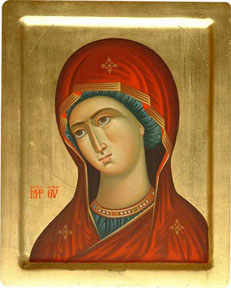
Illustration: Theotokos, Virgin Mary, Albanian icon

Bismillah al-Rahman al-Raheem. In the name of God, the Merciful, the Compassionate.

. . .And make mention of Mary in the Scripture, when she had withdrawn from her people to a place in the East, and had chosen seclusion from them. Then We [God] sent unto her Our Spirit and it assumed for her the likeness of a perfect human being. She said: “Truly I seek refuge in the Merciful One from you, if you are God-fearing”. He said: “I am only a messenger of your Lord, to give to you a pure son”. She said: “How can I have a son when no man has touched me, neither have I been unchaste”? He said: “Even so. Your Lord says: ‘It is easy for Me. And that We may make of him a revelation for humanity and a mercy from Us, and it is a thing ordained’”. And she conceived him, and she withdrew pregnant with him to a distant place. And the pains of childbirth drove her to the trunk of a palm-tree: She cried out: “Oh! Would that I had died before this! Would that I had been a thing forgotten and unseen!” Then (a voice) called out to her from beneath her: “Do not grieve, for surely your Lord has made a stream to flow beneath you; And shake towards you the trunk of the palm tree, it will drop on you fresh ripe dates: So eat and drink and refresh yourself. Then if you see any person, say: ‘Surely I have vowed a fast to the Merciful One, so I shall not speak to any one today’”. Then she brought the child to her own people, carrying him. They said: “O Mary! You have come with an amazing thing. O sister of Aaron! Your father was not a wicked man nor was your mother an unchaste woman”. Then she pointed to the child. “But they said, ‘How shall we speak to one who is still in the cradle, a little child?’ Jesus said, ‘Behold, I am God’s servant; God has given me the book and made me a prophet. God has made me blessed, wherever I may be; and God has enjoined me to pray and to give alms so long as I live, and likewise to cherish my mother; God has not made me arrogant or unblessed. Peace be upon me the day I was born, and the day I die, and the day I am raised up alive’”. Qur’an, Chapter of Mary, (19:16—35)

Good evening, al-salaamu alaikum, peace be upon you all.

I am, as ever, honoured to be here with you on this blessed night at Trinity-St. Paul’s. It is a great joy to be back in this church, both in the primary meaning of that word as this gathering of people, and in the secondary meaning of this amazing physical space that we share. Continue reading Tabsir Redux:Mary in the Qur’an

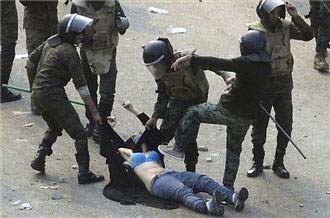
The picture


Beating a female protester in Cairo, Reuters

There it is above: the picture that sums up the resistance to political renewal more than any other image possibly could. It has been flashed across the world: a woman’s body exposed to anonymous male aggression. The issue is less the moment of an ongoing event which has riveted attention for almost a year than its symbolic depth. There are other images of security men beating protesters, including women. There are far more brutal shots of bloodied corpses and disfigured bodies. But this is the kind of picture that launches a thousand and one more protesters. Not only within Egypt. It is the kind of image that should shock us all, because it exposes an ugly truth we do not want to admit.

This is the kind of picture where the meaning far outstrips the specifics of the event. We do not know, nor do most people want to know, who she is or what she said or why she was singled out (if she was the only one), because she stands for the fragility of all protests against raw power. The reality is that force is entrenched. The purpose of military and security is to implement the policy of those who define power. Yes, there are revolutions and mutinies, but the need to control always wins out after a political house is “cleaned.” At times the power enforcers will give a little, but there is a point at which the batons are brandished and blood pours from the bodies of those who dare defy power.

What could this woman, dressed in the symbol of supposedly protective modesty — the hijab — have done to receive such treatment? Did they think she concealed an AK-37 beneath her black cover? Did they think any woman on her own posed a danger to men armed with crowd control equipment? Did they stop and think she is somebody’s daughter, probably somebody’s sister, perhaps someone’s wife or mother? No, because that is the ultimate tragedy of controlling protests, whether here on a Cairo street or a policeman spraying Occupy Wall Street young women with pepper spray. The only thing different this time is that the moment has been captured on film. It will never really be over, but replayed over and over again as a reminder that the violence never ends against those who dare protest a monopoly on violence.

While this beating was happening, several Egyptian protesters were killed and far more people were being eliminated in Syria. Such deaths are a daily occurrence in Yemen. Iraq and Afghanistan have not ceased to be killing fields. So why does this particular image have such power? Perhaps because it can resonate on all sides. For the liberal here is the epitome of woman’s ultimate lack of defense against male power. She had not stripped her own clothes off; she came to the square in the modest dress that was supposed to protect her, to set her off as immune to such actions. For the conservative here is the shame of exposing the body of a woman in public, not that of a criminal or a sorceress but a woman who dressed Islamically.

But there is another angle to this image that goes far beyond Egypt. Men virtually everywhere expose women’s bodies for their own perceived needs. On a gender scale the only real difference between this image and a simulated sex attack in a pornographic shot is that the woman is acting for money in the latter. But in both cases the message is that men are the ones who control women. It is a male power play to clothe the woman in any kind of dress and it is an ultimate male right to remove those clothes to suit his own purpose. A woman’s body is for the male to define. The young Egyptian blogger who posed naked, or nearly so, to speak up for freedom over her own body was roundly criticized by liberals and conservatives alike for rocking the voting public’s boat. How dare she defy the norm and expose her body voluntarily. It would only give more votes to the Islamic parties: such was the fear. But the issue is never really about the naked body, which men desire at almost any cost, but the fact that a woman dared defy the demanding male gaze by not letting the male strip her unilaterally or commercially. Look at the image above and look at the image of the blogger. If you see no difference, than you are the baton the security men wield against a defenseless body.

Daniel Martin Varisco

This commentary has been reposted on muftah.org.

Fantasy, action and the possible in 2011


by Samuli SchielkeØŒ “You’ll be late for the revolution!”: Samuli Schielke’s Diary of the Egyptian Revolution, December 11, 2011

[Webshaykh’s note: The following is an excerpt from an essay by Samuli Schielke “about Lenin, Tahrir, Islamists, poetry, choice and destiny in an attempt to provide some sort of theoretical synthesis of a confusing experience. It is the very slightly modified transcript of a lecture I gave at the University of North Carolina in Charlotte on 6 December 2011.” For the full essay. click here.]

The elections are now bringing a landslide victory of Islamic religious parties. I was just reading the results of the first round – we don’t have the final results because the elections take place in three rounds, different provinces voting at different times (the electoral law requires every polling station to be supervised by a judge and there are not enough judges in the country). One third of Egypt’s provinces have voted now. The results show that about sixty per cent of the vote of the party lists go to two Islamist party alliances, one of them the Muslim Brotherhood who are conservative, and one of them the Salafis who are badass fundamentalists. This has completely surprised some people, but anybody who has actually been following the situation in the streets has not been surprised at all. Actually the Muslim Brotherhood got less votes than one would think. With 36% of the vote, they actually did badly. They should have gotten 50%.

In a country that just had a revolutionary uprising against a corrupt system that was not an uprising in religious terms but one in terms of social justice, or freedom, or human dignity, why did people vote for Islamic parties? One of them, the Muslim Brotherhood, supported the revolution (but sided with the Army very soon afterwards), the other, the Salafis, were actually supporting Mubarak. Why did people vote for them? Continue reading Fantasy, action and the possible in 2011

Is Taiz going to be the next Benghazi of Yemen?


by By Tom Finn, Time, Tuesday, Dec. 13, 2011

Read more: http://www.time.com/time/world/article/0,8599,2102183,00.html#ixzz1gXKFNc14
During the day, Taiz, a mountainous municipality nestled in the basin of Yemen’s rugged central highlands, has the feel of any other Yemeni city. Scrawny teenagers with wheelbarrows filled with oranges weave in and out of the traffic dodging debabs — local six-seater microbuses — and motorbikes as they splutter up and down the city’s steep, dusty alleyways. But once the sun begins to set and the mountains surrounding the bowl of the city darken into jagged silhouettes, the wail of the muezzins soon competes with the ominous thud of explosions.

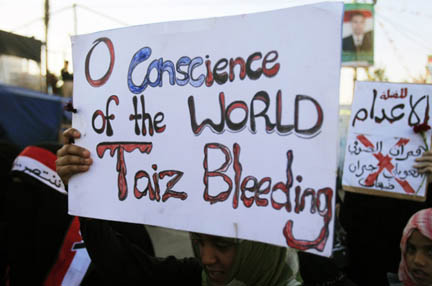
Taiz is famed for its doctors, lawyers and relative cosmopolitanism, but it was its youth who in February jump-started the movement in Yemen to oust the wily, decades-long ruler, Ali Abdullah Saleh, from power. Inspired by their counterparts in Tunis and Cairo, a group of men and women — most of them students — erected a circle of tents on a dusty boulevard in downtown Taiz and named it Freedom Square. Since then they have spent months braving a barrage of bullets, batons and tear-gas canisters from the security forces, marching through the city’s grubby streets and calling for change. (See photos of Yemen on the brink.)

But in recent weeks the conflict in Taiz has taken on a more deadly twist. Continue reading Is Taiz going to be the next Benghazi of Yemen?

Is it over “over there”?

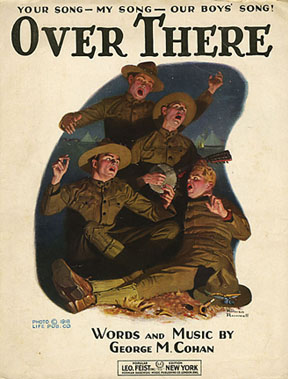
In the words of George M. Cohan from about a century ago, Johnny got his gun and the Yanks went “over there” and “they won’t come back ’til it’s over over there.” Billy Murray (the singer you probably do not know) sang it on Edison Records (the blue amberol cylinders you may never have heard). American troops have been over to several other “theres” since World War I, but ironically the longest lasting one has officially ended this morning in Iraq. There are only 4,000 troops of a high of 170,000 still left on the ground, a number less than the total of U.S. forces killed during the last nine years in Iraq. But if you think this is really “over”, think twice. The U.S. embassy will be the largest in the world with 15,000-16,000 people taking over a former air base.

The lingering question, for those who are even aware that Iraq is still on the current events map, is whether or not it was worth it. What started out as a big “if” (if there were weapons of mass destruction in Iraq) has made this an ever bigger “it.” As a ground war it was almost over as soon as it began. Sweeping through Iraqi territory to Baghdad was on the order of a Blitzkrieg; it was the ersatz policy for ensuring peaces that has been the problem. Iraq had no stockpiles of wmds. Yes, Saddam was a brutal dictator that most Iraqis were glad to see go, but few Iraqis have enjoyed the American occupation that ensued. The sectarian violence that continues to this day has ripped the society apart. Age-old fault lines of ethnic and religious were buried in historical rhetoric, but it was our invasion and inept mopping up that opened the wounds anew. The blood of tens of thousands of Iraqis is a legacy of this war that tarnishes any sense of having a “mission accomplished.” Continue reading Is it over “over there”?

Authenticity, Identity and the Spirit of the UAE Union


Spirit of the Union (UAE)

by el-Sayed el-Aswad, United Arab Emirates University

Over the past forty years there have been rapid transformations of the United Arab Emirates from rural and tribal communities to modern national states. Such transformations raise critical concerns related to authenticity, heritage, and social memory and identity construction. Heritage, indicating past and authentic lifestyles that people use in the construction of their identity, can be redefined according to a modern significance. Identity refers to the continuity of inherent constituents that last through all the various transformations individuals might undergo. Identity is not a given, but an ongoing activity that people engage in all the time.

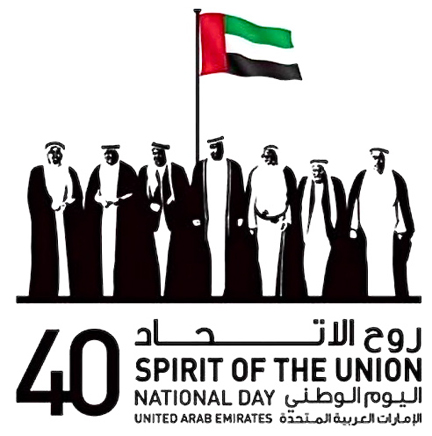
In the UAE one observes continuous negotiations over ideas of authenticity, tradition, identity, modernity, leadership, and local-national performances. For example, this year the UAE is celebrating its 40th anniversary in terms of authenticity. The official site of the UAE National Day, “Spirit of the Union”, includes such phrase as “Our Heritage, Our Pride,” “the Union shall forever remain,” and “It is the Spirit of the Union that celebrates our culture and heritage, and yet shapes our future.”

Tradition is negotiated because it enters into the construction of social identity that is based on the concept of authenticity (aṣāla). For the Emirates, aṣāla (or aṣīl) is a multiple meaning concept that can imply values of rootedness, descent, origin, nobility, honor, self-sufficiency and social status. Authenticity also refers to good manners of people, men and women, defining gender relations. Continue reading Authenticity, Identity and the Spirit of the UAE Union

Fire on Historic Gate of Zabid


ذكرت مصادر محلية بمديرية زبيد بمحافظة الحديدة مساء يوم أمس الجمعة بأن حريقا” هائلا” تسبب في تشويه المنظر التاريخي لسقف المبنى الأثري الواقع في بوابة سهام بالجهة الشمالية لمدينة زبيد القديمة بمحافظة الحديدة ØŒ بالإضافة إلى إتلاف كمية كبيرة من الأخشاب المزينة بالنقوش الإسلامية الأثرية جراء الحريق الذي لم تعرف أسبابه حتى اللحظة .

وأشارت مصادر أمنية بالمديرية بأن ألسنة اللهب اشتعلت في المبنى الأثري التاريخي لبوابة مدينة زبيد الأثرية المعروفة ببوابة سهام ما أدى إلى احتراق سقف البوابة بالكامل إلى جانب كمية كبيرة من الأخشاب القديمة المزينة بالزخارف والنقوش التي لا تقدر بثمن.

وأضافت المصادر بأن أبناء زبيد لم يتمكنوا من أخماد الحريق الذي تصاعد بشكل مخيف في المبنى الاثري ولا تزال التحقيقات جارية لمعرفة أسباب ودوافع الحريق.

هذا وكانت زبيد قد أدرجت في قائمة التراث الإنساني العالمي في العام 1993Ù… , واعطت منظمة اليونسكو التابعة للأمم المتحدة اليمن مهلة للبدء في تنفيذ برنامج إنقاذي شامل لحماية ما تبقى من المعالم الأثرية في المدينة التاريخية والتي باتت مهددة بالاندثار قبل أن تباشر “اليونسكو” في إجراءات شطبها من قائمة التراث الإنساني بصورة نهائية.

Turning a new page in an old Yemeni book


Over a week ago Yemen’s beleaguered President Ali Abdullah Salih finally stepped down after taking power in North Yemen 33 years ago during a military coup. Having promised three times to sign a deal worked out by the Gulf Cooperation Council, the fourth time was finally the charm. Saudi television carried the signing ceremony live from Riyadh, with the Saudi King Abdullah calling this a “turning of a new page” for its neighbor to the south.

The final details were negotiated by UN envoy Jamal Benomar. The transition is being directed by the current Vice-President Abd al-Rab Mansur al-Hadi. The first stage is forming a government of national reconciliation within two weeks. The new ministers will include half from the President’s ruling party and half from the opposition Joint Meeting Parties, with 20% of the positions reserved for women. In each case a minister of one party will have a deputy minister from another party. The cabinet has now been formed (click here to read the brief resumes of the cabinet officers in Arabic). Continue reading Turning a new page in an old Yemeni book