Votes that count… this time in Egypt


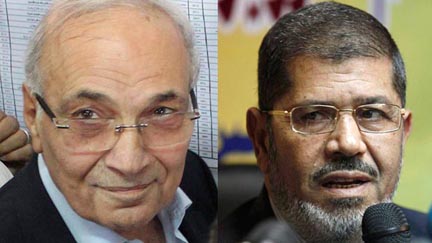
Al Jazeera just suggested, “I bet the world can hear the heartbeats of 80 million Egyptians.” With the heartbeat of Mubarak so close to closure, the irony in this statement does not escape me. Will it be Morsi, who virtually all the unofficial accounts indicate won the vote, or Shafiq, the epitome of the old guard that the revolution was supposedly ousting? I have no crystal ball and I have no doubt that votes can be manipulated (especially after having lived through the 1980 U.S. election in which our Supreme Court elected GWB (not the bridge) in full view). So as soon as I see the results across my screen, I will stop in my tracks and note the “winner.” I suspect that Morsi will be declared victor, as there have no doubt been negotiations behind the scenes to ensure that the military maintains its power. By recognizing Morsi, the military will be praised for not stealing the election, even though they have already stolen the power of the president. I also suspect that U.S. officials are pulling for Morsi as well, as that will lessen the chances for riots and will finally create a situation where the Brotherhood must put up or shut up.

Can the Brotherhood revitalize Egypt’s economy? This is the relevant question. An Islamic state in the image of Iran (which is not likely to happen unless the Fatimids regain power in Cairo) would not solve the problem of jobs. Egypt relies heavily on its greatest natural resource, apart from its people: an extraordinary history that the world adores and invites tourism. Tourists will only flock to Egypt if it is a safe environment with plenty of liquor flowing in the major hotels. Despite the number of veiled women in the streets, this is after all the country that Nasser built. Socialism may be passé, but the world that Umm Kulthum sang about lives on and this is not one that was around in the 7th century.

Much has been written about the Brotherhood, both pro and con. Apart from partisan Islamophobes, it is clear that Morsi is not Mullah Umar of the Taliban. If you were to poll Egyptians about the desire to see all statues of Ramses blown up, as happened to the Bamiyan Buddhas, I doubt you would find many who would applaud such an absurd idea. Islam is the dominant religion in Egypt, but the Pharaohs still reign in Egyptian hearts. To the extent that Egyptians view their cultural origins as Umm al-Dunya, they are not about to do in their mother. The Pyramids have survived for some five millennia, before Judaism, Christianity or Islam. They are more than likely to survive all three of these major monotheisms in their present form.

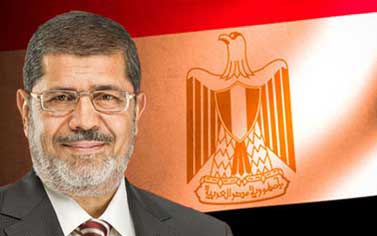
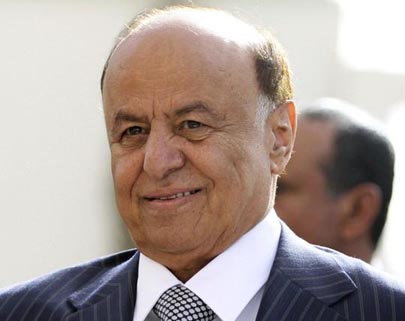
Time is twittering away, at least for me on a picture-perfect weather Sunday morning in New York. The hour of 3 pm in Cairo (9 am EST) has come and gone, but ma’a laysh. Inshallah the results will be out soon. Meanwhile, while browsing the Arabic edition of Al-Ahram, I see the picture (below) of Morsi.


Al-Ahram reports that Morsi will be making a speech after the announcement,no matter which way it goes. This picture is fascinating. Morsi does not look very Brotherhoodish here and stands securely in front of the national symbol of Egypt. He sure looks like a winner here and I will hedge my bets and say that I think he will be the announced winner. But we await the official results, or at least the right kind of twitter… I see via twitter that the announcement is about to be made. Listening to the live broadcast on Al Jazeera… Long winded and driving everyone crazy… and we hear that the election commission has been guided by Allah (now that’s a change)… Millions of people watching and this gets dragged out in a boring monotone and with self promotion that nobody cares about… this will make a great Adel Iman film… or maybe it is one …

And the winner is … Morsi!

Below the Arab Spring


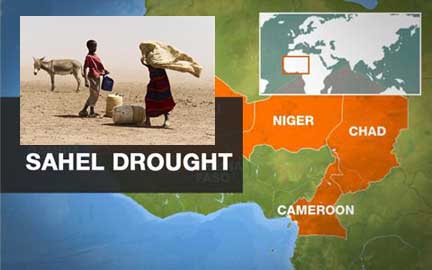
This summer the “Arab Spring” seems to be getting hot as hell, even beyond the “war-is-hell” sense. Masses of Egyptians are rallying in Tahrir Square to protest the military’s latest moves; Syria downs a Turkish fighter jet; there are increasing riots in Sudan not related to the secession of the south; and the list goes on. But below the North African countries where the jasmine-tinted winds of change first blew away dictators in Tunisia, Egypt and Libya (with the anti-dictatorial aroma catching on in Yemen and reaching as far east as Bahrain) there is a crisis which is not being covered. The hot topic should be the Sahel, the region that cuts across Africa in a dry zone of perpetual dearth and periodic death.

In a special report on Al Jazeera, it is reported that 15 million people are affected by a severe drought combined with ineffective government assistance programs and decreasing food supply. The report provides a country-by-country breakdown of the problem. Consider the situation in Mali, for example:

Prices of millet and sorghum grain have risen significantly after harvests in 2012 were 25 per cent lower than in 2011. Political instability, following a coup in March 2012 and the breakup of Northern Mali into the self-proclaimed state of Azawad, has further hampered the ability of aid agencies to assess needs and deliver the necessary aid to this landlocked country.

The UN Office for Coordination of Humanitarian Affairs (OCHA) reported that more than a million children face acute malnutrition, with as many as 146,000 people displaced into Niger, Burkina Faso and Mauritania, under deteriorating circumstances.
People affected: 3-4million.

Continue reading Below the Arab Spring

Iconclasm Again


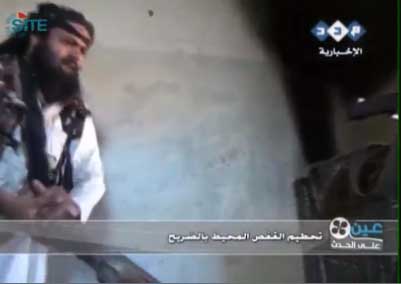
Once again AQAP/Ansar al-Shari’a shows its mean spirit, not only destroying the lives of the living but resorting to desecrating the dead. Before pulling out of Ja’ar in southern Yemen, several of the iconclasts destroyed the shrine of al Ja’dani in Al Tareyyah, among other shrines. Ibrahim Suleiman al Rubaish, a former detainee at Guantanamo Bay and now a senior AQAP leader, issued a video taking credit for the demolition work. Here is what he is reported to have said:

“Here are the mujahideen by the grace of Allah the Great and Almighty carrying out what Allah commanded them to do and reviving their jihad in the Cause of Allah…. So, just as they fought democracy and representative councils which make laws alongside Allah, they are destroying the domes which are being worshipped other than Allah, along with the graves and mausoleums, which people try to get close to other than Allah the Great and Almighty.”

“We fight the idolatry of the palaces and the graves – both are the same.”

The idolatry he does not see is his own intolerance, as though Allah has made him a successor of the prophet. Yemen’s south is dotted with shrines, reflecting the generations of Sufis and other devout scholars who have lived in Yemen over the centuries. Rubaish, who is in fact a Saudi and not Yemeni, places himself above all these Yemenis of the past. Like the other AQAP leaders, he is not likely to last long, but the destruction he touts adds salt to the wounds of the current turmoil in Yemen. Yemen has a rich Islamic history of monuments and saints tombs. Unlike the Taliban blasting in 2001 of the Buddha images at Bamiyan, also a senseless act, Rubaish cannot even claim to be destroying an image from another religion. He thinks he is fighting “the palaces and the graves,” but he is really fighting against time and doing more to harm Islam than promote it.

Where is the salam dunk?


The epitome of Arabic greetings is salam alaykum, peace be upon you, but it seems that the Middle East harbors more harb (war) than peace these days. It can be argued that this is hardly new for a region that has seen more warfare over time than any other. Perhaps the characterization of the region as the Holy Land has as much to do with the amount of human blood spilled on its soil as for the number of prophets preaching peace. But today’s news cycle is particularly sad because nowhere does there seem to be much hope for furthering the peace that most people are dying to achieve. The violence drones on and on.

As former President Mubarak lies in a coma, many Egyptians are once again flooding Tahrir Square to contest the military’s coup-like takeover of political power, although perhaps it should be styled a makeover, since they have held de facto power all along and will continue to do so no matter who is elected. To Egypt’s south far less individuals took to the streets in Khartoum, protesting the Sudanese government. Although Somalia has been pushed out of the major news cycle, the situation there remains as volatile as ever. Crossing over into Sinai, an Israeli construction worker was killed a few days ago and in the escalating tension Hamas has fired rockets at Israel and Israel has launched air raids in Gaza. Syrian violence continues but without the pretense of powerless monitors and the repaired helicopters that were being shipped from Russia. In Iraq pilgrims continue to be targets of bombs and pay for their devotion with their lives. In Yemen the military commander of the brigade that drove Ansar al-Sharia out of their southern base was killed earlier in the week by a suicide bomber. Even in Turkey there has been recent violence from Kurdish nationalists.

Long ago one of the prophets in this region said the immortal words: Blessed are the peacemakers. But how can they be blessed if they are absent? Why does the curse of the warmakers seem to outweigh efforts at peace? If Indeed we recently witnessed an “Arab Spring,” the reality is that spring is part of a seasonal cycle and not eternal. The “fall” of dictatorial regimes is still playing out, but the cold sectarian winds blowing out hopes for peace and the frosted rhetoric of intolerance do not bode well for the tender blossoming of sought freedoms. The region needs a Gandhi, not an Osama or an Assad. The region needs a salam dunk, not a harb to the right. But, if history is any gauge, there will still be no blessings to confer in tomorrow’s news cycle.

Yemen’s Beauty


Photograph by Steve McCurry

The photographer Steve McCurry has published some incredible pictures of Yemen on his blog. It is well worth checking out the pictures, but it is necessary to avoid the captions, which are neoconnish and ill conceived. When they say a picture is worth a thousand words, it can also be in reference to the kinds of words used. As long as the little boy is in the hands of his tribal family and values, he is most unlikely to be any kind of terrorist.


Photograph by Steve McCurry

And the winner is?


The polling is over in Egypt, but the dust has not yet settled. Given the simoon of recent political events, it is not likely to settle soon. Unofficial tallies place the Muslim Brotherhood backed candidate, Mohammed Morsi, with the lead. But the official results will not be released until June 21. Yet, it is possible to ask if there can be any real winner, since the ruling military council has ensured that it will continue to call the shots and ride oversight on any new government. The stage is now set for either a confrontation between supporters of the Brotherhood and the military or a marriage of convenience. I suspect the latter. The military is not about to lose power, not has it gambled away its prestige by engaging in ruthless slaughter as has happened in Syria.

Egypt, as most people know even if they only read their King James Bible, has a long history. Relics of the pharaohs dot the landscape; the pharaohs were gods on earth, the absolute dictators of their day, and they generally got along fine with the religious framers. When Akhenaten tried to go against the grains of the gods and call for the worship of one God, Aten, it was a short-lived moment. The rulers in the Islamic era were also not on the side of democracy. When the Mamluks, foreign mercenaries who wreaked havoc on the locals, took over in the 13th century, they played the religion game and adopted devout-sounding names, but their lust was for power and revenues and not to glorify Allah. It is tempting to view the continuing role of Egypt’s military as a Mamluk ploy, only from within. The military today is thoroughly Egyptian and has vast economic assets as well as the ability to channel politics. Continue reading And the winner is?

The 8th Voyage of Sindbad: #5


The Third Voyage of Sinbad, by Charles Robinson (1870 – 1937)

[Webshaykh’s Note: This last semester I taught an Honors Seminar on the Arabian Nights. The last assignment asked students to write the 8th voyage of Sindbad, drawing on what happened in earlier voyages. I will post several of these here for your enjoyment. This is the fifth one I am publishing by Becky Cuthbertson The fourth is by Mahmoud Abdelaziz. The third is by Peter Otis. The second is by Marissa Priest. For the first by Taryn Teurfs, click here.]

The Eighth Voyage of Sindbad the Sailor
by Becky Cuthbertson

For many years after his seventh journey, my father Sindbad the Sailor stayed at home, resuming his former lifestyle. He was joyous at my birth and that of my sister’s. We lead a life of indulgence and happiness; we had all the luck in the world. Many years later, my father sat at home with his wife, my mother, by the fire; they watched my sister and I play. He thought that it was a shame that my sister and I would never meet our grandfather; my parents fled my grandfather’s great city where men turn into birds and my father swore never to sail again. Smiling at my mother, he announced that we were journeying to see our grandfather; we were sailing next week.

My mother looked at him curiously, “Husband, have you not sworn to never sail the seas again?”

He smiled broadly, “Yes my dear but I shall press my luck one more time; I am not sailing for excitement or adventure but to visit family. Allah should not begrudge me that.”

So the following week we set off, sailing to find the city of my grandfather. A few days out to sea, a storm hit. The ship was rolling, rain down pouring, and wind gusts pitched the ship from side to side, almost capsizing us several times. All of us prayed to the Almighty God to protect us, save us, and deliver us from harm while the crew worked to stabilize the ship. Lightening began to strike off in the distance, but at every crash, a bolt loomed nearer and nearer. The captain bolted down below and brought up with him chalk. Murmuring to himself, he began to draw patterns all along the rails.

“Captain,” my father called, “why are you drawing with chalk all over the ship?” Continue reading The 8th Voyage of Sindbad: #5