
The winners of the 29th Aydın Doğan Cartoon Award have been announced. Details are available here and the cartoons can be seen here. Enjoy. Continue reading Cartoons a la turc
The winners of the 29th Aydın Doğan Cartoon Award have been announced. Details are available here and the cartoons can be seen here. Enjoy. Continue reading Cartoons a la turc
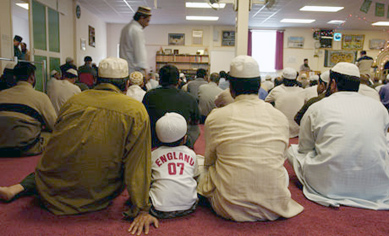
More than half (55%) of Britons would be concerned if a mosque was built in their area.’ Photograph: Martin Godwin for the Guardian
by Leon Moosavi, guardian.co.uk, Tuesday 3 July 2012
British Muslims often express a stronger sense of belonging than other citizens, so why are they still seen as outsiders?
In Britain today there is a mismatch between how non-Muslims often perceive Muslims and how Muslims typically perceive themselves. This disconnect is down to a tendency by non-Muslims to assume that Muslims struggle with their British identity and divided loyalties. These concerns were challenged a few days ago,in a report by the University of Essex that found Muslims actually identify with Britishness more than any other Britons.
This study is just one of several recent studies that have consistently found that Muslims in Britain express a stronger sense of belonging in Britain than their compatriots. Consider the following examples:
• 83% of Muslims are proud to be a British citizen, compared to 79% of the general public.
• 77% of Muslims strongly identify with Britain while only 50% of the wider population do.
• 86.4% of Muslims feel they belong in Britain, slightly more than the 85.9% of Christians.
• 82% of Muslims want to live in diverse and mixed neighbourhoods compared to 63% of non-Muslim Britons.
• 90% of Pakistanis feel a strong sense of belonging in Britain compared to 84% of white people.
Those who work closely with Muslim communities will attest to the integrated position of British Muslims and that despite frequent exoticisation, British Muslim lives are much the same as any other citizen’s. British Muslims also appreciate their ability to practise their religion in Britain without the type of subjugation that fellow Muslims are subjected to under despotic regimes in several Muslim-majority countries. Even though negative depictions may encourage people to imagine Muslims as similar to the 7/7 bombers who struck seven years ago this week, your average British Muslim is much more likely to be similar to a confident Amir Khan, a bubbly Konnie Huq or a hardworking James Caan. Continue reading Muslims are well-integrated in Britain – but no one seems to believe it
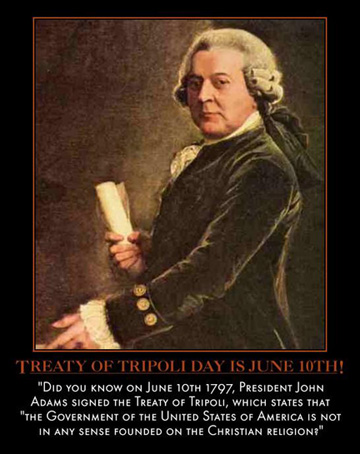
Yes, a treaty and not a Humean treatise, although Hume’s treatise on Religion no doubt had an influence on the creators of the text. The third treaty established by the young United States, recently liberated from British rule, with the nations of the “Barbary Coast” was with the Bey of Algiers in 1797. Like the earlier two treaties, the focus was on maritime trade in the Mediterranean and the problem of Barbary “pirates” as well as neutrality of the Barbary states when the U.S. was battling other “Christian” powers. Our Founding Fathers (for surely those members of Congress in 1797 were as close to being Founding Fathers as Sarah Palin’s contorted dubbing of John Quincy Adams, who had just turned 20 and had yet to enter politics) were obviously not working hard to free slaves (as these treaties will bear out), but they did stress a point that many rightwing pundits conveniently gloss over: the United States was not created as a “Christian nation.”
As you read the treaty below, in celebration of the 4th of July, note article 11 in particular. It turns out that the translation provided to Congress by Joseph Barlow, is not very accurate and the original Arabic version did not contain what we find in Article 11. But in fact, Congress never knew that and only saw the version printed here; this was accepted unanimously and then acknowledged as well by President John Adams at the time. So it was certainly not the contention of the Dey of Algiers that the U.S. was not a Christian nation, but an idea that resonated well with the young Congress.
Treaty of Peace and Friendship, signed at Tripoli November 4, 1796 (3 Ramada I, A. H. 1211), and at Algiers January 3, 1797 (4 Rajab, A. H. 1211). Original in Arabic. Submitted to the Senate May 29, 1797. (Message of May 26, 1797.) Resolution of advice and consent June 7, 1797. Ratified by the United States June 10, 1797. As to the ratification generally, see the notes. Proclaimed Jane 10, 1797.
[Translation]
Treaty of Peace and Friendship between the United States of America and the Bey and Subjects of Tripoli of Barbary.ARTICLE 1.
There is a firm and perpetual Peace and friendship between the United States of America and the Bey and subjects of Tripoli of Barbary, made by the free consent of both parties, and guaranteed by the most potent Dey & regency of Algiers.ARTICLE 2.
If any goods belonging to any nation with which either of the parties is at war shall be loaded on board of vessels belonging to the other party they shall pass free, and no attempt shall be made to take or detain them.ARTICLE 3.
If any citizens, subjects or effects belonging to either party shall be found on board a prize vessel taken from an enemy by the other party, such citizens or subjects shall be set at liberty, and the effects restored to the owners. Continue reading Tabsir Redux: An American Treaty on Religion
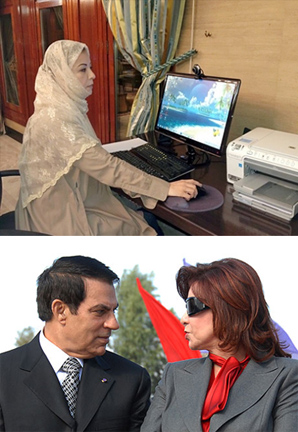
top, Leila Trabelsi in Saudi Arabia; bottom, Leila Trabelsi with Ben Ali in Tunis, pre-Jasmine Revolution
The West has long had a fascination with Muslim women, from the Oriental harem beauties of Ottoman seraglios to immigrants who wear niqab in Europe. As some critics have noted, perhaps those who laud or victimize the role of women in Islam (as though there could be “the” role), should look at the patriarchy in their own societies. The ability to go out in public with less of the body covered may be a sign of freedom in mobility, but it is not automatically symbolic of equality in economic or political terms. Ethnographic study for almost a century has illustrated the kinds of social contexts in which women and men are closer to being egalitarian, but there is no one factor (including religion) that is causal. The books and commentaries on women in Islam continue to proliferate and will into the foreseeable future. But what about the situation today within Islamic countries?
By today, I mean the totally unscientific sense of an arbitrary internet experience. In checking out several websites this morning to see what I might comment upon, several items caught my attention. First, a Yemeni website shows a photograph of Leila Trabelsi, the wife of the exiled Tunisian president Ben Ali; both are now living in Saudi Arabia (top picture, above). The picture is pregnant with interpretive possibilities. The former elegant first lady is now regaled in hijab while mouse-clicking her way through cyberspace. In that vast digital archive, she can easily come across previous pictures of herself, like the one shown below her new Saudi makeover look. So is one of these pictures of Leila more Islamic than the other? Does the veil indicate intent; does living in Saudi Arabia signify a closer relationship to Allah? Perhaps if we knew what websites she was surfing, we would have more clues. Continue reading What (who) drives Muslim women
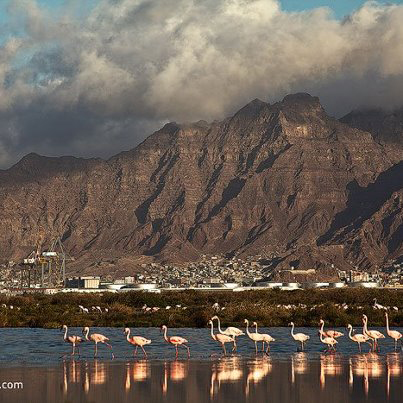
Aden with flamingos; photo by Ameen AlGhabri
There is a Facebook site with great pictures of Yemen. This is So you think you’ve seen Yemen. It is well worth surfing and perusing.
[Note: The commentary below was published as the presidential politics of 2008 were heading into the rhetorical throes of summer. Religion was all over the map, with Obama’s Christianity being questioned and his supposed “Islamic” past salivated by the right. This time around religion seems to be taking a back seat to the economy, perhaps in large part because Evangelicals do not want to remind themselves they are about to vote for a Mormon. But the sentiments discussed below are still quite alive…]
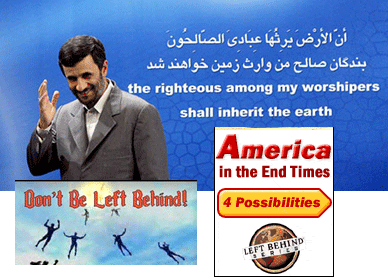
For some partisans, no matter who is elected President to succeed George W. Bush, it will seem like the end of the world. We are in the apocalypse silly season once again. Take Tim LeHaye, the doctrinal inspiration of the WASP-friendly Left Behind book series (Jerry B. Jenkins provides the verbal inspiration in sci-fi style); he has been preaching the politics of biblical apocalypse for years. Indeed, since the apostle John allegedly first had his vision on the island of Patmos, the world has been teetering in the end times. This world is always going to hell; Jesus must be coming soon. Bible-belting believers and bible-belching evangelists constantly look to the heavens with rapturous delight for the mother of all shock-and-awe shows to begin. Up go the faithful in the twinkling of an eye and then it is open tribulation season on the Jews that will make the 20th century Nazi holocaust look like a sabbath picnic. Fortunately, most of the world’s Christians look at such a naive-ity scene with alarm. “Even so,” it might be said, “do not come Lord Jesus.”
Reverends Tim LeHaye, Pat Robertson and John Hagee are not the only mega-mouths who know deep down in their saved souls that they will not be left behind. Ironically, they share theologically-maddened space with Mahmoud Ahmadinejad, the shi’a-evangelical President of Iran. As noted in a New York Times article today by Nazila Fathi, the Iranian President’s “high father” is Imam Mahdi, the hidden 12th “twelver” Imam who occulted well over a millennium ago, but whose reappearance has been looked for year after year in popular imagination. Ahmadinejad, who loves to wear his religion on his sleeves, says that Imam Mahdi guides his day-to-day decisions as a president. In gratitude, Ahmadinejad has sponsored an institute to prepare Iran for the Imam’s immanent return. This would be like Bush asking his faith-based supporters to create a special office in Homeland Security on Eternal Security Risks to those Left Behind. Continue reading Tabsir Redux: Mahdi Madness and the 2008 Election
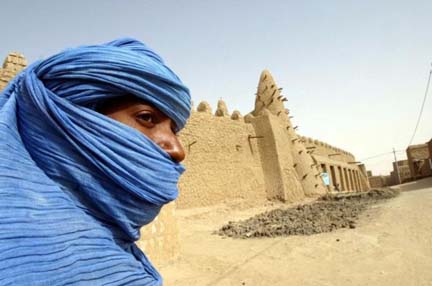
A Tuareg nomad stands near a 13th century mosque in Timbuktu in this file photo [Reuters]
There is an old saw in English: cutting your nose to spite your face. The sorry lot of vigilante Ansar extremists have already desecrated several Muslim saints’ tombs in southern Yemen, but now come reports of lawless fanatics destroying saint shrines in the famed city of Timbuktu in Mali. Al Jazeera is reporting that many, if not all, of the shrines there on the World Heritage List have been damaged or destroyed. These are ritual attractions considered sacred by local Muslims for several centuries, not replicas of the Buddha or foreign idols. So who exactly do these fanatics hate? If you think they are doing this because they hate America and its freedoms, think again.
Iconoclasm has a long history that is hardly unique to the Middle East. The modus vivendi is the idea that if you don’t like something, just get rid of it no matter what other people think. Tolerance and dialogue might as well be Satanic in this twisted worldview. It is important to observe that in both the Yemeni case and now in Timbuktu the destruction takes place because of an almost total breakdown of security. No government, responsible or not to world opinion, is behind this action to such a sacred Islamic site. It is very much a replay of the Wahhabi wave that swept across Arabia with the sword of the Sa’ud clan. The Wahhabis, considered fanatics at the time by most other Muslims, wanted to turn back the clock to a narrow understanding of what they thought life was like in the time of the Prophet. Were ‘Abd al-Wahhab, who died in 1792 (just six years before Napoleon invaded Egypt and proclaimed himself a true Muslim come to rescue Egypt from its corrupt rulers) to come back from the dead and see the palaces, shopping malls and gentrification of the ka‘ba as these have evolved with the vast oil wealth of the Saudi elite, he would no doubt follow Balaam and curse the day he ever met Ibn Sa’ud.
Timbuktu, as a major African center of Islamic education, is also a rich treasury of Islamic manuscripts. Will these fanatics torch the handwritten copies of the Qu’ran, traditions and other religious books in the libraries? ‘Abd al-Wahhab is not about to be resurrected, but there is a need for a modern day Muslim Balaam to get off his ass and curse such sacrilege.
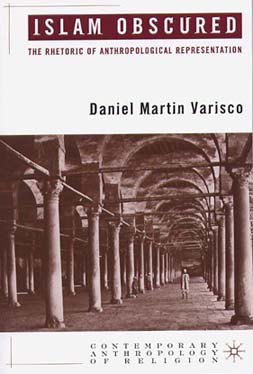
Review of D. M. Varisco, Islam obscured. The rhetoric of anthropological representation, Palgrave MacMillan, New York 2005.
by Estella Carpi, letturearabe di Jolanda Guardi, June 29, 2012
Anche a distanza di ben sei anni, vale la pena recensire il testo dell’antropologo Americano Daniel Varisco, considerate l’urgenza attuale di de-cristallizzare i discorsi sull’Islam, particolarmente nel contesto accademico italiano.
Attraverso una rassegna concettuale di eminenti studiosi tra i quali Ernest Gellner e Clifford Geertz, e la de-mitizzazione della sociologa marocchina Fatima Mernissi che ancora pecca di una visione monolitica dell’Islam, Varisco riesce totalmente, a mio avviso, nell’intento di decostruire il solo Islam univoco, omogeneo, aspettatamente coerente e destoricizzato che ci viene rifilato.
L’Islam che definirei “monolitico†tuttora pervade i discorsi dei più esperti: Varisco, attraverso il suo background squisitamente antropologico, invoca invece all’osservazione degli individui che si auto-definiscono “musulmaniâ€, piuttosto che alla catalogazione di ciò che l’Islam teologicamente prevede. L’Islam, come qualsiasi altra religione intesa sia come istituzione che pratica culturale, può soltanto essere rappresentato.
Per demolire le tuttora ancor troppo diffuse stagnazioni dogmatiche e una comprensione campanilistica dell’Islam, è quindi necessario, sostiene Varisco, tener conto del fatto che additiamo costantemente ai misfatti compiuti dai musulmani con maggior indignazione, in riflesso appunto alla nostra lettura dell’Islam, inteso come insieme di valori e pratiche rigorosamente coerenti, rispetto a qualsiasi altra religione.
I musulmani sono invece “conservatori o comunisti, maschi o femmine, giovani e vecchi, ricchi e poveri, di buon umore o mal intenzionatiâ€, che poco hanno a che fare con una logica islamica del “prendere o lasciareâ€, quale invece ampiamente diffusa nella letteratura al riguardo. Continue reading Islam Obscured reviewed