Saudi ARAMCO World published a nice article on films about the Middle East by Suzanne Simons in its May/June 2010 issue, which can be read online.

Saudi ARAMCO World published a nice article on films about the Middle East by Suzanne Simons in its May/June 2010 issue, which can be read online.
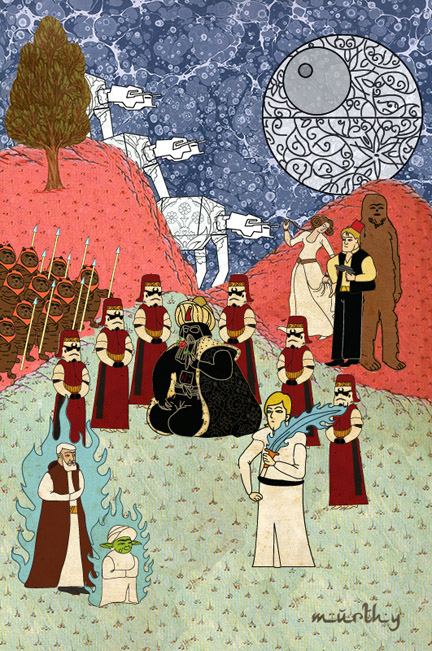
The Turkish artist Murat Palta has posted a series of drawings online about famous movies, but with an Ottoman miniaturist flair. Check out his fabulous website. Here are my favorites…

Star Wars

Terminator 2

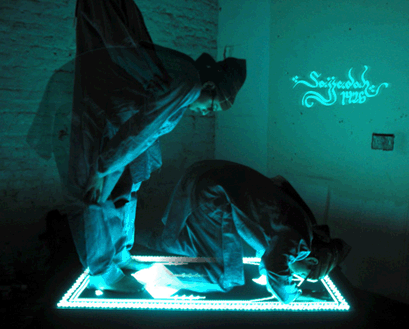
Muslims are obligated to try and find the direction (qibla) of Mecca for prayer. Although this may be a heavy duty at times, new technology will lighten the effort. Specifically, how about an idea that almost seem to come out of the Arabian Nights. Imagine a prayer rug that would not fly you to Mecca but would light up when it is properly oriented to Mecca, no matter where you are on earth. This is the aim of EL Sajjadah. Here is how it is described on the website:
EL Sajjadah is an illuminating prayer mat that lights up when facing Mecca.
‘EL’ stands for ‘Electro Luminescent’ and ‘Sajjadah’ means ‘Prayer Mat’. EL Sajjadah is thin and flexible. You can roll it and carry it around in its special case.
EL Sajjadah is not only a functional / practical product but also a unique art piece that you can hang on the wall as a night light.
My only suggestion is that you not try to prayer while it is hanging on the wall …

Dietary rules — I suspect these have always been around as our earliest ancestors learned what foods made them feel good, what foods made them sick and what foods made them well. The ancient world and the Islamic era have bequeathed a wealth of herbal remedies and food recipes that continue to have relevance. Then there are the taboos, the kosher and halal rules that go beyond any scientific rationale to diet by revelatory fiat. The kosher laws in Leviticus, as anthropologist Mary Douglas showed many years ago, are not really about health, but symbolic for the community that applies them. Tainted beef will get you sick just as quickly as tainted pork. But as long as there is no harm, then eating kosher or halal is not a problem. It may be an inconvenience, but it is not going to harm your health.
It is one thing to eat halal and another to turn the idea of halal food into something that is more about consuming than eating as a religious preference. Devout Christians complain that Christ has been x’d out of Christmas and they are right: Santa Claus, Christmas trees and oligatory gifts define Christmas as it is currently consumed in the United States. I suspect there is a danger that the same thing can happen to halal food and to the fasting month of Ramadan. Let’s take Ramadan first: the original intent was for religious reflection at a time when both Jews and Christians also observed fasting as a reflective rite. Going without food and water, no matter what the exact time dimension, is a powerful symbol pointing to those less fortunate who may have no food or water or barely enough to survive. It can also cleanse your body. But if you simply abstain during the day, then gorge after sunset and spend half the night celebrating, what exactly is the point of fasting? Continue reading Consuming halal or letting halal consume you

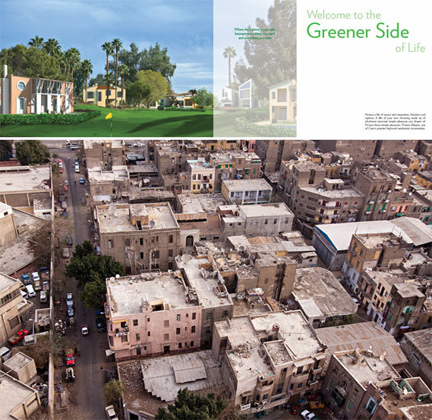
Top: Promotional image for Allegria, a gated community in Sheikh Zayed City, a suburb of Cairo, Egypt. [Image by SODIC] Bottom: Neighborhood in Cairo. [Photo by Brandon Atkinson]
by Karen Piper, The Design Observer Group, July 12, 2012
“Welcome to the Greener Side of Life” beckoned the billboard on Cairo’s Ring Road, which showed a man in a jaunty hat teeing off on a verdant golf course flowing into the horizon. I was stuck in traffic, breathing that mix of Saharan dust and pollution also known as “air,†so I could see the appeal. Somewhere outside the city, in a gated community called Allegria — Italian for “cheerfulness†— a greener life awaited. “Over 80% of Allegria’s land is dedicated to green and public spaces,” boasts the developer’s brochure, “meaning you’ll never lose the peace and tranquility which goes hand in hand with outdoor living.â€
It was a scorching hot summer, several months before the Egyptian revolution. Beneath the expressway sprawled the informal settlements where an estimated 60 percent of metropolitan Cairo’s 18 million residents live. [1] Some were using billboard poles to keep the brick structures from collapsing. Many did not have running water, and those who did found the taps drying up as water was diverted to the lavishly landscaped suburban developments with names like Allegria, Dreamland, Beverly Hills, Swan Lake, Utopia — a diversion that was straining the capacity of state-run water distribution networks and waste treatment plants. [2] Continue reading Revolution of the Thirsty

Bushra Al-Maqtari
by Sama’a Al-Hamdani, Yemen-iati, August 3
“The Arab Awakening protest movement encouraged religious tolerance among its participants, while in some instances, the resulting political crisis provided a context that stoked existing religious tensions” – Yemen’s Religious Freedom Report
Is it possible that the Arab Awakening opened doors for a new war on women? is there a new form of sexism that is declared in the name of religion?
Women all over the Middle East have been demanding political equality and while we await their democratic freedoms to expand, newspapers are reporting rapes from Libya, sexual assaults in Egypt and deaths in Syria. Sexism is not the least bit a phenomenon in the Middle East; however, the utilization of religion as a tool of war against women is becoming a trend. Religion, which was once implemented with care and knowledge, is now used in most political conflicts.
In Yemen, the political war between the Houthis and the government has become about religious ideology. Underneath the religious facade, it is mostly about power to rule. This war even invited unwanted political involvement from Iran and Saudi, threatening the security of the nation with a proxy war; all in the name of religious authenticity. This July, the United States Department of State released the International Religious Freedom Report for Yemen and declared that religious freedom in Yemen is not ideal yet not too problematic. The report focused on religious pluralism and sectarian violence, but it failed to recognize Yemeni women as victims of religious partiality.
Should Yemeni women be fearful? Perhaps, if they are to choose to have a voice and challenge Yemeni culture. Case in point, Bushra Al-Maqtari, a 31 year-old divorcee from Taizz. Bushra, a journalist, wrote an article about the revolution. In this article, she expressed her thoughts about the bloody battle of Khidar (Dec. 2011) between the demonstrators and pro-Saleh forces. She shared her feelings by saying that she questioned whether God was witnessing everything. While some may agree and many may disagree, religious extremists in the country declared Bushra an infidel who questioned the existence of God. In response, Bushra clarified that she is believing Muslim and that she did not question the existence of God but rather his presence in all situations. Regardless, what Bushra wrote may be a reason for many people to dislike her, but what happened after that made this about all women. Continue reading A New War on Women?

“We want imams to discuss our problems, discuss government decrees and oppose oppression.â€
Friday sermons not relevant
by Mohammed Al-Samei, Yemen Times, August 2, 2012
Yemenis have been critical of the performance of imams because of the topics they address in Friday sermons.
They say that the imams do not address the relevant issues from which residents suffer. Moreover, they don’t discuss new topics in their sermons.
Fathi Abu Al-Nassr, a Yemeni journalist, said that many imams don’t touch on the problems of society or new developments among residents. He added that the core of the sermon ought to be the concerns of Yemenis.
Abu Al-Nassr described imams as “parrots who address expired issues.†He pointed out that they are one of the most important reasons behind the ignorance of society.
Although some imams attempt to address different issues, they are discouraged by society members who refuse to discuss such topics.
Khaled Al-Hada’i, an imam who appears in various mosques in Sana’a, told the Yemen Times that many imams don’t shed light on local problems; instead they address religious issues.
He explained that bringing discussion of current affairs to the sermons is a slow process due to the complicated situation in Yemen and lack of awareness among residents. Continue reading Thank God it’s Friday? Not in Yemen these days

Yemeni children in the Tihama coastal zone; photography by Daniel Martin varisco
The struggle for security and against terrorism in Yemen: in whose interests?
by Helen Lackner, Open Democracy, 20 July 2012
When Yemen features in the news, it is usually due to the supposed activities in Yemen or outside of Al Qaeda in the Arabian Peninsula [AQAP], the group said to be a follower of Osama Bin Laden’s similarly named organisation. The most prominent such events have been the 2010 ‘underpants bomber’ who was trained in Yemen, the 2011 ‘cartridge’ bombs which were sent from Yemen and – most important for Yemenis – the occupation of a Southern Governorate [Abyan] by AQAP and its associate Ansar al Shari’a between May 2011 and June 2012, when they were ousted.
AQAP and Ansar al Shari’a[1]
While the first two of these events are of limited interest to the average Yemeni, the presence of AQAP is one of the many security issues which Yemenis have to face on a daily basis. Although AQAP had been present and active in many remote parts of the country [Shabwa, Mareb and Abyan Governorates] since the beginning of the century, this presence only became a direct serious threat to the population in the last year when they occupied all the major towns of Abyan as well as some in Shabwa. Although earlier their presence had made it difficult for development and aid agencies to operate, these occupations led to mass displacement of over 200,000 people who have taken refuge either with relatives in neighbouring governorates [eg al Baidha] or moved to Aden where they settled in schools and other facilities and became Internally Displaced Persons [IDPs] recognised as such by UNHCR and other humanitarian agencies. These groups were successfully ousted from their positions between May and mid-June 2012 after holding the area for a year.
Continue reading In whose interests?