
Cavorting with Cazotte #2

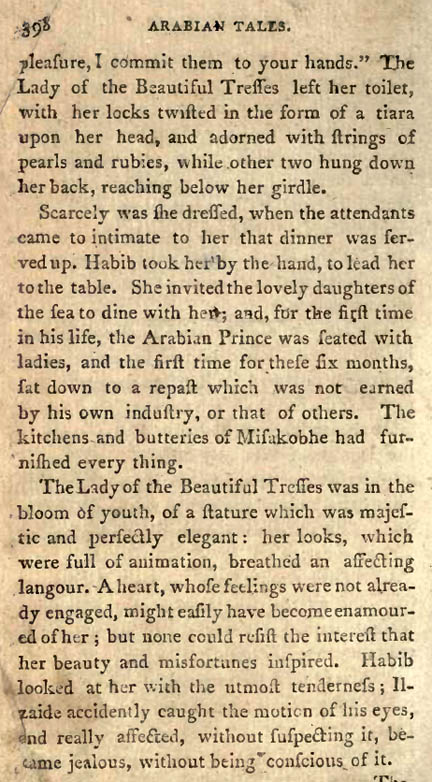
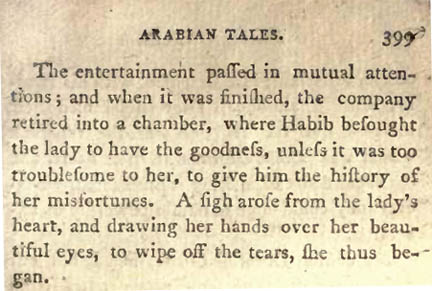
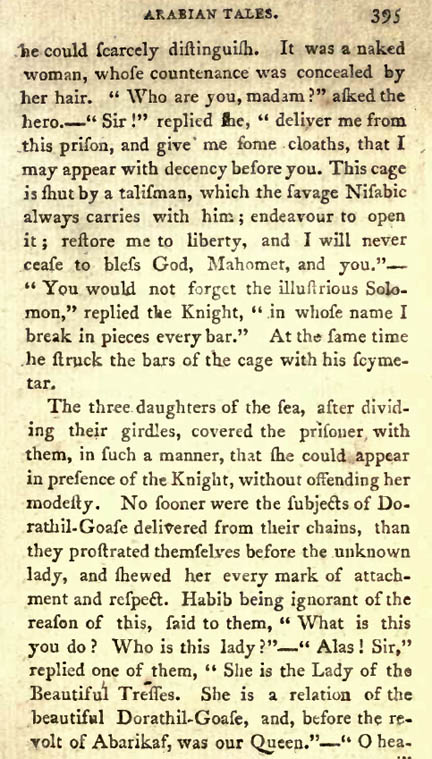
Here is the continuation of a previous post the story of Habib the knight from Jacques Cazotte’s Mille et une fadaises, Contes a dormir debout (The Thousand and One Follies, Tales to Sleep Upright), which was later translated into English. The English edition published in the year of his death is available in that magical resource for book lovers: archive.org. There are several volumes, but the excerpt here is from volume 3. Enjoy.

Continue reading Cavorting with Cazotte #2

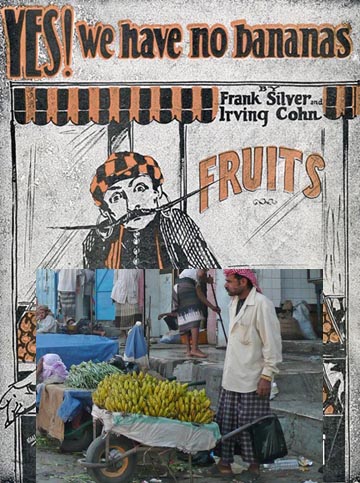
Yes, Yemen has bananas


One of the great novelty Vaudeville songs of the early 20th century was “Yes, We Have No Bananas,” a number one hit for the singer Eddie Cantor in 1923. I have the Edison 1923 recording sung by Billy Jones, Arthur Hall and Irving Kaufman, which is also on Youtube. The song made fun of Italian accents, like the one my Sicilian Grandfather no doubt had as a boy. But it seems that in this case, almost a century later, unlike the Little Italy vendor in the song, Yemen does have bananas and very good ones at that.

Here is the report from Yemen’s Saba News Agency:

Yemen comes first among 45 countries exporting bananas

SANA’A, July 24 (Saba)- Yemen has came the first among 45 countries exporting bananas at the Regional Roundtable for exporters of banana products, held in Geneva during the period (July 20-21).

Yemen has sent varieties of bananas from some farms in the Yemeni provinces famous for the production of bananas, through the U.S. Agency for International Development (USAID), which is the mediator for this product in the Regional Roundtable for exporters of bananas, Official of the agricultural export activities at the Small and Micro Enterprises supported by the Social Fund for Development, engineer Samar Abdullah, told Saba.

Samar said that this win motivates the banana growers in Yemen to compete in the improvement of banana production and its cultivation as it has health benefits, and enables Yemen to enter into the global markets of bananas exporters.

Karim Ben Khelifa at Harvard


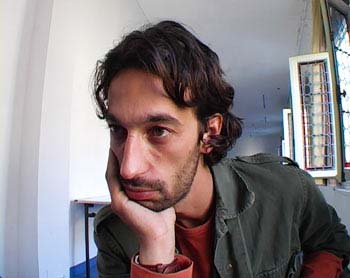
Harvard University has announced its 2013 International Nieman Fellows. Among them is the superb photographer Karim Ben Khelifa, whose work can be seen here.

Karim Ben Khelifa is a photojournalist and the co-founder and CEO of Emphas.is, a website designed to promote crowdfunded visual journalism. For the past 12 years, he has covered conflicts in the Middle East and Africa and other stories around the world. His work has appeared in The New York Times, The Washington Post, The Wall Street Journal, Vanity Fair, Time, Le Monde and Stern. He has exhibited his photos on four continents and has won numerous photography awards including the 2004 Fujifilm Young Reporter Award. He also was selected for the 2000 World Press Photo Joop Swart Masterclass in the Netherlands. At Harvard, Ben Khelifa will conduct research on journalist-audience engagement, analyze the behavioral economics linked to crowdfunding and study new business models promoting the diversification of visual storytelling. He is the 2013 Carroll Binder Nieman Fellow. The Binder Fund honors 1916 Harvard graduate Carroll Binder, who expanded the Chicago Daily News Foreign Service, and his son, Carroll “Ted” Binder, a 1943 Harvard graduate.

Cinematic Contending with the Companions


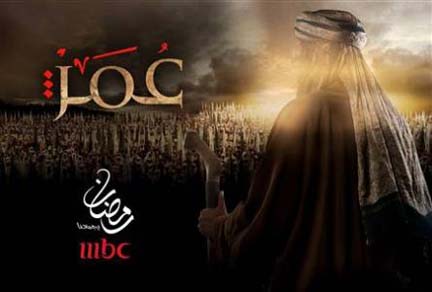
As Ramadan for the Hijri year 1433 draws to a close, the violence between Muslims on the ground is paralleled by the violence about Muslims on the screen. The daily slaughter of Syrians, continued terrorist bombings throughout the region and the uncivil rebellion in Mali dominate the news, as such atrocities should. But cinema does not lag far behind in showing blood spurting out of bodies and broken bones, all in the name of politicized religion. I am not talking about The Expendables, where aging Hollywood superheroes unite to make themselves even more money, but a Ramadan television serial that has captured the attention of Muslims across the Middle East: a retelling of the story of the second caliph ‘Umar ibn al-Khattab. Click here for the trailer and here to watch Episode #2.

Premiering 36 years after Moustafa Akkad’s acclaimed The Message recreated the life of Muhammad without actually showing Muhammad, the serial ‘Umar in 30 episodes is a millions-of-megabucks production worthy of Cecil B. DeMille. The earlier film had the blessing of the major Islamic organizations, since it avoided showing an image of the prophet Muhammad. It was a bit eerie to see Anthony Quinn as Hamza constantly speaking to the camera as though the camera-not-very-obscura was in fact the Prophet. But this new film has been railed against by the Grand Mufti of Saudi Arabia and the sheikhs of al-Azhar because it dares to show an actor playing a companion of the Prophet, notably the caliph ‘Umar ibn al-Khattab. If it had been Saladin, that would be okay it seems. Continue reading Cinematic Contending with the Companions

Cavorting with Cazotte #1

The name Jacques Cazotte may not ring many bells these days. After all, he died in 1792, a victim of the success of the French Revolution, but probably not because he was into the Illuminati… But fans of Oriental tales imitating the famous Arabian Nights may recognize his name. In 1742 he published Mille et une fadaises, Contes a dormir debout (The Thousand and One Follies, Tales to Sleep Upright), which was later translated into English. The English edition published in the year of his death is available in that magical resource for book lovers: archive.org. There are several volumes, but I have chosen an excerpt about Habib the knight from volume 3. Enjoy.

to be continued (just like the 1001 Nights…)

Did Islamophobia Fuel the Oak Creek Massacre?


Sikhs hold up placards with photos of six mass shooting victims after a candlelight vigil in Oak Creek, Wisconsin, August 7, 2012. The killings of six worshippers at a Sikh temple in Wisconsin has thrust attention on white power music, a thrashing, punk-metal genre that sees the white race under siege.
Photograph by: JOHN GRESS , REUTERS

by Moustafa Bayoumi, The Nation, August 10, 2012

The tragedy of the shooting in Oak Creek, Wisconsin, is enormous. Six innocent people were gunned down in a Sikh temple by a white supremacist—but they weren’t innocent because they were Sikh, they were innocent because, well, they were innocent! Had Wade Michael Page walked into a mosque and begun shooting Muslims, the victims of his rampage would have been no more deserving of death.

It’s true that we don’t yet know Page’s precise motivations, but in all likelihood it wasn’t Sikhophobia, a term barely known in the United States. It was Islamophobia [1]. That’s why to say that Page made a “mistake” in targeting Sikhs, as many have reported [2], or that Sikhs are “unfairly” targeted as Muslims, as CNN stated [3], is to imply that it would be “correct” to attack Muslims. Well, it’s not, and even if this is an error embedded in the routine carelessness of cable news, we need to be attentive to the implications.

Over the last few days, there has been a lot of media coverage about the Sikh religion and its origins and practices. Knowledge is always welcome over ignorance, but what we really need to educate ourselves about is the way racism operates in this country and its deadly character. The facts are not consoling. According [4] to the Southern Poverty Law Center (SPLC), the extreme right wing grew “explosively” in 2011 and for the third year in a row. The SPLC now tracks 1,018 hate groups, up from 602 in 2000, the year that Page is reported to have appeared on the Neo-Nazi scene. The number of hate groups, in other words, has almost doubled in the last twelve years, and that growth has accelerated since the election of Obama. The targets have also expanded. White supremacists have always been obsessed with Jews, blacks and the LGBT community as their objects of hate. And ten years ago, Jews and blacks were Page’s villains, according to Pete Simi, who interviewed him in 2001. But things have changed over this past decade. What continues to be underappreciated is how the hatred of Muslims [5] has become a major motivating and mobilizing force in this putrid scene. Continue reading Did Islamophobia Fuel the Oak Creek Massacre?

The best Kurd?


In the social media revolution Twitter has taken a breathtaking role. The Arab Spring may still have sprung without cellphones, but the rapid ability to communicate has been an enormous aid to coordinating protests. But it seems that much of Twitter is for twits, to whit media narcissists who think the public lives to follow their quotidian banality and the full range of bigots who use Twitter to spew out hate. Take the Turkish phrase “En İyi Kürt Ölü Kürt” (“The best Kurd is a dead Kurd.”), which trended on August 9, as reported on Al Jazeera. The trend came after news coverage of an ambush of a Turkish military bus by suspected Kurdish separatists. But the anti-Kurdish sentiments may also have been heightened by Turkey’s decision in June to allow the teaching of Kurdish in schools.

Part of the trend was the response by Kurds who were angry at the racist post. Continue reading The best Kurd?