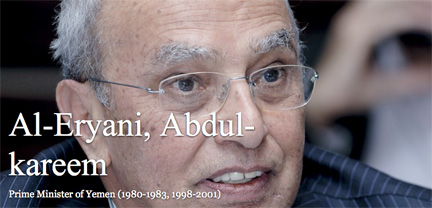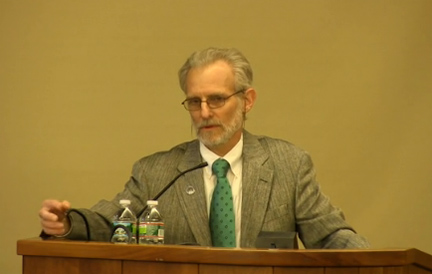
A conversation with Dr. AbdulKarim Al-Eryani


[Editor’s note: This superb interview with a major figure in Yemeni politics has recently been posted by Samaa al-Hamdani, who blogs at Yemeniaty.]

Dr. Abdulkarim Al-Eryani has been involved in Yemeni politics for more than 40 years, holding various senior positions within the government, first under the Yemen Arab Republic (YAR) then the Republic of Yemen. Moreover, he is an influential member of the General People’s Congress (GPC) political party. Currently, Dr. Al-Eryani presides over the National Dialogue Committee (NDC). For his full biography, click here.

In New York City, Yemeniaty sat down with him to discuss some Yemeni politics. Click here to watch the interview.

Who was (fill in the prophet)?


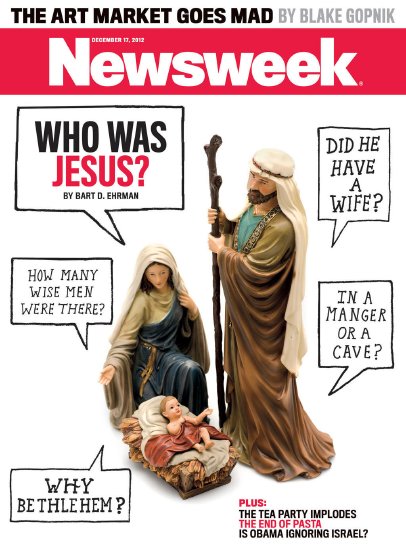
The current cover of about-to-be-print-defunct Newsweek asks a question that could be seen as an old (and oh so tired) joke:

Who’s there?
Jesus.
Jesus who?
Jesus who? After 2000 years you still don’t know who Jesus was?

Perhaps Newsweek is reduced to the digital because it took so long to follow up on Time Magazine‘s 1966 cover that asked “Is God Dead?” Both are questions that beg further questions. For Time, which God? For Newsweek, which Jesus? For that matter, it could also be asked which Moses, which Muhammad, which Buddha, which Krishna, which Ishtar, which Baal, which Zeus, which Napoleon, which Joseph Smith and which Elvis? In all but the last three choices above, no historian can ever answer the question, and even Napoleon is philosophically iffy.

Since this is the Christmas season that is consuming our time, let’s start with Jesus. Do you want the Jesus who is mortal or the one born of a virgin and equal to eternal deity? Be careful how you choose for you could end up (and it would be your end after the middle of the 4th century) being an Arian heretic rather than accepting the alternative of homoousious (a word worth looking up if only because it has a double o in the middle). Do you want the babe away in a manger while angels sang to shepherds and wise guys followed a star to Bethlehem? Then even the current Pope has his doubts. Do you want Jesus of the Gospels, who thought it was easier for a camel to go through the eye of a needle than for a rich man to get into heaven and preferred the wisdom of children to the theologians of his day? Then think twice about applying for funding from the for-profit Andrew Carnegie’s trying-philanthropically-to-be-like-the-prophet Carnegie Foundation.

Do you want the Jesus that died for your sins so you could go on a crusade to the Holy Land and kill the infidels who had taken over Jerusalem? Continue reading Who was (fill in the prophet)?

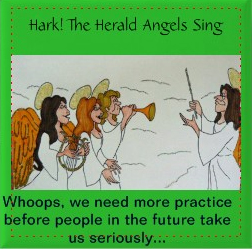
Hark! The Herald Angels Didn’t Sing


by Tanya Lurhmann,The New York Times, December 14, 2012

We are in Advent, but over the transom has come the sobering news that Image Books has just published a book written by the pope, “Jesus of Nazareth: The Infancy Narratives,” in which he observes that there was neither an ox nor a donkey in the stable where Jesus was born. Nor did a host of angels sing. They spoke.

Is “Hark! the Herald Angels Sing” doomed?

In fact, the news is not so grim. This is not an encyclical; the pope is writing as Joseph Ratzinger. It turns out that he tolerates, even encourages, the presence of lowing animals in the manger. He writes: “In the Gospel there is no reference to animals at this point. But prayerful reflection, reading Old and New Testaments in the light of one another, filled this lacuna at a very early state by pointing to Isaiah 1:3: ‘The ox knows its owner, and the ass its master’s crib, but Israel does not know.’ ” A few pages later, the pope explains that “Christianity has always understood that the speech of angels is actually song.” Continue reading Hark! The Herald Angels Didn’t Sing

How Ecumenical Was Early Islam?


“How Ecumenical Was Early Islam?” is the title of a lecture by Fred M. Donner, Professor of Near Eastern History, University of Chicago, in celebration of Roy P. Mottahedeh, Gurney Professor of History, Harvard University, at Harvard’s conference entitlted”Law, Loyalty and Leadership: Roy P. Mottahedeh’s Contribution to Middle Eastern and Islamic Studies at Harvard.” The lecture is available for viewing online at http://cmes.hmdc.harvard.edu/node/3252

Poison Gas: Does it cut mustard?


British planes bombed Iraqi Kurds after World War I; Churchill once said “I do not understand this sqeamishness about the use of gas. I am strongly in favour of using poison gas against uncivilised tribes.”

[Editor’s Note: The issue of Syria’s chemical weapons overshadows the continual loss of life in the current uncivil civil war. Below is a journalistic take by Robert Fisk, who debunks the notion that Syria has stockpiles of gas ready to unleash. A more sophisticated view of the problem is presented by Syrian writer Rime Allaf in a New York Times commentary on December 6; she notes that drawing a “red line” over the blood already spilled only encourages Assad to do everything but use gas. The thought of chemical weapons added to the already toxic mix is, of course, deplorable, but meanwhile the more conventual slaughter goes on and on…]

Bashar al-Assad, Syria, and the truth about chemical weapons

by Robert Fisk, The Independent, December 8, 2012

Bashar’s father Hafez al-Assad was brutal but never used chemical arms. And do you know which was the first army to use gas in the Middle East?

The bigger the lie the more people will believe it. We all know who said that – but it still works. Bashar al-Assad has chemical weapons. He may use them against his own Syrian people. If he does, the West will respond. We heard all this stuff last year – and Assad’s regime repeatedly said that if – if – it had chemical weapons, it would never use them against Syrians.

But now Washington is playing the same gas-chanty all over again. Bashar has chemical weapons. He may use them against his own people. And if he does…

Well if he does, Obama and Madame Clinton and Nato will be very, very angry. But over the past week, all the usual pseudo-experts who couldn’t find Syria on a map have been warning us again of the mustard gas, chemical agents, biological agents that Syria might possess – and might use. And the sources? The same fantasy specialists who didn’t warn us about 9/11 but insisted that Saddam had weapons of mass destruction in 2003: “unnamed military intelligence sources”. Henceforth to be acronymed as UMIS. Continue reading Poison Gas: Does it cut mustard?

The Full Palestinian Experience


In today’s New York Times, drive-my-Lexus-over-olive-branch journalist Thomas Friedman posts a column entitled The Full Israeli Experience. Having read the headlines in The Jerusalem Post, he begins his commentary on the violence in Egypt, Syria, and Tunisia alongside a missile defense drill in Israel. Through it all, muses the journalist, the Ministry of Tourism invites all comers to visit Israel for the “full Israeli experience.” Here is the gist:

The full Israeli experience today is a living political science experiment. How does a country deal with failed or failing state authority on four of its borders — Gaza, South Lebanon, Syria and the Sinai Desert of Egypt — each of which is now crawling with nonstate actors nested among civilians and armed with rockets. How should Israel and its friends think about this “Israeli experience” and connect it with the ever-present question of Israeli-Palestinian peace?

Ah, yes, poor Israel, mired in a political science experiment in which ideological hawks are pitbullied against “bastards for peace.” The idea that internal Israeli politics could as easily be characterized as doves vs “bastards for war” does not occur to Friedman, nor does he ever seem to fill out his own experience by reading Haaretz or conferring with Palestinian leaders, at least not to describe the “full” Israeli experience. Continue reading The Full Palestinian Experience

What do Ordinary Egyptians want?


[Editor’s Note: The following commentary is a post originally submitted to the Sociology of Islam listserv about the current debate over the proposed new Egyptian constitution. There has been an active discussion of the pros and cons of the constitution, both in Egypt and among academics abroad, as evidenced in Dr. Bamyeh’s comments.]

by Dr. Mohammed Bamyeh

I think we have been constantly losing track of, or at least are not sure about, the right question to ask. For me, the primary question has always been: what ordinary Egyptians wanted? I know that “ordinary” is a construct, but there are ways to either measure that when you can, or at least sense with reasonable evidence where the prevailing sentiments may be heading. The revolution was made by those “ordinary people,” not by professional “revolutionaries.” It would never have succeeded any other way. But within the revolution there has always been a hardcore self-identified “revolutionary camp” (which in fact was the minority) that had an inflated sense of self-importance, and thus a propensity to be easily and deeply frustrated when it did not get its way (beginning with the March 19, 2011 referendum). Out of that they developed a strong suspicion of ordinary Egyptians, but outwardly that suspicion appeared as a strong resentment of what to them appeared as a monolith called the Brotherhood. The fact that they did not afterwards hesitate to use the Supreme Constitutional Court, that bastion of the counter-revolution, as their main weapon against popular will, and do so precisely in the name of the revolution(!) is simply shameless.

The fact that they did not want to accept was that the Ikhwan won not because of any manipulation, nor because of a deal with the military, but simply because they deserved to win. I am certainly not an Islamist–in fact I would describe my political leanings as anarchist. However, the real question for me is not one of ideology, but of sociology. The force that will have most resonance after the fall of a dictatorship would naturally be one that is most organically embedded in the deep, deep fabric of society, that exists in every Egyptian village, that for more than 80 years has been doing what ordinary Egyptians have felt to be useful, practical, everyday, non-revolutionary work–mostly. In contrast, what have the leftists/secularist/liberals ever done other than issuing pamphlets and grand declarations? What have they ever done for anyone, so as to cultivate the conviction that they should be the natural leaders of a society in which they had little roots and to which they spoke as vanguardist strangers–and before the revolution, often with contempt? Continue reading What do Ordinary Egyptians want?