Wise Men and the Infant Jesus, a Century Past


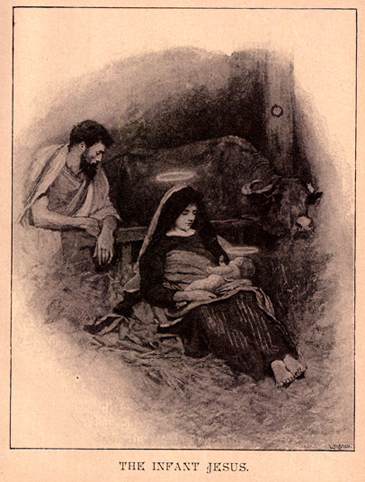
In sorting through the books owned by my maternal grandmother, I recently came across a gift she received in 1901, when she was 10 years old. The book is entitled The Good Shepherd and consists of the life of Jesus in language for a young child. There are several lithographs and line drawings. I include here one of “The Infant Jesus” in a more realistic setting than most Christmas card scenarios. I love the cow in the immediate background. clearly one of good European stock, as the face of Mary also suggests. It must have been warm enough this Christmas season in Bethlehem, as the infant child is naked, apart from the halo.


Continue reading Wise Men and the Infant Jesus, a Century Past

The Morale of the Moral Animal


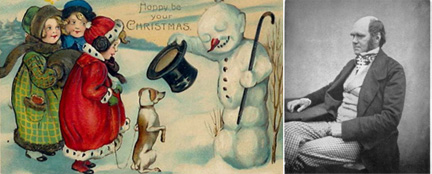
A Christmas message from Charles Darwin

In a New York Times commentary two days ago, Rabbi Jonathan Sacks tackles the consumerist “war on Christmas/Hanukkah” but with a neuro-evolutionary twist traced back to none other than Charles Darwin. He argues that despite the rightwing clamor about the impending destruction of Christmas and all things deemed proper religion, religion is doing quite well “in an age of science” and after “a series of withering attacks, most recently by the new atheists, including Sam Harris, Richard Dawkins and the late Christopher Hitchens.” The proof? Well, “still in Britain three in four people, and in America four in five, declare allegiance to a religious faith.” He might have added that an even higher percentage would work for Islam, and probably Hinduism and Buddhism as well.

For Sacks this adherence to a religious faith “is truly surprising.” Really? It seems that the best explanation for him comes from Darwin, once considered the Great Satan of Scientific Doubt. Here is the dubious (and I believe ultimately “missing”) link between what people say in opinion polls about religion and the scientist whose 200th birthday was celebrated only three years ago:

Our biological and cultural makeup constitutes our “adaptive fitness.” Yet religion is the greatest survivor of them all. Superpowers tend to last a century; the great faiths last millenniums.

So “survival of the fittest” must mean that since something as vague as “religious faith” survives in opinion polls, it must be very, very fit. In this case the evidence does not fit very well. Sacks notes that Darwin was “puzzled” by the fact that the ruthless do not always win in the battle for survival. How could altruism possibly result from natural selection? Darwin was puzzled because he had no idea of genetics or DNA, despite his correct notion that inheritance is always unique; thus, his model provided a mechanism that explained why so-called “fixed” species could actually transform and did not in itself explain why. But Sacks misses the point on what allows humans (and no doubt several of our ancestral cousins) to be moral at all: the ability to think morally rather than simply act according to a programmatic code. The seeming altruism of an insect or bird is not the same as altruism among humans, because it is not thought out as humans do. Nor is it the case that altruism demands self-sacrifice; caring for one’s offspring can be as altruistic an act as sacrificing one’s life for a comrade. If a mother or father sacrifices herself or himself to save a child, this is indeed reproductive success as Darwin would define it.

But Darwin is not really the issue here, unless Sacks wishes to analyze Darwin’s own views on religion. In his Autobiography (a great read at any time of year), Darwin clearly rejected the formal Anglican Christianity of his day, but he did not consider himself an atheist. The term “agnostic,” created by his friend and public relations bulldog Thomas Huxley, is a closer fit to what Darwin is suggesting about the transformation of his own faith. He did not reject the idea of some intellectual force setting the whole universe in motion or keeping it together, but he did not see any viable explanation in the religions he knew. Continue reading The Morale of the Moral Animal

New Syrian Schools in Lebanon


New Syrian Schools in Lebanon: between refugees’ empowerment and unwillingly fueled Social Alienation

by Estella Carpi

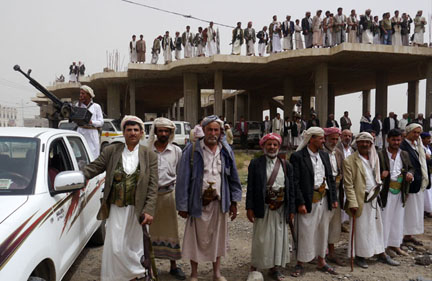
Last October 1, the school “Madrasat al-Iman al-Islamiyya” in Abu Samra in the city of Tripoli (North Lebanon) opened to “fresh off the boat” Syrian refugee kids and youth, in order to cope with the need of providing proper education in their everyday existential limbo.

The doors of this originally Lebanese Islamic school open daily to Syrian pupils from 4pm to 6pm in the afternoon, with the exception of Friday and Sunday, as established in the Tripoli district school calendar. When I visited the school on a Friday morning, the space was being used for playing volleyball and other entertainment activities were organized in class. The Back-to-School campaign has been quite large this year in Lebanon. To date, 4,942 children have been enrolled in schools, 1,650 of who are also supported by UNICEF, of a total refugee population of 162,050 individuals according to the most updated statistics provided by UNHCR.

“Soon we’re going to open new classes for high school students as well”, tells me A., administrative staff member of the school. The school director specifies that there will not be any coordination between the Syrian and the Lebanese school programme: “We made certain that, once the kids are done with their studies here and they will be able to get back to Syria in safe conditions, their certificate will be considered valid whatever the political system will be back home, with or without nizam al-Assad” (the current Syrian regime of Bashar al Assad). The school policies, hence, purvey the underlying intention of the whole Syrian refugeehood system to get back to Syria as soon as it is feasible. “We are going to translate all books from French and English – used in the Lebanese school system – into Arabic, and it’s going to be a big job”, explains to me the director of the school, who has been in Lebanon for 31 years, unlike the newly arrived Syrian teachers and the school’s administrative staff, who make up the vast majority. Continue reading New Syrian Schools in Lebanon

Tunisians frustrated but engaged


by Lindsay Benstead, Ellen Lust, Dhafer Malouche, The Middle East Channel, Foreign Policy, December 11, 2012

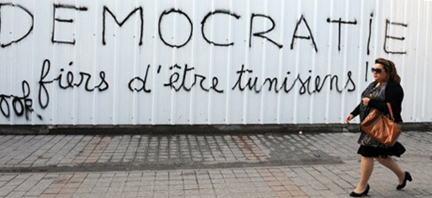
Just over a year since Tunisia’s October 23, 2011 Constituent Assembly elections, long lines of patient citizens who emerged beaming from polls last October have given way to new demonstrations and general strikes — this time against the Ennahda-led troika. In the cradle of the Arab uprising, Tunisians are deeply frustrated with the economic and political failure of the government. Today, nearly half of Tunisians feel they are worse off than they were before the revolution, and only 26 percent believe their situation has improved. Despite this, however, our original survey of 1,200 Tunisians conducted between October 10 and November 20 finds reason for optimism.

Tunisia’s problems run deep. A December 1 New York Times article, written in the wake of uprisings in the Tunisian town of Siliana in November that led to a five-day stand-off with the government, chronicles the problems: unemployment is up from 13 to 18 percent since the fall of former President Zine el-Abidine Ben Ali, youth increasingly flow out of universities to find themselves without work, a constitution is yet to be written, elections are postponed, and local governments remain appointed. Tunisians talk about the disconnect between the government and the people — grumbling that it is no more concerned with daily needs than Ben Ali’s before it. People say that the current government and police are as corrupt as in the past, and express a general sense of insecurity. Continue reading Tunisians frustrated but engaged

Self-inflicted wounds


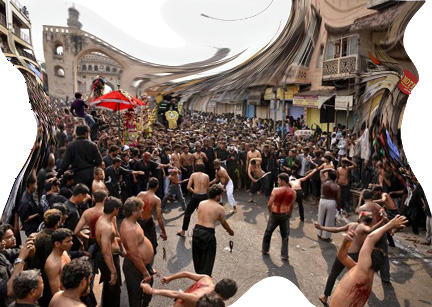
The most potent symbol of the history of the Middle East, indeed of much of human history, is the stuff of life itself: blood. In the sacred history of the three major monotheisms enough blood has been shed since their inception (by and against each one of them) to raise the sea level meters upon meters. Even in the Genesis origin story the first two natural births, Cain and Abel, became the first to introduce bloodshed as a norm. The God of Genesis got into the act, killing animals to make skins that would clothe the naked bodies he created of Adam and Eve and then preferring the animal sacrifice of Abel to the firstfruit figs raised by Cain. The same God went on to substitute a lamb for Abraham’s heir, although only when Abe’s knife was poised to slit his son’s throat, but then in Christian dogma the now-threefold deity shed a third of his essence on the cross. In that same dogma Jesus no longer needs that lost blood as he resurrected to make the trinity a divine threesome once more. But the bloodletting has never stopped.

By all accounts the prophet Muhammad was not fond of shedding blood. The forays and battles that took place while he and his followers were in exile in Medina are remarkable for how few deaths are said to have occurred. When he returned in triumph to Mecca it was not because of any great military victories, nor was their a bloodbath of the Meccans. At the start of Islam the Allah seen through the Quran is neither interested in literal blood sacrifices or a figurative eucharistic variety. Muslims purify themselves with water to make themselves ready for prayer. Calls for jihad have resonated throughout the Islamic era as countless thousands upon thousands have died for not being Muslim, being Muslim or being the wrong kind of Muslim: such is the political baggage common to most religions known to history and probably before recorded history. Continue reading Self-inflicted wounds

Mayans and Mahdis: No End in Hindsight


Today is December 21, 2012. For most of us it is just another day. But for some it is the end of the world. The most infamous prediction for today is a claim about the Mayan calendar and the nebulous plant Nibiru. I am not sure what time of the day the end is supposed to happen, but I am taking the precaution of posting my commentary the night before. Of course, since NASA has seen fit to deem this prediction a hoax (imagine that) with a Youtube video, I am perhaps being overly cautious. I suppose NASA took action because there is a Youtube channel out there on the Mayan date and we all know how many people accept anything they see on Youtube as true. Fingers have been pointed at the filmmakers of 2012, said on the official film website to be the “number one movie in the world.” But who knows why Hollywood bothered to make the film at all if the producers won’t be around to cash in on sales. Well, they did make it a couple of years ago and have no doubt been partying right up until December 21.

But just in case Muslims are wondering about this 2012 doomsday scenario, it is comforting to note that Ahlul Bayt News Agency has issued a statement that Muslim scholars have condemned the threat as a hoax. Continue reading Mayans and Mahdis: No End in Hindsight

Suffer the little children


Suffer the Little Children to Come Unto Me, by Lucas Cranach the Elder, 1538

Growing up on the King James Version of the Gospels, I well remember the force of a verse from Mark 10:14 in which Jesus, in anger, said: “Suffer the little children to come unto me, and forbid them not: for of such is the kingdom of God.” The occasion was when several parents brought children to Jesus to be blessed, but were discouraged by his disciples. This past week has seen the suffering of little children around the world. Last Friday America was gripped by the tragedy of twenty elementary children and six adults gunned down by a disturbed young man, who first killed his mother in bed and then at the school took his own life. In a nation that wears its constitutional “right to bear arms” on its political sleeves, this was a shot to the gut. For all of us whose children have gone through the public school system, the shock lingers. It could have been any local school in any state. It could have been any of our children. A killer with a gun has denied them life. This suffering is not what Jesus meant when he said “suffer the little children to come unto me.” One need not be an expert in 17th century English to understand the meaning of the verse.

But children continue to suffer at the hands of adults all over the world. In Pakistan on Monday six health workers engaged in a project to immunize children were shot to death by extremists who have been told that such a program to save children’s lives is actually a Western plot to undermine Islam. Along with five brave women and one man, the Pakistani children who will not have immunity from polio will also suffer. The irony that six adults were killed both in Pakistan and in New Town, Connecticut is worth reflecting on. In both cases those trying to save children became victims; in both cases children suffer. Continue reading Suffer the little children