Category Archives: Bible and Holy Land

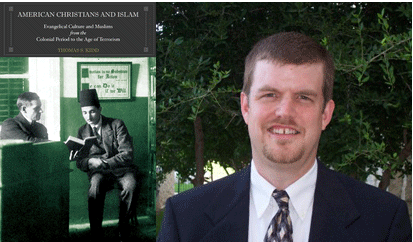
American Christians and Islam


Author Thomas S. Kidd

In the wake of the September 11 terrorist attacks, many of America’s Christian evangelicals have denounced Islam as a “demonic” and inherently violent religion, provoking frustration among other Christian conservatives who wish to present a more appealing message to the world’s Muslims. Yet as Thomas Kidd reveals in this sobering book, the conflicted views expressed by today’s evangelicals have deep roots in American history.

Tracing Islam’s role in the popular imagination of American Christians from the colonial period to today, Kidd demonstrates that Protestant evangelicals have viewed Islam as a global threat–while also actively seeking to convert Muslims to the Christian faith–since the nation’s founding. Continue reading American Christians and Islam

Rizpah and the Politics of Vengeance


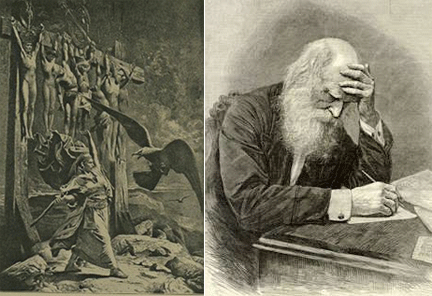
Rizpah protecting the bodies of her sons, by George Becker, left; William Cullen Bryant, right

With Gaza ablaze, the political woes of contemporary Palestinians continue to echo past tragedies on the same blood-drenched ground. Consider the vengeance of the Gibeonites, both a purge and a scourge in the early days of Israel’s King David. Setting aside who is who for the moment, the biblical account recorded in the book of II Samuel describes a weak David with a struggling economy (called a famine in those days). The Gibeonites, who sought vengeance for their slaughter by the former King Saul, demanded seven of his sons, and David agreed. The princes were soon hanged in eye-for-an-eye justice. Yet the queen mother of two of the sons spent five months protecting the bodies from being devoured by beasts not shaped like humans. Her name was Rizpah and she can be seen as a maternal heroine or a distraught widow.

Like so many of these seemingly sacred stories, almost any moral can be teased out of the narrative. Should the lesson be “Do not make deals with the enemy, even when you are weak”? I can see both supporters of Hamas and Israeli hardliners applauding the message. Or might it be possible to read the story in a more sane hindsight as a referendum on the futility of vengeance? Were the matter simply an eye for an eye, it could theoretically stop after the first act of vengeance, but this region has seen an infinity of eye-gouging that no blessed peacemakers have yet been able to stop. My own preference is for Rizpah fighting off the vultures of violence, less an act of protecting only one’s own than defiance of the perpetual killing that makes martyrdom a virtue on both sides.

Once again, I prefer to tune out the talking heads and let a poet of the past speak: Continue reading Rizpah and the Politics of Vengeance

David vs Goliath, the IDF vs Hamas


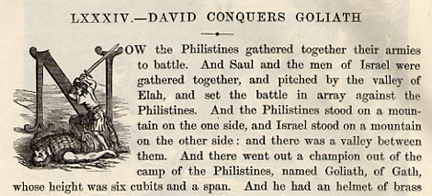
Lithograph letter illustrating The Child’s Bible Illustrated from a 19th century serial publication.

When the once holy land of Biblical proportions is the issue on the front page of every newspaper, politics must make way for metaphor. The Israeli plan to bring down Hamas echoes with Samson bringing down the temple on the Philistines. Lots of Philistines were killed that memorable day, but only with a martyr’s mentality. Plug in “Gazans” or “Israelis” for “Philistines,’ and the martydom makes both scenarios equally mad. Moving forward in Biblical time, the Philistines did not disappear as a thorn in the side of Israel. Today, well beyond the world of the prophets, the jet fighters and tanks of the IDF have replaced David’s sling, but search as the military scanners may there is no Goliath in modern Gaza. Was Sophocles still writing for the stage, the ongoing Israel/Palestine tragedy would make Oedipus Rex look like Twelfth Night. How unbiblical a thought. Continue reading David vs Goliath, the IDF vs Hamas

Picturing Bethlehem

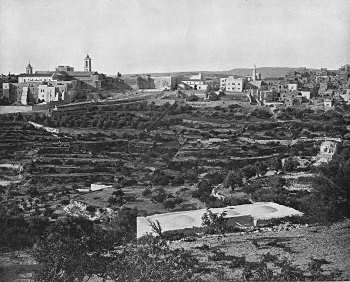
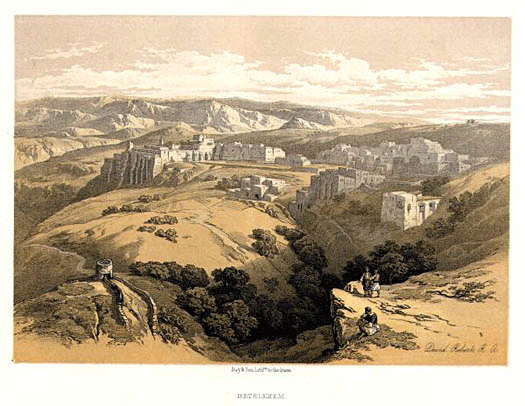
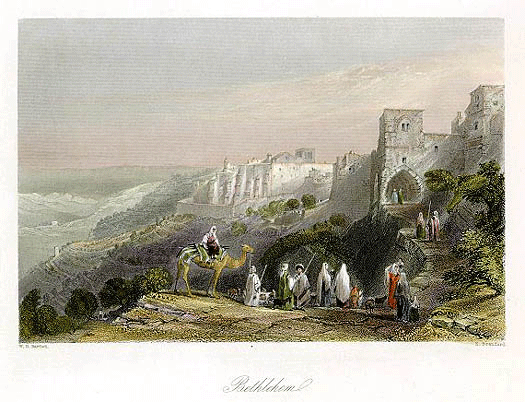
December eyes are fixed on Bethlehem, which has been an inspiration for artists over many years and indeed centuries. On this Christmas day, take a look at Bethlehem as it might have looked more than a century ago.


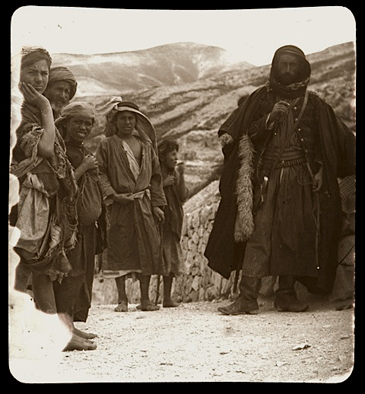
Left hand element of a stereoscopic photograph of the Bethlehem region circa 1900. Courtesy of Glenn Bowman.


Approaching Bethlehem. Source: Earthly Footsteps of the Man of Galilee.

The following two illustrations of Bethlehem can be found on the website (Jerusalem in 19th Century Art) put up by James E. Lancaster.


Bethlehem Tinted lithograph printed by Day & Son, after David Roberts, published about 1855.


Bethlehem Engraved by S.Brandard after a picture by W.H.Bartlett, published in The Christian in Palestine, about 1840. Steel engraved print with recent hand colour.

The Semiotics of Ayah

[Note: The following article is posted on the website forum for the Journal of Scriptural Reasoning, hosted at the University of Virginia.]

The Semiotics of Ayah: A Comparative Introduction”

by Basit Bilal Koshul, Concordia College

Introduction

As is the case with non-Abrahamic religious traditions Judaism, Christianity and Islam are very much concerned with the sacred. But, as Paul Ricoeur points out, the Abrahamic religions have a different understanding of the sacred in contrast to other religions. In the Abrahamic traditions “the accent is placed on speech and writing and generally on the word of God” (Ricoeur, 1995, 48) when referring to the sacred. In contrast the non-Abrahamic religious traditions often see the sacred as being present in the natural world (and the human world that is part of the natural world.) From the non-Abrahamic perspective anything and everything in the natural world can be a place, object or occasion for a hierophany—the numinous irruption of the sacred: “The sacred can manifest itself in rocks or in trees that the believer venerates; hence not just in speech, but also in cultural forms of behavior” (Ricoeur, 1995, 49). Beginning with the Revelation at Mt. Sinai the revealed word “takes over for itself the function of the numinous” and rejects all claims of the numinous/sacred being present anywhere in natural or cultural phenomena (Ricoeur, 1995, 65). Continue reading The Semiotics of Ayah

In Jesus’ Name?

As I write this, being Sunday, I have no doubt that we could wipe out the National Debt and bail out every Wall Street firm if we only had a dollar for each time someone recited “in Jesus’ name” today alone. Since Jesus has not yet returned (or surely Pat Robertson would have told us), there is no end of WWJD speculation over this election. In some parts of this country there is an idea that being Christian is the same as being Republican. Blessed are those who smear the character of their opponents: that’s what the Bible ought to say, according to Karl Rove. In the nation’s tightening Bible Belt there are those who think a Christian should never vote for a democrat, as though politics can be read the same way as apocalypse. So it should not be a surprise that the vitriolic rhetoric of Sarah Palin results in the kind of hate speech that makes Obama the same as Osama and rekindles the kind of KKK racism that used to lynch “uppity” black folk. Not long ago a black man could be beaten to death simply for daring to vote, so imagine how grating it must be to the kind of racists who are scared a black man might actually president. Didn’t God curse Ham?

There is no question that prayer is a much better option for this campaign than the hate speech heard at Palin and McCain rallies during the past week. But then, as the country song reminds us, be careful what you pray for. On Sunday at a McCain event in Davenport, Iowa, the crowd was warmed up by a local pastor of the Evangelical Free Church. Here was his prayer, as reported by a blogger at the event:

“There are plenty of people around the world who are praying to their god, be they Hindu, Buddah, or Allah, that (McCain’s) opponent wins. I pray that you step forward and honor your own name.” Ends with “in Jesus’ name.”

Continue reading In Jesus’ Name?

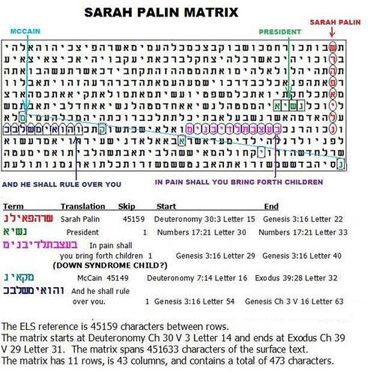
Holy Moses, Palin’s in the Torah

The choice of Alaska Governor Sarah Palin to be the one-heartbeat-away running mate for Republican John McCain was not just throwing another hat into the political ring. No, this was a hunk of red meat, Red Heifer over moose flesh, for the hungry religious right to savor. Here was a born-again Pentecostal who overnight transformed the gambling non-Christian (just ask James Dobson before the epiphany) Navy war hero into a respectable church elder. The apocalyptic baggage of Palin’s Assemby of God church raised more than a few eyebrows outside the red-faced Bible Belt. If she became Vice-President (or President) would God finally let Satan unleash the Tribulation, killing off hundreds of thousands of Jews and millions of unborn-again Americans? What better place to hold out in caves and read those KJV blood-soaked Bibles than in Alaska, where the remaining believers could actually see Gog across the Being Strait? If Sarah Palin’s oil pipeline, like the Iraq War, was something the Redneck State God wanted, then surely Senator Obama is a perfect fit for the Antichrist.

But wait, it gets better than what the Prophet Daniel had to say about the Day of Jacob’s Trouble and the Apostle Paul predicted so rapturously about the Second Coming of Jesus. Now we know that Sarah Palin got onto the GOP ticket because it was predicted in the Torah. Move over De Vinci and make room for Josephus. Here is what the Ark of the Covenant Code says abut Election o8: Continue reading Holy Moses, Palin’s in the Torah

A Strategic Error, a Tactical Mistake

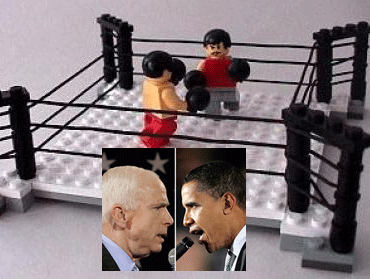
Last night Senators Obama and McCain squared off for the first debate, setting off a feeding frenzy among surrogate spinmeisters around the mediasphere. It was the Old Man and the Sea Change. So who won? Who landed the most blows? Who survived? If this had been a heavyweight bout, there would have been a decision ringside with judges who could tell real blows from low blows. The pandering of pundits only goes round and round with no “real” winner. The only way political debates ever matter is at the polls on election day. Of course, John McCain’s campaign knew ahead of time that he won. Even before McCain agreed at the last minute to honor his commitment to the independent debate commission and the American people (not to mention Ole Miss), his campaign (apparently not in suspension, just in free fall) put up an ad Friday morning on the Wall Street Journal that claimed McCain as the winner.

You could say it was a draw, although not with much blood loss. But there were a number of strategic errors and tactical mistakes. Continue reading A Strategic Error, a Tactical Mistake