Category Archives: Ethics

CIA, C.O.D., LOL


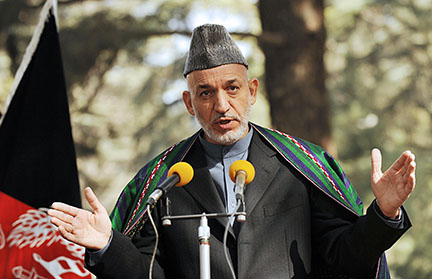
Afghan President Karzai explaining how large a bag he wants his CIA cash delivered in

Following the “revelation” that the CIA has been dropping off bags of cash to Afghan’s President Karzai, perhaps its acronym should also stand for Covert Insurance Allowance. What better way to spread democracy and freedom-loving among the Afghan people than to buy allegiance with greenbacks. After all, if Karzai is not supplied with freshly minted American dollars, how can he get the warlords to side with him. Let’s face it, the Taliban have stockpiled the opium, so Karzai needs some source of income for his fragile economy. As bribed supporters of American liberation, we can be assured that these warlords would never use any of that under-the-table funding to buy opium from the Taliban.

Many Americans are shocked that the CIA would provide clandestine aid to a foreign president who is pulled out on the kilim in public to be chided over Afghan’s notorious corruption. But rest assured that President Karzai gives America receipts for every dollar. These receipts are actually recycled and used as toilet paper back in CIA headquarters, resulting in a significant savings for the agency. The CIA can now cover its own shit without having to buy truckloads of Scots Tissues, much to the consternation of the Koch Brothers. Now that the shit has hit the fan, so to speak, more money will need to be provided to Karzai so that more receipts can make their way back to headquarters. There is plenty of cash available, despite sequestration, since so many of the other dictators that were getting genuine made-in-America bribes on the sly are gone. Continue reading CIA, C.O.D., LOL
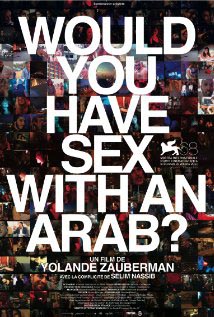
Would You Have Sex With an Arab?

Sleeping With the Enemy? Review of “”Would You Have Sex With an Arab?
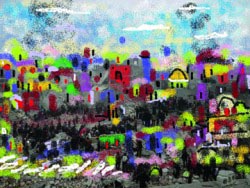
By Clara Abdulaziz,http://ta3beer.blogspot.com, April, 19

“One in five Israelis is an Arab, but it is difficult to find places where they touch fingertips.”

In her latest feature-length documentary, French filmmaker Yolande Zauberman ventures out into the nightlife of Tel Aviv and asks the people she meets a deceptively simple question: “Would you have sex with an Arab?” It is clear that sex serves merely as a proxy to grapple with a much larger question: can individuals transcend identities rooted in long histories of conflict, or is identity so rigidly constructed that it in fact defines one’s humanity?

Zauberman has said that she produced the film to “give space for awareness.” It is meant to be “a little bit sexy, a little bit funny.”

It is also, quite frankly, pretty depressing.

Zauberman’s choice of Tel Aviv for her film was not arbitrary. It is famous for its non-stop club scene, and is one of the most LGBT and queer-friendly cities in the world. She shows that even here, where most young residents seem more concerned with partying than religion and politics, the boundaries of Jewish and Arab identity remain stubbornly situated within the larger Arab-Israeli conflict. Continue reading Would You Have Sex With an Arab?
Fatima’s Head

By Ziad Majed, al-Jadid

It is hard to imagine what happened to Fatima,* and it is hard to describe the silence that engulfed the witnesses of her death. I think the artistic works on Facebook that restored her head and depicted a rose garden or the moon or the sun have tried to compensate for that terrible silence and ease the pain of Fatima and her loved ones and all of us together.

What can be done to a Syrian child who “lost” her head?! And what can be said to a girl sprawled in her dress on the ground, arms spread wide, her small, drooping shoulders clinging to the wall directly?

Fatima Maghlaj did not understand what happened to her; she was headless all of a sudden. In an instant she lost the ability to dream and focus. She was paralyzed. She wanted to feel the dryness of her throat and ask for water. She wanted to call mother or father, but she could not make the words with her tongue and she could not find their picture in her memory. She tried to look around her to reassure herself that she was sleeping in a safe place to wait until these strange feelings of emptiness had ended. But her eyes and eyebrows and eyelashes were out of reach, scattered in the emptiness of the cold room. She found nothing but a tuft of hair that her mother had combed in preparation for her uncle’s wedding that evening. Continue reading Fatima’s Head

Syria Has a Massive Rape Crisis

by Lauren Wolfe, The Atlantic, April 3

One day in the fall of 2012, Syrian government troops brought a young Free Syrian Army soldier’s fiancée, sisters, mother, and female neighbors to the Syrian prison in which he was being held. One by one, he said, they were raped in front of him.

The 18-year-old had been an FSA soldier for less than a month when he was picked up. Crying uncontrollably as he recounted his torture while in detention to a psychiatrist named Yassar Kanawati, he said he suffers from a spinal injury inflicted by his captors. The other men detained with him were all raped, he told the doctor. When Kanawati asked if he, too, was raped, he went silent.

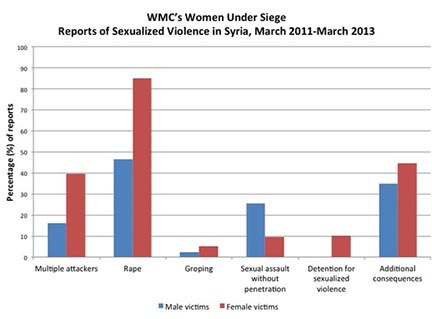
Although most coverage of the Syrian civil war tends to focus on the fighting between the two sides, this war, like most, has a more insidious dimension: rape has been reportedly used widely as a tool of control, intimidation, and humiliation throughout the conflict. And its effects, while not always fatal, are creating a nation of traumatized survivors — everyone from the direct victims of the attacks to their children, who may have witnessed or been otherwise affected by what has been perpetrated on their relatives.

In September 2012, I was at the United Nations when Norwegian Foreign Minister Espen Barth Eide shook up a fluorescent-lit room of bored-looking bureaucrats by saying that what happened during the Bosnian war is “repeating itself right now in Syria.” He was referring to the rape of tens of thousands of women in that country in the 1990s.

“With every war and major conflict, as an international community we say ‘never again’ to mass rape,” said Nobel Laureate Jody Williams, who is co-chair of the International Campaign to Stop Rape & Gender Violence in Conflict. [Full disclosure: I’m on the advisory committee of the campaign.] “Yet, in Syria, as countless women are again finding the war waged on their bodies–we are again standing by and wringing our hands.”

We said after the Holocaust we’d never forget; we said it after Darfur. We probably said it after the mass rapes of Bosnia and Rwanda, but maybe that was more of a “we shouldn’t forget,” since there was so much global guilt that we just sort of sat back and let similar tragedies occur since and only came to the realization later — we forgot.

Could we have forgotten that the unfolding human catastrophe in Syria exists before it’s even over? Continue reading Syria Has a Massive Rape Crisis

Can Atheists and Muslims Support Freedom of Conscience Together?

By Qasim Rashid and Chris Stedman, Religion & Politics, March 5, 2013

Thomas Jefferson once wrote: “But it does me no injury for my neighbor to say there are twenty gods or no God. It neither picks my pocket nor breaks my leg.”

For many of us, it’s easy to appreciate Jefferson’s eloquently stated advocacy of religious freedom of conscience, as well as the idea that all individuals should be able to express religious or nonreligious positions independent of others’ beliefs. Likewise, at the United Nations, both the Universal Declaration on Human Rights and the binding International Covenant on Civil and Political Rights guarantee “freedom of thought, conscience and religion” to all individuals. But, in spite of international agreements and Jefferson’s beautiful words, the reality is that these tenets are often forgotten.

Today, few corners of the world are immune from the oppression of conscience. Last year, Pakistan’s Malala Yousafzai captivated the world after the Taliban viciously attacked her for promoting education for girls and women. Nearby, Pakistani Christian Rimsha Masih’s future and safety are still uncertain after she beat a blasphemy charge. In 2010, the Taliban murdered 86 Ahmadi Muslims on account of their faith. In Indonesia, Alexander Aan continues to languish in prison for the “crime” of professing his atheism, and atheist Alber Saber has been persecuted in Egypt for his lack of faith. In Iran, U.S. Pastor Saeed Abedini is serving an eight-year prison sentence for the alleged crime of preaching Christianity. And these examples are just a snapshot of what Pew reports as roughly 75 percent of the world—5.25 billion people—that live under some sort of social or governmental oppression of religious conscience. Continue reading Can Atheists and Muslims Support Freedom of Conscience Together?

Harun’s houris


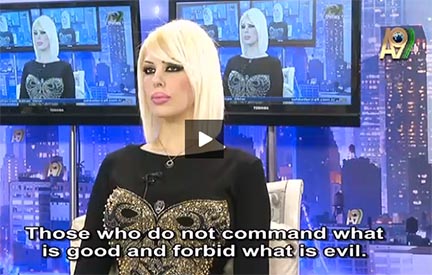
Harun Yahya, a.k.a Adnan Oktar

But what greater temptation than to appear a missionary, a prophet, an ambassador from heaven? Who would not encounter many dangers and difficulties, in order to attain so sublime a character? Or if, by the help of vanity and a heated imagination, a man has first made a convert of himself, and entered seriously into the delusion; who ever scruples to make use of pious frauds, in support of so holy and meritorious a cause?
David Hume, “Of Miracles” (1748)

David Hume, the eminent 18th century philosopher, was probably not thinking about Islam when he wrote his seminal essay “Of Miracles,” but his description resonates well with the media realm of the would-be Mahdi Harun Yahya (alias of Adnan Oktar). Put enough money and media-savvy glitz behind a delusion and the gullible will come to the trough. All you need to do is check out the main website of Harun Yahya to see a sexed-up Disney version of Islam. And even if you happen to be Igbo (yes Igbo), you can read what the Harun Yahya machine has to say about the “Koran.”

The checkered history of Adnan Oktar is hardly a secret, especially in Turkey. But his cyber-reach is massive, with multiple websites available in many different languages. If you have time to spare, spend a few minutes perusing some of his 160 websites devoted to attacking evolution, proving miracles, calling for an Islamic Union led by Turkey, the coming of the Mahdi, hell, atheism and beyond. Oktar recently made news by interviewing Israeli guests, despite earlier writings which include holocaust denial.

The latest twist in the televised adoration of Adnan Oktar might best be labeled “Harun’s houris.” Continue reading Harun’s houris

What ails humanitarian aid in Lebanon


The high social price of media and humanitarian dissimulation in North Lebanon.

by Estella Carpi

In the aid provision sphere of North Lebanon, international media in close connection with humanitarian agencies often hasten to show how North Lebanon’s hospitality of Syrian refugees coming in large numbers to flee destruction, scarcity, repression, chronic fear and instability is huge. Such hospitality is actually a product of a quite complex picture with an up-close look, unlike the idyllic scenario humanitarian practitioners and local people usually provide. In addition, social dynamics are normally depicted in the media in ethnicized terms: that is to say Lebanese versus Syrians.

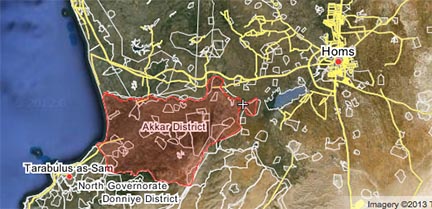
A few months ago, while conducting my fieldwork in Lebanon, I was told that some Lebanese threw stones to humanitarian workers during the food kits’ distribution for Syrian refugees in a town in Akkar, the northern region. The episode had been interpreted by local people themselves as an outburst of tension because of the sudden massive presence of humanitarian organizations in the area, which has always been neglected by state and non-state actors due to lack of political interests. The latter, in fact, were slightly more localized in Beirut and in the south of the country, vexed by Israeli occupation and by a consequent local impoverishment (1978-2000).

The humanitarian agencies operating in that town decided not to let journalists publish about the episode. Others published about it by contending that local people in North Lebanon would definitely stop “hostilities” and warm up if aid were provided to them too. The main reason behind the omission and amendment of this kind of information is apparently the intention not to generate further frictions between the local community and the Syrians. Continue reading What ails humanitarian aid in Lebanon

To kiss or not to kiss: Iranian style

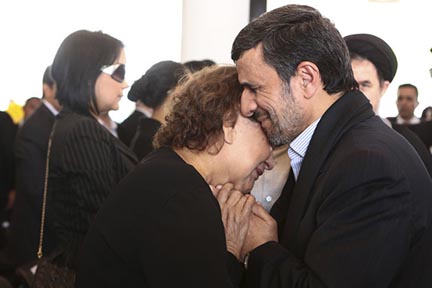
A controversial tempest in a samovar erupted last week when Iran’s President Ahmadenijad appeared to kiss the grieving mother of Hugo Chavez at the state funeral for the Venezuelan leader. The lips do touch the face of Chavez’s mother, but the context suggests an embrace of consolation rather than anything untoward. To the extent this innate human reaction of sympathy is something to be forbidden as unIslamic, religion becomes a mockery. The Muhammad presented in the Sira was a man of compassion. I suspect he would not approve of those who take the charge of modesty to such an extreme as to deny the most basic of positive human instincts.

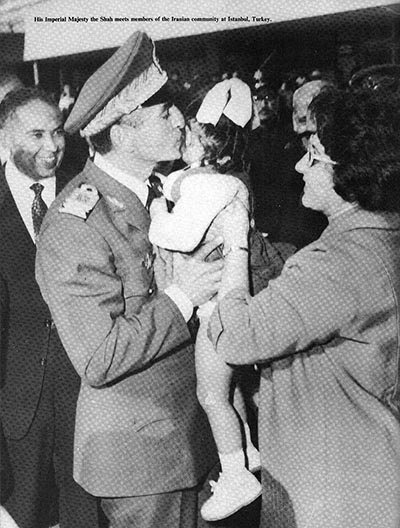
But the controversy over this alleged “kiss” reminded me of an image from a different time in Iran. I have a booklet (Iran Today) issued by the Imperial Iranian Government in the early 1960s, when Lyndon Johnson was still vice-president. This is pure propaganda for the then-young Shah’s Iran. Opposite the Table of Contents, and thus the first image in the booklet, is a full-page spread with the caption: “His Imperial Majesty the Shah meets members of the Iranian community in Istanbul, Turkey.” You will note that this image is the classic politician baby kissing. Obviously, this was seen as a positive side of the ruler who loves his people. What a difference half a century makes in the interpretation of a kiss.

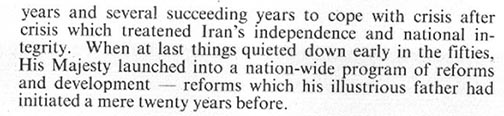
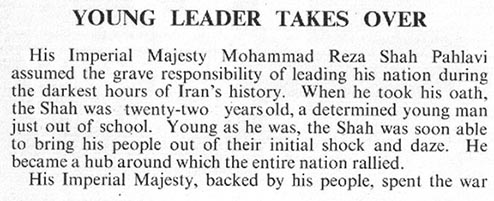
The propaganda aspect of the booklet is most evident in the unflinching praise for the Shah, as can be seen below:

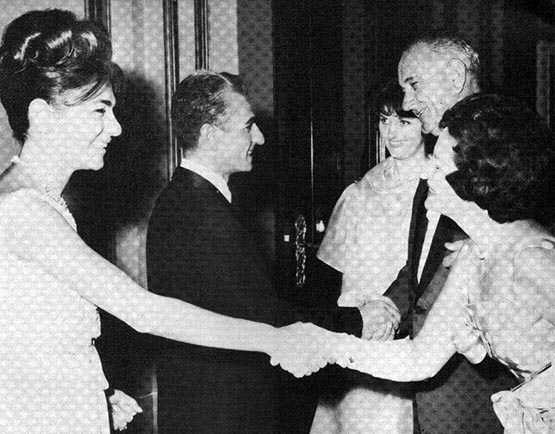
“Their Imperial Majesties the Shah and Queen Farah greet distinguished guests from the United States: Vice President and Mrs. Lyndon Johnson and their daughter, who visited Iran last summer.