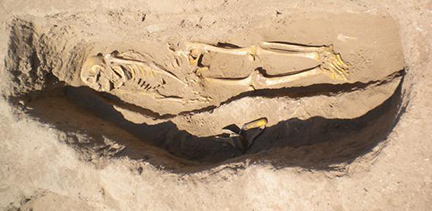
Chalcolithic burial at Zeidan; Credit: Gil Stein, Oriental Institute, University of Chicago
6200-year-old parasite egg may be first proof of early human technology spreading disease
Latest research shows that schistosomiasis, a disease caused by flatworm parasites, may have been spread by earliest crop irrigation in ancient Mesopotamia, suggesting early technology exacerbated disease burden.
The discovery of a schistosomiasis parasite egg in a 6200-year-old grave at a prehistoric town by the Euphrates river in Syria may be the first evidence that agricultural irrigation systems in the Middle East contributed to disease burden, according to new research published in Lancet Infectious Diseases.
Schistosomiasis is a disease caused by several species of flatworm parasites that live in the blood vessels of the bladder and intestines.
Infection can result in anaemia, kidney failure, and bladder cancer. This research shows it may have been spread by the introduction of crop irrigation in ancient Mesopotamia, the region along the Tigris-Euphrates river system that covers parts of modern-day Iraq, Iran, Kuwait, Syria, and Turkey. Continue reading Schisto in Mesopotamia