Category Archives: Yemen

Breaking News: Salih on Yemeni TV


from Al Jazeera website

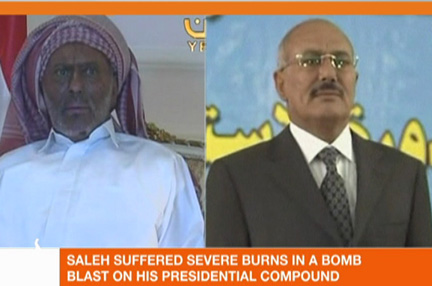
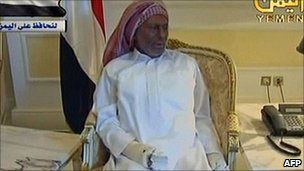
The first video of President Ali Abdullah Salih since his severe injuries has been broadcast in Yemen just a short while ago. A brief excerpt is already on Youtube with better videos likely to be posted. As the pictures above and below show, he is heavily bandaged and the audio indicates he has trouble speaking. It is hard to imagine that he would be able to resume work any time in the foreseeable future. It appears he is lucky to even be alive. For an interview on Al Jazeera with Dr. Ameen al-Himyari of Qatar University, click here.


from the BBC website

The Seduction of Simple Solutions


Over at Waq al-Waq there is an excellent commentary by Greg Johnsen on the situation in Yemen, responding to a “think tank” report from people who really do not know Yemen very well (or apparently want to know it in a certain way). Here is the start…

Late last week Frank Cilluffo and Clint Watts released a policy brief from George Washington University’s Homeland Security Policy Institute entitled “Yemen and al-Qaeda in the Arabian Peninsula: Exploiting a Window of Counterterrorism Opportunity.”

My in-box quickly filled up with helpful people sending me copies of the report, I have now had time to read it and digest and my thoughts follow below.

(Note:) I don’t know Frank Cilluffo but I do know and respect Clint and he has seen a copy of my rebuttal here prior to posting.

For those who are faithful readers of Waq al-waq it should come as no surprise that I strongly disagree with the report and its conclusions. I think this is what happens when smart people tackle a complex problem in an environment they don’t know particularly well. The report, in my opinion, is full of assumptions that make sense broadly but break down the closer one gets to Yemen.

Obviously there are parts of the report I agree with, and many other places where well-intentioned people can disagree.

(Quotes from the paper are in italics; mine are in regular caps.)

Assumption 1: AQAP suddenly stronger this month

“This week’s escape of 63 suspected al Qaeda in the Arabian Peninsula (AQAP) fighters from a Yemeni prison exemplifies how President Saleh’s departure to Saudi Arabia and Yemeni instability embolden this lethal al Qaeda affiliate.“

I’m pretty sure that AQAP was emboldened prior to Salih’s departure, the group has been incredibly active in Yemen recently and I would argue that largely as a result of US air strikes between December 2009 and May 2010, the organization is actually stronger now in terms of recruits than it was when it dispatched the so-called underwear bomber who tried to bring down the airplane over Detroit on Christmas Day 2009.

Assumption 2: Huthis and Southern Movement are responsible

“In recent weeks, the writ of government in Yemen has evaporated under the twin strains of the Houthi rebellion in northern Yemen and the Secessionist movement in southern Yemen.”

This is simply untrue – the writ of Yemen’s government has evaporated under popular protests. The Huthi rebellion has been ongoing since 2004 and the Southern movement since 2007 – neither of these are new, and neither of these are the cause of the recent collapse.

For Greg’s full commentary, click here.

New blog on Yemen


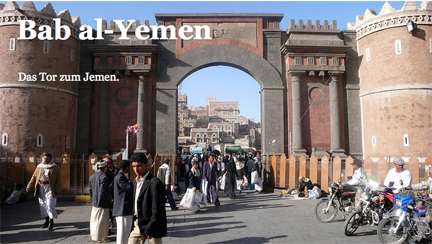
There is a new blog on Yemen: Bab al-Yemen: Das Tor zum Yemen; this is created by Marie-Christine Heinze, who is a graduate student at the Bielefeld Graduate School in History and Sociology. Marie-Christine is working on her Ph. D. about the “Social Life of Weapons in Yemen,” including the famous Yemeni jambiyya. In her new blog she has posted a review of a recent book privately published by Stephen Gracie entitled Jambiya: Daggers from the Ancient Souqs of Yemen.

French Center for Yemeni Studies threatened


Le CEFAS : un instrument indispensable de compréhension de la péninsule Arabique

by Laurent Bonnefoy (chercheur, Institut français du Proche-Orient)

En 2011, jamais la France et l’Union européenne n’ont autant eu besoin de comprendre les sociétés arabes. Jamais les chercheurs spécialistes du monde arabe contemporain n’ont autant répondu à une demande sociale venant tant des médias et des diplomates que même parfois des entreprises. A l’heure où le Yémen connaît un profond mouvement de révolte et où s’expriment des aspirations au changement, à la liberté et à la démocratie, le ministère des Affaires étrangères songe à mettre fin à l’expérience du Centre français d’archéologie et de sciences sociales de Sanaa (CEFAS).

Ce centre, créé sous le nom de Centre français d’études yéménites en 1982 sous la double tutelle du ministères des Affaires étrangères et du CNRS, a en près de trente ans permis à des centaines d’étudiants et de chercheurs de se familiariser avec les sociétés de la péninsule Arabique, d’apprendre l’arabe et de mener à bien de nombreux projets de recherche avec les partenaires locaux qu’ils soient yéménites, saoudiens, omanais ou autres. Son travail d’interface avec les institutions yéménites et du Golfe, sa bibliothèque exhaustive ont fait du CEFAS un instrument unique au monde, valorisé à l’échelle internationale. Les archéologues liés à cet institut ont été à la pointe des découvertes sur les cités antiques de l’Arabie Heureuse. Ses historiens ont pu analyser et réévaluer tant les spécificités que l’intégration ancienne de la péninsule Arabique dans le système monde. Ensemble ils ont directement contribué à valoriser, mais également à préserver, un patrimoine d’une richesse inestimable qui reste encore pour une grande part inconnu. Les chercheurs en sciences sociales ont pour leur part travaillé à rendre intelligible les sociétés et systèmes politiques de cette région du monde arabe. Le rôle de chacun, dans un Yémen et dans un Golfe arabo-persique en transformation, est dès maintenant d’appréhender et d’analyser les transformations et, à l’usage de chacun en France, en Europe et dans le monde, de fournir de nouvelles grilles de lectures indispensables. Continue reading French Center for Yemeni Studies threatened

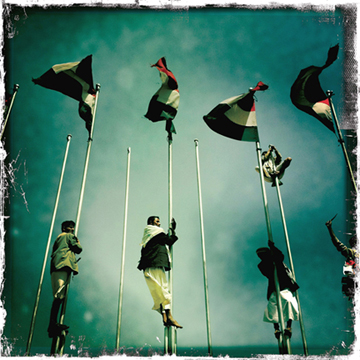
Yemen’s Unfinished Revolution


Photo by Karim Ben Khelifa

By TAWAKKOL KARMAN, The New York Times, June 18, 2011

Sana, Yemen

AFTER more than five months of continuous protests, I stand today in Change Square with thousands of young people united by a lofty dream. I have spent days and nights camped out in tents with fellow protesters; I have led demonstrations in the streets facing the threat of mortars, missiles and gunfire; I have struggled to build a movement for democratic change — all while caring for my three young children.

We have reached this historic moment because we chose to march in the streets demanding the resignation of President Ali Abdullah Saleh, an end to his corrupt and failed regime and the establishment of a modern democratic state. On June 4, our wish for Mr. Saleh’s departure was granted, but our demand for democracy remains unfulfilled.

Following months of peaceful protests that reached every village, neighborhood and street, Yemen is now facing a complete vacuum of authority; we are without a president or parliament. Mr. Saleh may be gone, but authority has not yet been transferred to a transitional presidential council endorsed by the people.

This is because the United States and Saudi Arabia, which have the power to ensure a peaceful transition to democracy in Yemen, have instead used their influence to ensure that members of the old regime remain in power and the status quo is maintained. American counterterrorism agencies and the Saudi government have a firm grip on Yemen at the moment. It is they, not the Yemeni people and their constitutional institutions, that control the country. Continue reading Yemen’s Unfinished Revolution

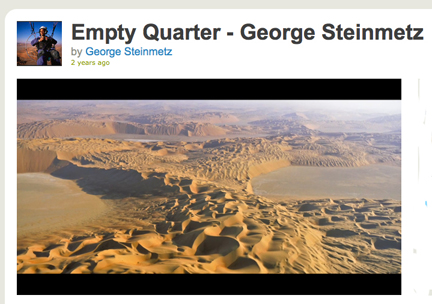
Cruising above the Empty Quarter


There is a spectacular photographic website devoted to a book by George Steinmetz, who took photographs across the fabled Empty Quarter of Arabia.

I became captivated by Arabia’s Empty Quarter as a young man when I read Wilfred Thesiger’s Arabian Sands. The Empty Quarter is larger than France without a single permanent point of water or human habitation. It’s both the world’s largest sand sea and one of the hottest places on earth, and has only been traversed a handful of times. I didn’t want to repeat Thesiger’s epic journeys many decades later, but when I discovered motorized paragliding I found a way to visualize this remote landscape in a new way. I made three paragliding trips into the sands, first for GEO in Saudi Arabia, and then returned two years later to go from Riyadh to Oman and Yemen for National Geographic, and finally made a personal trip to the southern most reaches of the U.A.E. to complete my field work. What I found was one of the most beautiful and unseen wilderness on earth. On its fringes I encountered elements the oil wealth that has forever changed Arabia, but I also found Bedouins still clinging to traditions, and offering up a level of hospitality that was truly humbling. This body of work would simply not have been possible without their kindness.

Empty Quarter is George’s second book, published by Harry N. Abrams. This is the most extensive compilation of photographs ever taken in the Arabian Desert. Measuring 9.5 x 13 inches, the book has 208 pages with 150 color photos and captions.

Is it civil war yet in Yemen?


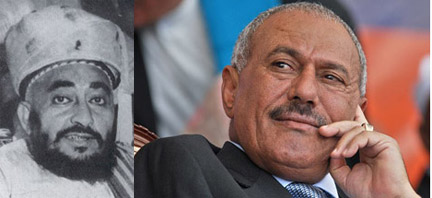
Imam Ahmad, left; Ali Abdullah Salih, right

[Webshaykh’s Note: This is a nice summary of the situation in Yemen just before Salih was wounded and left for Saudi Arabia.]

An avoidable civil war in Yemen that has already begun

by Brian O’Neill, The National, June 5, 2011

The scenes coming to us out of Yemen appear as raw and bloody chaos: running gun-battles through the streets, protesters screaming fiercely and the president, Ali Abdullah Saleh, apparently wounded in a mortar attack at the weekend (and rumoured to be headed to Saudi Arabia for treatment).

But while it looks like madness, the falling apart of Yemen is deeply rooted in the inexorable logic of its own history, the personalities of the major players and a looming generational shift. While civil war is not inevitable, circumstances have made it likely, and it may be too late to prevent the country from violently tearing apart its own seams.

Probably the biggest question swirling around the fighting is why? Not why is President Saleh clinging to power, but why has he established a series of feints and dodges that would appear to propel unrest rather than restore stability?

For instance, why did the president offer to sign a GCC-sponsored transfer of power, only to back away multiple times? If he had no intention of signing, why even bother with the pretence?

The answer to these questions is one of the keys to understanding why Yemen is where it is.

Mr Saleh has ruled parts or all of Yemen for over 30 years. But even the “all” in that sentence is misleading. Mr Saleh has never ruled all of Yemen, even if he has arguably the longest reach in his country’s ancient history. Yemen is governed by negotiation and appeasement, by the carrot and the stick, by squeezing one party while massaging the other.

Rule in Yemen is very personal; the president, like the Imam before him, is intimately involved in tribal politics – a game of swirling alliances. Continue reading Is it civil war yet in Yemen?

Ali Abdullah Salih and Yogi Berra


The picture chosen by The Washington Post for its lead article today

The speculation about the health and future of President Ali Abdullah Salih of Yemen is wild today. On Friday he was wounded by a rocket attack on his compound that killed several others. I first heard about this when someone called me and mentioned that in Pakistan they were saying he had been killed in the attack. When he only gave an audio message afterwords, and that with a clearly heavy breathing voice, it was still not clear what his injuries were. Since government sources are certainly not believable and no reporters were on the scene, all kinds of rumors spread easily. Now it is known that Salih with a number of family members and some of the other wounded are in Saudi Arabia for treatment.

So what next? The BBC takes a cautious approach with the headline “Yemenis rejoice as Saleh leaves but fighting continues” while The Washington Post is more optimistic, leading the headlines with “Yemeni crowds cheer as Saleh transfers power,” and stating “The departure of Yemen’s president for Saudi Arabia raises the prospect that a key U.S. ally in the fight against al-Qaeda has lost his grip on a nation tumbling into chaos.” Over at Waq al-Waq Gregory Johnsen reflects the hopes and fears of the situation:

“My guess is that his wounds are much more severe than Yemeni officials have let on, as Salih was well aware that leaving Yemen would make it incredibly difficult for him to return. Continue reading Ali Abdullah Salih and Yogi Berra