Category Archives: Anthropology/Sociology

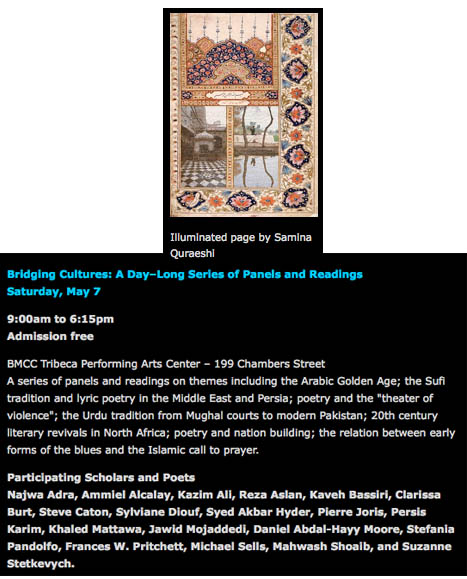
Illuminated Verses: The Poetries of the Islamic World


Illuminated Verses explores some of the rich and varied poetic traditions of the Islamic world. For a schedule of panels, click here (and scroll to bottom to download pdf of program).

Here is the program for Saturday, May 17, 2011:

Detailed Schedule

•9:00-9:15am
Welcome by Poets House Executive Director Lee Briccetti and City Lore Executive Director Steve Zeitlin

•9:20-9:55am
Illuminated Verses: the Poetries of the Islamic World
An opening panel setting up large questions and contexts with Reza Aslan and Michael Sells.

•10: 00-11:00am
Origins and Orality: the Poetry of the Arabian Peninsula
An examination of the poetries of the Arabian Peninsula from the Golden Age to contemporary oral tribal poetry. With anthropologists Najwa Adra and Steve Caton and literary scholar Suzanne Stetkevych. Continue reading Illuminated Verses: The Poetries of the Islamic World

Pornographic War Gazing: Why We Don’t Look Away


[This commentary was origially published in Religion Dispatches, April 12, 2011.]

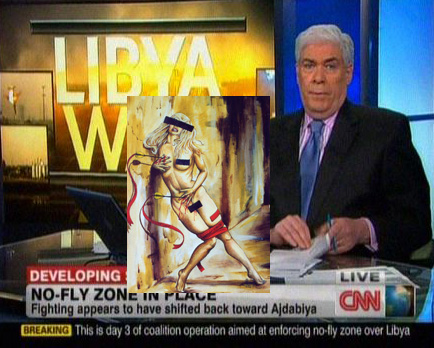
When it comes to grabbing attention bad news is the best news. Whether selling war or natural disaster or a fugitive serial killer, the competitive edge goes to the media outlet that can scoop the most violence, brutality or sheer inhumanity in an event.

The most recent news cycle of political protests started out on a hopeful note. As the spirit of frustrated youthful protest spread at tweet speed to dictatorial regimes and elitist monarchies, journalists flocked to North Africa and the modern day Holy Land. Live coverage has shifted from country to country, depending in large part on where the most violence is erupting. Yet, as much as the story may be promoted as one of hope and liberation, the hook is all about devastation. Continue reading Pornographic War Gazing: Why We Don’t Look Away

Central Asian, Early Iranian and Islamic Numismatic Conference


The Third MECA Seminar on early Iranian and Central Asian Numismatics will be held at Hofstra University in Hempstead, NY, this Sunday, April 10, 10:00 am to 5:00 pm in 106 Breslin Hall. This seminar has been organized by Prof. Aleksandr Naymark and is open to faculty and students of Hofstra University and to the public, free of charge. For more information, check out the conference website.

Program

Session I: Early Islamic Coinage
10:30 am to 12:00 pm

• Konstantin Kravtsov (State Hermitage Museum)
An Obscure Period in the History of Tabaristan (760s AD): Analysis of Written and Numismatic Sources

• Stuart Sears (Wheaton College)
Crisis on an Asian Frontier: The Countermarking of Umayyad Dirahms in Khurasan in the Early Eighth Century CE

• Luke Treadwell (Oxford Univeristy)
Aleksandr Naymark (Hofstra University)
The Very Last Sogdian Coin

Lunch break
12:00 pm to 1:00 pm

Session II: Classical Age of Islamic Coinage
1:00 pm to 2:15 pm

• Michael Bates (American Numismatic Society)
The Second Muhammadiyya, the Mine of Bajunays

• Arianna d’Ottone (La Sapienza University of Rome)
From Russia to Rome: the Stanzani Collection of Islamic Coins

• Aleksandr Naymark (Hofstra University)
Byzantine Anonymous Folles from Qarakhanid lands in the Ferghana and Chu Valleys

Coffee Break
2:15 pm to 2:30 pm

Session III: On the Borders: India and Yemen
2:30 pm to 3:30 pm

• Waleed Ziad (Yale University)
Islamic Coins from a Hindu Temple: Reevaluating Ghaznawid Policy towards Hinduism
through new Numismatic Evidence from the Kashmir Smast in Gandhara

• Daniel Martin Varisco (Hofstra University)
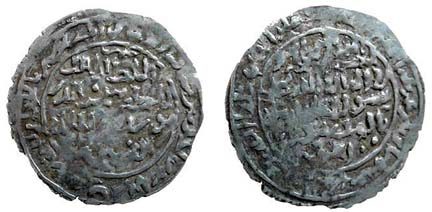
Rasulid Coinage in the Daftar of al-Malik al-Muzaffar: A Preliminary Textual Study

Coffee Break
3:30 pm to 3:45 pm

Session IV: Mongols
3:45 am to 5:00 pm

• Stefan Heidemann (Metropolitan Museum of Art B Bard College Graduate Center)
The Coin Finds from the Heart of the Mongol Empire: Qaraqorum Results of the Bonn University Excavation

• Necla Akkaya (Selcuk Universty)
Coins of the Ilkhanid ruler Abu Sa`id Bahadur Khan

• Olga Kirillova (Orel, Russia), Aleksandr Naymark (Hofstra University)
A Copy of the Seal of the Bulgarian Tsar Ivan II Asen from Samarqand

General Discussion
5:00 pm – 6:00 pm

Dinner in Brooklyn – 6:45 pm

Café Uzbekistan
2170 86th St. Brooklyn, NY 11214 (in the first block east of the crossing with Bay Parkway; parking on the sides streets)
Tel.: (718) 373-9393
India Orientalized for War, 1


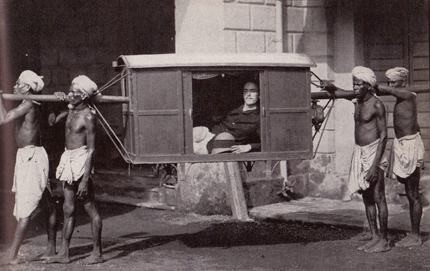
“Palkee or palanquin and bearers, Calcutta. Although the palanquin is no longer used for travel in India, in the days before the railroad it was of primary importance. The Kahars and other castes of palanquin bearers are thought to have been the prototypes of the bearers who are assigned to European sojourners in India today.”

During World War II the Smithsonian Institution issued a number of “War Background Studies.” I recently came across #18 in this series entitled Peoples of India by William H. Gilbert, Jr. (Washington D.C.: Smithsonian Institution, April 29, 1944). The image on Plate 6, reproduced above, sets the tone for this non-war zone. I was struck by the archaic presentation of images and the overtly Orientalist writing of Gilbert, who is billed as a “Specialist in Sociology and Anthropology, Legislative Reference Series, Library of Congress.” The Introduction (pp. 1-2) sets out in words the image vividly portrayed above. Read this for yourself and consider the various ways in which the author’s rhetoric both romanticizes India and justifies the colonial enterprise. I will make my own comments in a succeeding post, but I welcome comments posted here.

Introduction

Hardly any other country in the world can make a stronger claim on man’s inherent desire for the unique and the romantic than India. Continue reading India Orientalized for War, 1

Song, Poetry and Gender in Yemen’s Central Highlands


Dr. Najwa Adra, an anthropologist who has worked in Yemen since 1978, will be presenting a talk on “Song, Poetry and Gender in Yemen’s Central Highlands” today (April 7) at Marymount Manhattan College. The talk is from 7:30-9:30 pm in the Regina Peruggi Room of Marymount at 221 East 71st St. (between 2nd and 3rd avenues) in New York. This is a free event but seating is limited, so please RSVP to MilliBurns@gmail.com.

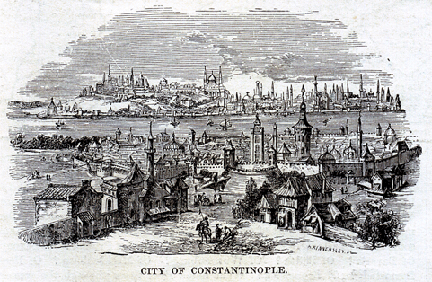
A Geography Lesson from 1879: #5: Turkey in Europe


In a previous post I presented an account of the geography of Arabia and Turkey in an 1879 geography school text. Here is the discussion on the European part of the declining Ottoman Empire:

1. TURKEY, constituting the European dominion of the Ottoman Empire, comprises the middle portion of the great southeastern peninsula of Europe.
2. The Climate in some places is severe, but is healthful and favorable to the growth of all the common cereals.
3. The Soil is productive, yielding in abundance the useful grains, tobacco, and grapes, as well as the olive and mulberry. Much attention is given to the culture of plants yielding medicines and perfumes. Continue reading A Geography Lesson from 1879: #5: Turkey in Europe

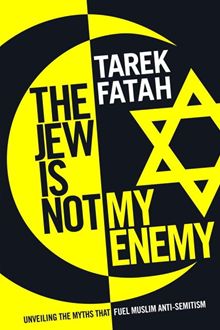
Review of “The Jew Is Not My Enemy”


The following is a review of The Jew Is Not My Enemy: Unveiling the Myths that Fuel Anti-Semitism by Tarek Fatah, published by McClelland & Stewart
ISBN: 978-0-7710-4783-1 (0-7710-4783-5). The review is written by Ivan Davidson Kalmar and published in the Literary Review of Canada, March, 2011.

As Tarek Fatah, the author of this provocative book, puts it, “By all rational standard, Muslims and Jews should have been, and could be, partners. Their faiths are very similar (…). There were even times when Muslims and Jews prayed together around the tone covered today by the Dome of the Rock [in Jerusalem].” Certainly in the imagination of western Christians at least, Muslims and Jews were for centuries regarded as two of a kind.

From the medieaval theologians through to Hegel, Islam was considered to be a revival of Judaism (which Christians thought should have died with Christ). Though the attitude to both Jews and Muslims has generally been hostile, it was not always so. For example, Jews and Muslims were both admired by nineteenth century romantics as possessors of an eastern spirituality that inspired and could continue to inspire the Occident.

When Jews and Arabs were both classed as members of the same “Semitic” race, “Semite” was at first often meant as a compliment. It was partly in reaction to romantic accounts of the Semites that the term “anti-Semitism” was invented by a new breed of Jew-haters. And it was, in turn, largely a reaction to modern anti-Semitism that the old idea of “returning” the Jews to the Orient took hold in the form of modern Zionism. Zionism led to a long and still ongoing, bloody conflict between Jews and Muslims over the holy land of Israel/Palestine. Continue reading Review of “The Jew Is Not My Enemy”

When in Paris


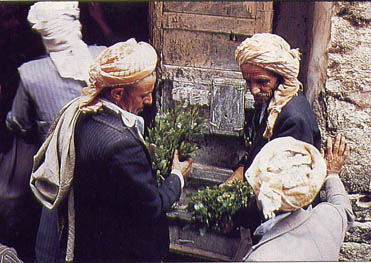
Qat market in Yemen; photograph by Pascal Maréchaux

For anyone reading this in Paris, I am giving a talk in the afternoon on qat in Yemen. Here are the details:

CONFÉRENCE
Prof. Dan Martin Varisco (Anthropologie, Hofstra university)
Qāt, Sex and Traditional Healing / Qāt, sexe et médecine traditionnelle

Abstract/Résumé
There is a substantial corpus of analysis about “Catha edulis”, or qāt in Arabic, both for Yemen and East Africa. Much of this focuses on the origin and distribution of the plant and its legality in an Islamic context. Prof. Varisco has previously published articles on both these aspects of the plant’s history. This talk will focus on the proposed medical benefits of qāt chewing in traditional Yemeni culture, with a focus on the issue of sexual
performance and libido. Although relatively late as an introduction into the medicinal and pharmacological literature, qāt was placed within the existing humoral system. Qāt was considered cold and dry, which explains why the recommended preparation for its use is eating a meal of ‘hot’ food like sorghum porridge or meat. Opinions differ about its impact on the libido. Prof. Varisco examine relevant historical sources (including legal
and medicinal texts), ethnographic accounts, poetry and contemporary scientific analysis of “Catha edulis” for his talk.

Un corpus est déjà constitué sur le qāt ou Catha edulis, aussi bien pour le Yémen que pour l’Afrique de l’Est. Il porte essentiellement sur l’origine et la distribution de cette plante, ainsi que sur son caractère légal en Islam. Ces deux aspects ont déjà fait l’objet de plusieurs publications du Prof. Varisco. Dans sa conférence de Paris, il s’intéressera plutôt aux vertus médicales du qāt, selon la culture yéménite, en particulier aux performances sexuelles et l’accroissement de la libido qu’il est considéré procurer. Bien que le qāt ait été introduit dans la théorie médicale et pharmacologique de manière tardive, il n’en fait pas moins partie du système des humeurs. Il est classé parmi les matières froides et sèches, ce qui explique qu’il doive être absorbé avec des mets Ë‹chaudsËŠ, tel que brouet de sorgho ou viande. Cependant, les opinions varient à propos de son effet sur la libido. Pour les besoins de sa communication, le Prof. Varisco aura donc recours à des sources historiques variées, incluant les textes légaux et médicaux, à des relevés ethnographiques, à la poésie et, enfin, aux analyses scientifiques contemporaines de « Catha edulis ».

La conférence se tiendra le 10 mars 2011 entre 15h et 17h, à l’Institut National d’Histoire de l’Art (INHA), en salle Vasary, Paris, France