Category Archives: “Arab Spring”

Ali Abdullah Salih: First Take


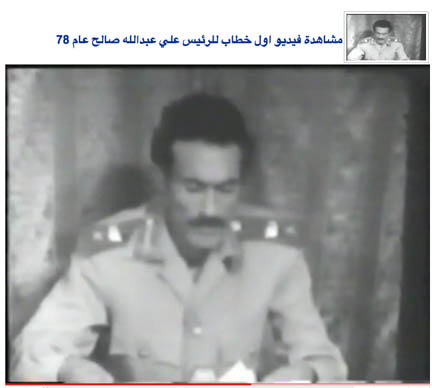
Yesterday, July 17, is a day that will live in history. Not because it was the day of my 35th anniversary, but because 33 years ago Sunday Ali Abdullah Salih came to power in Yemen. Yemen Press has posted a video of his first speech. Yemen remains in stalemate as President Salih remains in Saudi Arabia, despite all the rumors of his return to Sanaa. But stalemate is a downward slope as the government has ceased to function and even basic commodities are hard to get. We are watching a country self-destruct. The fact that videos get posted and Twitter whirls away over the continuing protests overshadows the obvious: Yemen has been a military dictatorship far too long to transition overnight into a practical democracy. Hopefully in another 33 years we will not see yet another first take of a military leader rebroadcast on the Internet…

Yusuf al-Qaradawi: Fatwa on Islam and Democracy

by Yusuf al-Qaradawi, Islamopedia, June 27, 2011

The Islamic state is a civil one, like other governments in the modern world and the only difference is that it makes Islamic Shari’a its reference. We would like to highlight, in this chapter, that the Islamic state is based on the Shura Council, allegiance, free choice of the nation to its ruler, advice to him, accountability of him, obedience to him, break of his allegiance if he commands sin, and the nation’s right to dismiss him if he insists on straying and deviation. This approach makes the essence of the Islamic state close to the democratic one.

By democracy we mean political democracy. As economic democracy is concerned, it means capitalism and it has its advantages and disadvantages, so we have been conservative about it while the social democracy means liberalism holding the absolute freedom, and we have been conservative about it too. Capitalism (of Qaron, a king of the past) is unacceptable to us since it is based on an idea of wealth refused by the Holy Quran. As Qaron said about his wealth, “I have been given it according to my knowledge”(stories: 78). Or as people said to Prophet Shoaib, “Does your prayer command us to leave what our fathers worshiped or that we do in our money what we want (Hud: 87).

According to Islamic thought, human being are heirs to the wealth of God. The Quran said: spend of that He made you heirs in it (Iron: 7). The true owner of the wealth is Allah while the rich man is trustee of this wealth and agent of the real owner. So ownership is bound with some duties and obligations as it is constrained in consumption, investment, distribution and circulation. Also, the giving of alms (Zakat) is imposed on the wealthy as one of the pillars of Islam. And usury, monopoly, fraud, injustice, extravagance, luxury, treasuring and other transactions are prohibited to the owners. With these admonitions and law, we could dull the dangerous nail of the capitalism, so as to achieve social justice, care for vulnerable groups in society such as orphans, the needy and the wayfarers, and work on a better distribution of the wealth “in order not to be the circulated among the rich of you” (al-Hashr: 7). Continue reading Yusuf al-Qaradawi: Fatwa on Islam and Democracy

Tabsir Redux: The Cynical Dairy Farmer’s Guide to the New Middle East


BY Karim Sadjapour, Foreign Policy, June 15, 2011

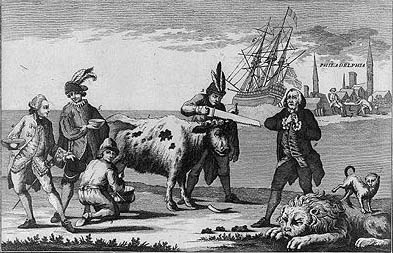
How a couple of cows explain a changing region: equal opportunity offender edition.

In the early years of the Cold War, in an effort to simplify — and parody — various political ideologies and philosophies, irreverent wits, in the spirit of George Orwell, went back to the farm. No one really knows how the two-cow joke known as “Parable of the Isms” came about, but most students of Political Science 101 have likely come across some variation of the following definitions:

Socialism: You have two cows. The government takes one of them and gives it to your neighbor.

Communism: You have two cows. The government takes them both and provides you with milk.

Nazism: You have two cows. The government shoots you and takes the cows.

Capitalism: You have two cows. You sell one and buy a bull.

Over the years, the parables gradually expanded, using the two-cow joke to explain everything from French unions (You have two cows. You go on strike because you want three cows.) to the Republican Party (You have two cows. Your neighbor has none. So what?). While in its original iteration the cows were a metaphor for currency, capital, and property, they later began to take on different meanings.

Today, the Middle East has replaced the Cold War as America’s primary foreign-policy preoccupation. As opposed to the seemingly ideologically homogenous communist bloc, however, the 22 diverse countries that compose the modern Middle East are still confusing to most Americans. Why can’t the Israeli and Palestinians stop fighting already? What’s the difference between Libya and Lebanon again?

Herewith then is a satirical effort to simplify the essence of Middle Eastern governments so that, in the immortal words of George W. Bush, “the boys in Lubbock” can read it. And, rather than symbolizing property, the cows here symbolize people, which — funny enough — is how most Middle Eastern regimes have traditionally viewed their populations.

Saudi Arabia
You have two cows with endless reserves of milk. Gorge them with grass, prevent them from interacting with bulls, and import South Asians to milk them.

Iran
You have two cows. You interrogate them until they concede they are Zionist agents. You send their milk to southern Lebanon and Gaza, or render it into highly enriched cream. International sanctions prevent your milk from being bought on the open market.

Syria
You have five cows, one of whom is an Alawite. Feed the Alawite cow well; beat the non-Alawite cows. Use the milk to finance your wife’s shopping sprees in London.

Lebanon
You have two cows. Syria claims ownership over them. You take them abroad and start successful cattle farms in Africa, Australia, and Latin America. You send the proceeds back home so your relatives can afford cosmetic surgery and Mercedes-Benzes.

Hezbollah
You have no cows. During breaks from milking on the teat of the Iranian cow you call for Israel’s annihilation. Continue reading Tabsir Redux: The Cynical Dairy Farmer’s Guide to the New Middle East

الأزهر والزنداني والدولة المدنية


محمدعبدالملك المتوكل

د.محمدعبدالملك المتوكل, المصدر أونلاين

بتاريخ 21/6/2011م نشرت جريدة الأهرام وثيقة الأزهر بشأن مستقبل مصر وبتاريخ 9 يوليو2011م نشرت جريدة الشارع هجوماً للشيخ الزنداني على الداعين للدولة المدنية والشرعية الثورية مطالباً لهم مراجعة دينهم، ومن المفيد للقارئ أن يعلم أن الأزهر بعلمائه والشيخ الزنداني بجامعته كلهم ينتمون إلى مذهب أهل السنة والجماعة ولكن، وللناس فيما يعشقون مذاهب.

حدد بيان الأزهر أحد عشر مبدأ نذكر منها خمسة مبادئ أساسية تتعلق بنظام الحكم.
الأول: تأسيس الدولة الوطنية الدستورية الديمقراطية الحديثة التي تعتمد على دستور ترتضيه الأمة يفصل بين سلطات الدولة ومؤسساتها القانونية الحاكمة ويحدد إطار الحكم ويضمن الحقوق والواجبات لكل أفرادها على قدم المساواة بحيث تكون سلطة التشريع فيها لنواب الشعب. وينسجم ذلك مع المفهوم الإسلامي الصحيح، فالإسلام لم يعرف لا في تشريعاته ولا حضارته ولا تأريخه ما يعرف في الثقافات الأخرى بالدولة الدينية الكهنوتية التي تسلطت على الناس.. بل ترك للناس إدارة مجتمعاتهم واختيار الآليات والمؤسسات المحققة لمصالحهم مع اشتراط أن تكون المبادئ الكلية للشريعة الإسلامية هي المصدر الأساسي للتشريع وبما يضمن لأتباع الديانات السماوية الأخرى الاحتكام إلى شرائعهم الدينية في قضايا الأحوال الشخصية.
Continue reading الأزهر والزنداني والدولة المدنية

كيف استقبل شباب الثورة بصنعاء ظهور صالح؟!


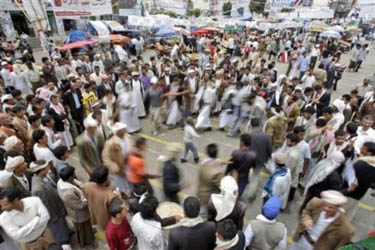
  • الصورة لمتظاهرين في ساحة التغيير بصنعاء في 4 يوليو الجاري (AP).

    لمصدر أونلاين ـ صلاح القاعدي

    تباينت ردود الفعل لدى شباب الثورة في ساحة التغيير بصنعاء من الظهور العلني للرئيس صالح من خلال خطابه المسجل الذي بث يوم الخميس الفائت، وتوزعت بين حالة من الاحتقان والسخط على القوى المحلية والدولية لتأثيرها على مسار الثورة، وأخرى ساخرة.

    الشباب الذين استولى عليهم السخط والغضب نتيجة شعور سيطر عليهم، بسبب تفويتهم الفرص المتاحة لحسم الثورة، التي كان أبرزها فرصة رحيل صالح إلى السعودية. ومع ذلك خرج الشباب في مسيرات تجوب ساحة التغيير مرددين هتافات ضد قوى يعتقدون أنها سبباً حقيقياً في تأجيل حسم الثورة وومن بينها أحزاب اللقاء المشترك ودولتي السعودية والولايات المتحدة الأمريكية.

    وتنامت حالة العداء تجاه السعودية والولايات المتحدة في أوساط شباب الثورة في اليمن خلال الآونة الأخيرة بسبب دور الأخيرتين البارز في حل المشكلة اليمنية، وسط اتهامات لهما بالتواطؤ مع نظام صالح والسعي لإجهاض الثورة السلمية المطالبة بإنهاء حكم صالح المستمر منذ نحو 33 عاماً.

    الاختلاف في الآراء ووجهات النظر كان سيد الموقف حول انعكاسات خطاب صالح، ويرى الشاب سليمان الراشدي ان اتضاح حالة صالح الصحية بعد أسابيع من التضارب، سيسهل في الإقدام على الخطوات القادمة وتحقيق بقية الأهداف التي قامت من أجلها الثورة.

    لكن كثيراً من شباب الثورة جعلوا من ظهور صالح مادة لصياغة النكتة التي تتميز بسرعة انتشارها على قطاع واسع من اليمن بمختلف الوسائل المتاحة.
    Continue reading كيف استقبل شباب الثورة بصنعاء ظهور صالح؟!

  • Breaking News: Salih on Yemeni TV


    from Al Jazeera website

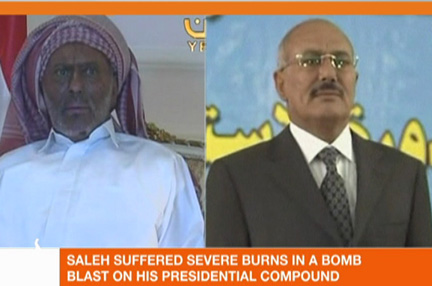
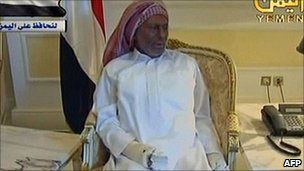
    The first video of President Ali Abdullah Salih since his severe injuries has been broadcast in Yemen just a short while ago. A brief excerpt is already on Youtube with better videos likely to be posted. As the pictures above and below show, he is heavily bandaged and the audio indicates he has trouble speaking. It is hard to imagine that he would be able to resume work any time in the foreseeable future. It appears he is lucky to even be alive. For an interview on Al Jazeera with Dr. Ameen al-Himyari of Qatar University, click here.


    from the BBC website

    The Seduction of Simple Solutions


    Over at Waq al-Waq there is an excellent commentary by Greg Johnsen on the situation in Yemen, responding to a “think tank” report from people who really do not know Yemen very well (or apparently want to know it in a certain way). Here is the start…

    Late last week Frank Cilluffo and Clint Watts released a policy brief from George Washington University’s Homeland Security Policy Institute entitled “Yemen and al-Qaeda in the Arabian Peninsula: Exploiting a Window of Counterterrorism Opportunity.”

    My in-box quickly filled up with helpful people sending me copies of the report, I have now had time to read it and digest and my thoughts follow below.

    (Note:) I don’t know Frank Cilluffo but I do know and respect Clint and he has seen a copy of my rebuttal here prior to posting.

    For those who are faithful readers of Waq al-waq it should come as no surprise that I strongly disagree with the report and its conclusions. I think this is what happens when smart people tackle a complex problem in an environment they don’t know particularly well. The report, in my opinion, is full of assumptions that make sense broadly but break down the closer one gets to Yemen.

    Obviously there are parts of the report I agree with, and many other places where well-intentioned people can disagree.

    (Quotes from the paper are in italics; mine are in regular caps.)

    Assumption 1: AQAP suddenly stronger this month

    “This week’s escape of 63 suspected al Qaeda in the Arabian Peninsula (AQAP) fighters from a Yemeni prison exemplifies how President Saleh’s departure to Saudi Arabia and Yemeni instability embolden this lethal al Qaeda affiliate.“

    I’m pretty sure that AQAP was emboldened prior to Salih’s departure, the group has been incredibly active in Yemen recently and I would argue that largely as a result of US air strikes between December 2009 and May 2010, the organization is actually stronger now in terms of recruits than it was when it dispatched the so-called underwear bomber who tried to bring down the airplane over Detroit on Christmas Day 2009.

    Assumption 2: Huthis and Southern Movement are responsible

    “In recent weeks, the writ of government in Yemen has evaporated under the twin strains of the Houthi rebellion in northern Yemen and the Secessionist movement in southern Yemen.”

    This is simply untrue – the writ of Yemen’s government has evaporated under popular protests. The Huthi rebellion has been ongoing since 2004 and the Southern movement since 2007 – neither of these are new, and neither of these are the cause of the recent collapse.

    For Greg’s full commentary, click here.

    French Center for Yemeni Studies threatened


    Le CEFAS : un instrument indispensable de compréhension de la péninsule Arabique

    by Laurent Bonnefoy (chercheur, Institut français du Proche-Orient)

    En 2011, jamais la France et l’Union européenne n’ont autant eu besoin de comprendre les sociétés arabes. Jamais les chercheurs spécialistes du monde arabe contemporain n’ont autant répondu à une demande sociale venant tant des médias et des diplomates que même parfois des entreprises. A l’heure où le Yémen connaît un profond mouvement de révolte et où s’expriment des aspirations au changement, à la liberté et à la démocratie, le ministère des Affaires étrangères songe à mettre fin à l’expérience du Centre français d’archéologie et de sciences sociales de Sanaa (CEFAS).

    Ce centre, créé sous le nom de Centre français d’études yéménites en 1982 sous la double tutelle du ministères des Affaires étrangères et du CNRS, a en près de trente ans permis à des centaines d’étudiants et de chercheurs de se familiariser avec les sociétés de la péninsule Arabique, d’apprendre l’arabe et de mener à bien de nombreux projets de recherche avec les partenaires locaux qu’ils soient yéménites, saoudiens, omanais ou autres. Son travail d’interface avec les institutions yéménites et du Golfe, sa bibliothèque exhaustive ont fait du CEFAS un instrument unique au monde, valorisé à l’échelle internationale. Les archéologues liés à cet institut ont été à la pointe des découvertes sur les cités antiques de l’Arabie Heureuse. Ses historiens ont pu analyser et réévaluer tant les spécificités que l’intégration ancienne de la péninsule Arabique dans le système monde. Ensemble ils ont directement contribué à valoriser, mais également à préserver, un patrimoine d’une richesse inestimable qui reste encore pour une grande part inconnu. Les chercheurs en sciences sociales ont pour leur part travaillé à rendre intelligible les sociétés et systèmes politiques de cette région du monde arabe. Le rôle de chacun, dans un Yémen et dans un Golfe arabo-persique en transformation, est dès maintenant d’appréhender et d’analyser les transformations et, à l’usage de chacun en France, en Europe et dans le monde, de fournir de nouvelles grilles de lectures indispensables. Continue reading French Center for Yemeni Studies threatened