Category Archives: “Arab Spring”

Newsweak


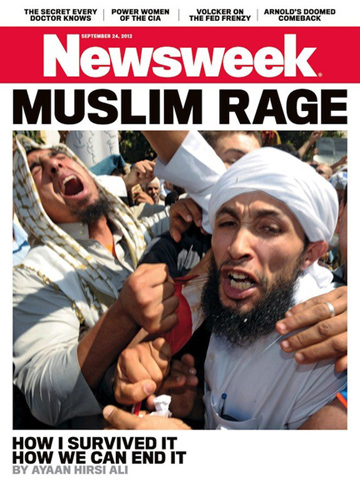
Edward Said wrote a poignant critique of media coverage of the Iranian hostage crisis just over three decades ago. He called it “Covering Islam.” The subtitle was “How the Media and the Experts Determine How We See the Rest of the World.” Once again Islam is being covered, the latest being the “cover” on Newsweek Magazine. Said’s [Covering Islam (1997 edition), p. lv.] assessment is as relevant as ever today:

For the right, Islam represents barbarism; for the left, medieval theocracy; for the center, a kind of distasteful exoticism. In all camps there is agreement that even though little enough is known about the Islamic world there is not much to be approved of there.

The latest Newsweek cover demonstrates just how weak its sense of responsible news reporting is. The trope of “Muslim Rage” conflates the cultural dimensions of politics with a religious faith. When Israeli planes bomb Hamas in Gaza, no major newspaper calls this “Jewish Rage.” When Terry Jones burns a Quran or when Anders Behring Breivik shoots fellow Norwegians, I have yet to see a headline of this act as one of “Christian Rage.” Rage is almost always political at base and the events subsumed under a blanket umbrella of “Muslim Rage” are local politics to the core. The fact that we see these images on CNN and the Internet tells us more about the audience than it does about those engaged in the activities.

The photograph captures “rage” to be sure, but the choice of turbaned and bearded protesters (when the majority in Cairo at least are young clean-shaven men in Western clothing lobbing rocks at the police) identifies rage with a style of dress and a style of dress with a violent religion. Ironically, the voices of those who are enraged are not to be heard anywhere inside the story. Instead, the cover boasts an article inside by Aayan Hirsi Ali, a controversial Somali whose claim to fame was posing naked with Quranic verses on her body and then becoming a darling of the Islamophobic mob. Her knowledge of Islam is so immature and biased that the very idea she might have something to contribute to the issue staggers my imagination.

I see little difference between this cover photo and that on the French tabloid Closer, which brandished the privately bared royal breasts of British princess Kate Middleton. Continue reading Newsweak
Foot[ball] in mouth disease


A division of labor: ultras wage parallel battles to shape Egypt’s future

By James M. Dorsey, The Turbulent World of Middle East Soccer, September 16, 2012

Militant soccer fans of arch rival Cairo soccer clubs Al Zamalek SC and Al Ahly SC represent two sides of the same coin in the forefront of a struggle for the future of Egypt.

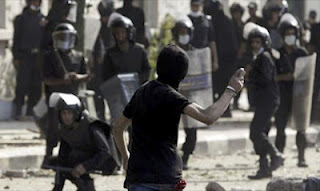
Militants of the Ultras White Knights (UWK), the Zamalek support group, are locked near the US embassy in Cairo into vicious street battles with police and security forces, one of a string of confrontations since last year’s toppling of president Hosni Mubarak. In the ultimate analysis, their struggle aims to force reform of Egyptian law enforcement, the country’s most despised institution, which is widely seen as the brutal enforcers of Mr. Mubarak’s repressive regime, even if those on the battlefield often express their goal in simpler terms of revenge and settling scores.

On the other hand, Al Ahly militants, who together with UWK played a key role in ousting Mr. Mubarak as well as in subsequent street battles that have left scores dead and thousands wounded, have turned their ire on the management of their club in an effort to combat corruption in Egyptian soccer.

Neither battle is easy but achieving victory in the struggle in which UWK has taken the lead is likely to prove far more difficult than turning soccer into a model for the fight against corruption in Egypt and removing the remnants of the Mubarak era. Continue reading Foot[ball] in mouth disease

Mitt miffs the tweets


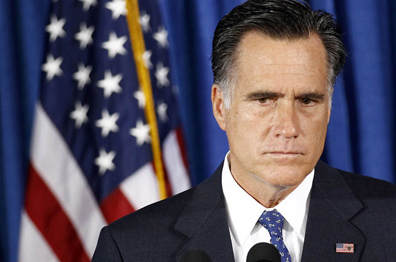
US Republican presidential nominee Mitt Romney listens to questions on the attack on the US consulate in Libya, in Jacksonville, Florida, September 12, 2012. [Reuters]

Romney poses, as militants burn a US consulate over Islamophobic film

By Juan Cole, Al Jazeera, September 14, 2012

As Mitt Romney misfires on the campaign trail; scholar argues that the events in Benghazi are atypical of the new Libya.

Predictably, Republican presidential candidate Mitt Romney tried to make political hay of the tiny demonstrations in Cairo and Benghazi by Muslim militants. The Benghazi mob turned violent in clashes with police and the consulate ended up being burned and an embassy staffers being killed.

Romney seized on the frantic tweets of the Cairo embassy, which condemned the sleazy Youtube videos by American Islamophobes that had provoked the ire of the crowds, as evidence that the Obama administration was sidingwith the attacking mobs. First of all, really? Romney is trying to get elected on the back of a dead US diplomat? Second of all, really? He thinks the State Department thought the attack on themselves was justified? Third of all, really? Romney is selective. When it comes to Christianity, Romney decries a ‘war on religion.’ But apparently he thinks there *should* be a war on Islamic religion. Romney’s intervention (he is just a civilian at the moment) in American foreign policy is unwise and risky, not to mention distasteful. Continue reading Mitt miffs the tweets

Beyond religion in the Middle East


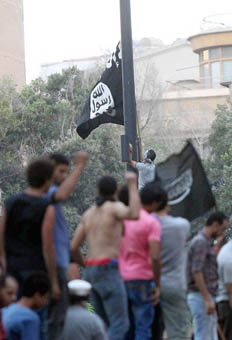
An Egyptian protester tries to raise an Islamic flag at the U.S. embassy during a protest, in Cairo, Egypt on September 11, 2012. (Khaled Elfiqi / EPA / September 13, 2012)

Violence in Egypt and Libya is more about local politics than Islam.

By Mimi Hanaoka, LA Times, September 13, 20121

The chaotic violence that killed U.S. Ambassador J. Christopher Stevens and three American staffers in Libya, and that resulted in a mob storming the U.S. Embassy in Cairo, has been garbed in religious language and references. However, the religious rhetoric from all corners distracts from the real issues: serious domestic political fragmentation in Libya and Egypt in the aftermath of the Arab Spring, and America’s place in the region.

Media attention has focused on a polemic 14-minute movie trailer for “Innocence of Muslims” posted on YouTube, which prompted protests in Benghazi and Cairo. The film was allegedly produced by Sam Bacile, who has identified himself as an Israeli Jew. In the Wall Street Journal, Bacile called Islam a “cancer” and claimed he raised $5 million from about 100 Jewish donors to fund the film, details that only intensify the film’s polemic power.

The trailer, translated into Arabic and viewed thousands of times in the Middle East, portrays the prophet Muhammad as, among other things, a child abuser. Florida pastor and provocateur Terry Jones, who burned the Koran in 2011, claims to have screened the film; a self-described Christian militant in California claims to have consulted on it. Continue reading Beyond religion in the Middle East

Hakadha (Thus Spake Zahed Sultan)


Zahed Sultan Releases ‘Revolutionary’ New Song & Music Video

Watch Zahed Sultan’s new ‘Like This (ha-ka-tha)’ music video on www.youtube.com/zahedsultan

Sign up on www.mousemusic.org and download free ‘Like This (ha-ka-tha)’ wallpaper for your computer.

Zahed Sultan announces the release of his new song & music video entitled “Like This (ha-ka-tha).” The song pays tribute to the social frustrations that have plagued the MENA region prior to the Arab Spring. In classical spoken-word Arabic, Zahed calls upon the Arab people to stand in unity, against tyranny, with a sense of civic pride.

In his music video, Zahed gives a gripping account of the revolutions as they sequentially unfold in each Arab country through use of raw-footage (shot by protestors with cell-phones) and stop-motion animation.

Be an active part of the change happening around you and share Zahed’s latest song & music video with your network!

About The Artist

Zahed is a music producer and social entrepreneur from Kuwait. He released his debut album “Hi Fear, Lo Love” on April 1st 2011and attained success with his 2nd single “I Want Her But I Don’t Want Her.” Parisian Dj, Stephane Pompougnac, featured the single on the internationally acclaimed Hotel Costes 15 compilation, which was released on Sept. 26th 2011. Continue reading Hakadha (Thus Spake Zahed Sultan)

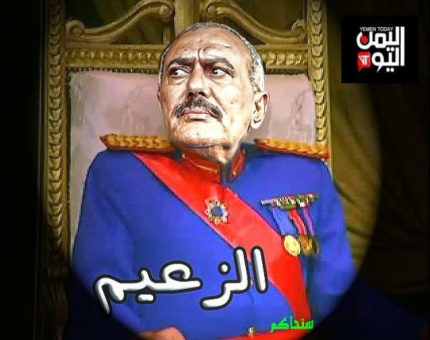
Ali Abdullah Salih: Not invincible, not invisible


A little over six months ago, Ali Abdullah Salih finally resigned himself to the fact that he was no longer wanted by the people of Yemen or the international community as president-for-life in Yemen. But instead of taking his stashed away millions to exile in Saudi Arabia, which has open-armed several past dictators with Muslim names, or bribing a poor country to host him and his family, he remains in Yemen. I suspect when someone is in power for as long as Salih was, that delusion is the normal path. Perhaps he thinks that if things keep on getting worse (ignoring the fact that the problems are largely his own creation), Yemenis will bring him back. Perhaps he has heard those Iraqis who say things were better under Saddam? Perhaps, but his delusion contributes to the problem as long as he is living in Yemen.

Salih played the “dancing on the heads of snakes” game throughout his tenure at the head of the Yemeni state. He built a family-run state, allying himself with tribal powerbrokers like Shaykh Abdullah al-Ahmar, and shaping the military into a private army. Corruption was rampant and few Yemenis were fooled by the state-tun media myth of Salih as the father of his country. His triumph of uniting north and south was a ruse from the start, extending his control rather than actually caring to build a united country. But his downfall is largely due to backing the extremists, the Jihadis back from Afghanistan, those whose ideology he could never uproot for his own advantage. When his troops took over Aden in the 1994 civil war, Salih allowed northern zealots to raze religious shrines and demolish the one beer factory in the country. As the zealots shouted “Allahu Akbar” the guy in the presidential palace could only think of himself as the “akbar.” Building a monster mosque in the capital, not unlike Saddam’s architectural piety, could hardly disguise the fact that here was a man who worshipped himself. He was not the first to do so, is not alone in doing so, and will not be the last. Continue reading Ali Abdullah Salih: Not invincible, not invisible

Revolution of the Thirsty


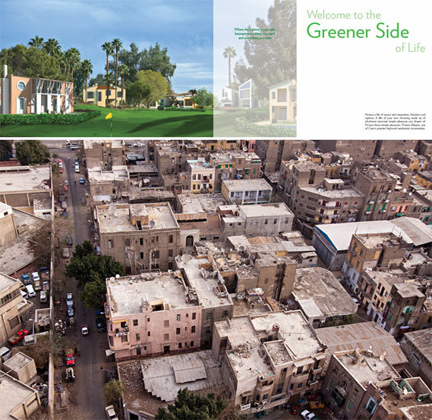
Top: Promotional image for Allegria, a gated community in Sheikh Zayed City, a suburb of Cairo, Egypt. [Image by SODIC] Bottom: Neighborhood in Cairo. [Photo by Brandon Atkinson]

by Karen Piper, The Design Observer Group, July 12, 2012

“Welcome to the Greener Side of Life” beckoned the billboard on Cairo’s Ring Road, which showed a man in a jaunty hat teeing off on a verdant golf course flowing into the horizon. I was stuck in traffic, breathing that mix of Saharan dust and pollution also known as “air,” so I could see the appeal. Somewhere outside the city, in a gated community called Allegria — Italian for “cheerfulness” — a greener life awaited. “Over 80% of Allegria’s land is dedicated to green and public spaces,” boasts the developer’s brochure, “meaning you’ll never lose the peace and tranquility which goes hand in hand with outdoor living.”

It was a scorching hot summer, several months before the Egyptian revolution. Beneath the expressway sprawled the informal settlements where an estimated 60 percent of metropolitan Cairo’s 18 million residents live. [1] Some were using billboard poles to keep the brick structures from collapsing. Many did not have running water, and those who did found the taps drying up as water was diverted to the lavishly landscaped suburban developments with names like Allegria, Dreamland, Beverly Hills, Swan Lake, Utopia — a diversion that was straining the capacity of state-run water distribution networks and waste treatment plants. [2] Continue reading Revolution of the Thirsty