Category Archives: Gender and Sexuality

Flowers and Virtue

[The following commentary discusses a recent attempt in Yemen to create religious police, such as are found in Iran, as an intrusion on Yemeni values and rights in the modern state.]

The paradox of “Mashaqir” and the religious police

Dr. Mohammed Al-Qadhi, Yemen Times

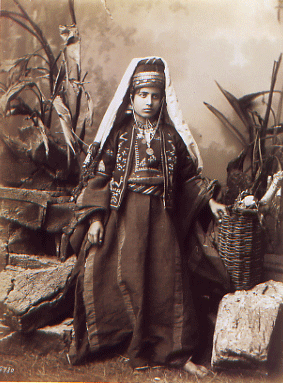
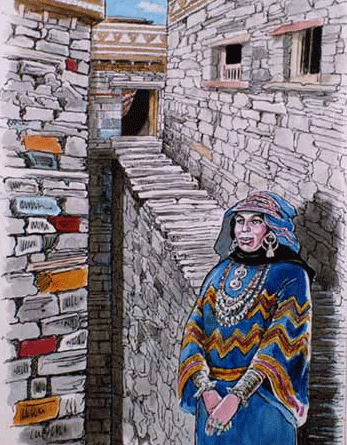
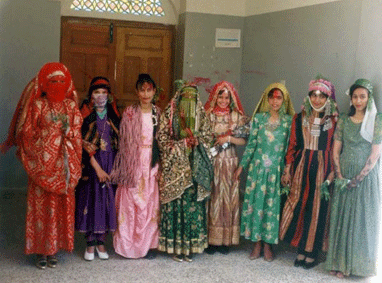
I think the best response to the establishment of a religious police force, under the banner of promoting virtue and curbing vice, is the mashaqir (traditional flowers women put on either side of their head) function run by the House of Folklore. I was extremely thrilled with spiritual joy with the function that revived in everybody nostalgia for a simple and pure life for both men and women free from extremism and fanaticism. The mashqour, a singular form of mashaqir, is a symbol of chastity and freedom women enjoyed in an ordinary rustic life. It also stands for an abused femininity now by a puritanical interpretation of life where everything is devilish and hellish and a male-dominated and masculine culture that considers women inferior to men.

See the paradox between a group of fundamentalist clerics that want to kill life and a function organized by Arwa Othman, director of House of Folklore, that wants to revive and breathe life into the society and women through restoring the culture of the mashaqir. Continue reading Flowers and Virtue

Niqab and the Social Contract

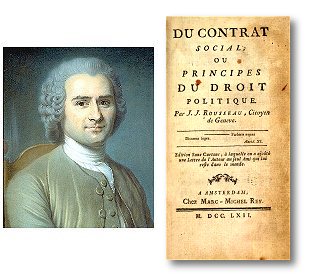
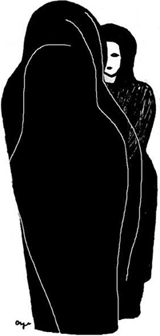
Remember your Rousseau: “man is born free, but he is everywhere in chains.” Updating the male-oriented language of his day, women must also be born free. Feminists would argue that everywhere she is also bound in chauvanistic chains, but what would Rousseau say about women who in some places are hidden away head to toe in full-length veils? To veil or not to veil: that has become more than a philosophical question these days. A recent legal opinion in France denied Faiza Silmi, a Moroccan woman, French citizenship because of her insistence on wearing the niqab, which obscured all but a narrow slit-view of her eyes in public. In a similar context, a Muslim woman in Florida was not allowed to have her driver’s license picture taken without showing her face. While relatively few Muslim women in Western societies choose to be chador laden or walk around in full-length woven tents, the few that do invariably stir strong feelings. If the intention is to be invisible, the opposite response is inevitable. In both these cases the issue was not one of physically removing their choice of dress in public, but one of a lack of the conformity necessary for negotiating individuality in the public sphere. If you want to become a French citizen, an option rather than a natural right, then you must accept the range of behavior agreed upon as acceptable in secular French culture. Dressing like Muhammad’s wives supposedly did in the 7th century may convince the authorities in Saudi Arabia, but modern France freed itself from the bloody history of religious bigotry that such symbols often cover. If you want the privilege of driving a car, then you need to pass a driving test and not obstruct your vision or prevent authorities from identifying you by failing to show your face. Continue reading Niqab and the Social Contract

Divided We Stand

Divided We Stand: A Woman’s Word about the Iranian-American Experience

by Dagmar Riedel

Gertrude Stein is alleged to have advised young Ernest Hemingway that he’d better stick to writing postcards if he had messages for his readers. It is understandable that Iranian-Americans want to reach American-American audiences with their stories about men and women with legs astride in two different cultures. But who is authorized to question a novel with a message, if its content is certified by the author’s traditional upbringing in Iran before the Islamic Revolution?

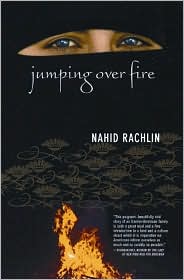
The fourth novel of Nahid Rachlin, Jumping over Fire (City Lights Books, 2005; cf. www nahidrachlin.com), has an intriguing black cover. Above the title a pair of blue eyes are staring intently at the viewer through the eye slit of a head scarf, while the bottom half merges a floral Arabesque with the yellow-red flames of a Nowruz bonfire. The title’s reference to the Nowruz purification ritual of jumping over fire is explained in the course of the novel. But on the cover the Zoroastrian tradition is presented as a variant of Western stereotypes of both the Oriental harem and Shia fanaticism because the collage promises a peek in the otherwise hidden world of a secluded Iranian woman and her burning desires. The reader has just to turn to the back cover to receive from Andre Dubus III, the son of the famous short-story author Andre Dubus, the confirmation that this is indeed a novel about a forbidden desire. The interpretation is further reinforced by the one-page biographical sketch in the back, written in the third person singular and designed to highlight in an objective language the author’s lifelong personal experience with displacement and gender-based social restrictions. Continue reading Divided We Stand

Gender Takes a Licking

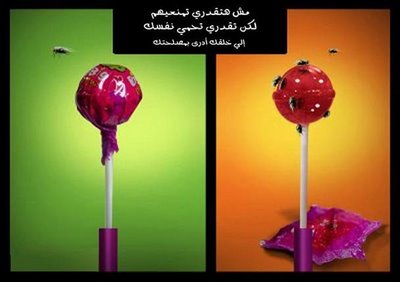
One thing that ethical reflection by most Muslims, Christians and feminists can agree upon is that female sexuality in advertising is degrading to women, turning them into objects for the male gaze. There is no question that sex sells and not just on Madison Avenue. A recent video commercial for Wall’s Magnum chocolate bar, starring Pakistani model Neha Ahmed, is as suggestive as any MTV video. Indeed Bollywood rivals Hollywood in depicting the female body as a focus of attraction. But exploitation is not only from companies out to make a buck by subliminally changing the letter “b” to the letter “f.” Sometimes those sincere individuals who think they are defending women’s honor end up reinforcing the stereotype. Such is the case for the image pictured above and posted on an Islamic website. There are many reasons why a woman would choose to wear hijab, but in this metaphor their gender takes a licking. The issue is not the wrapping, whether hijab or sticky paper, but the fact that flies will go for the candy no matter what you try to do. Does it occur to the creator of this image that the problem is not with candy, which is tasteful in the right context, but the nuisance of unzipped flies. Someone go find the fly swatter, please.

Luke R. E. Publican

FGM, Early Marriage and Juvenile Delinquents

MPS say: no to genital mutilation, 18 is minimum marriage age, juveniles cannot be punished as adults

By: Kawkab Al-Thaibani For the Yemen Times

SANA’A, June 24 — A two-day workshop in Parliament concluded that the minimum marriage age in Yemen should be 18, and the sponsors of both brides and grooms should be punished if they allow them to marry under this age.

The workshop’s participants also concluded that juvenile delinquents between the ages of 15 and 18 are not equal to adult criminals. They further recommended laws banning female genital mutilation.

The workshop covered three main areas: the criminality of juveniles, female genital mutilation, and the minimum age of marriage. These three subjects were chosen because the existing laws concerning them are not specific enough and are often ignored.

This workshop was arranged by Parliament, the Higher Council for Motherhood and Childhood, and the Yemeni Network Combating Violence Against Women known as SHIMA, under the sponsorship of the UN Children’s Fund (UNICEF), OXFAM International, and Save the Children, a worldwide children’s rights organization. Attendees included members of the Sharia Committee, who matches the constitutional laws with Islamic sharia law, Parliament members (MPs), doctors and human rights activists. Continue reading FGM, Early Marriage and Juvenile Delinquents

Me without my hijab

Removing my head covering changed how I saw myself and the world.
By Zainab Mineeia, Los Angeles Times, June 8, 2008

When I came to this country, I took off my hijab. It wasn’t an easy decision. I worried at night that God would punish me for it. That’s what I had been taught would happen, and it filled me with fear.

I was 27, coming from my home country of Iraq to study in California. I hoped that by taking off the hijab I had been wearing for eight years, I would be able to maintain a low profile. In Baghdad, you keep a low profile to stay alive. But in the United States, I merely wanted not to be judged.

Still, I was filled with anxiety. As I flew toward the United States, I wondered how I would feel when the moment came to appear with my head uncovered. Continue reading Me without my hijab

Comparative Islamic Studies

The latest issue (Vol 2, No 2, 2006) of Comparative Islamic Studies, edited by Brannon Wheeler, is now available online. The articles in this special issue all deal with Islam and gender. While the articles are by subscription or for purchase, the book reviews can be read for free. Here are the article abstacts.

“Traditional” exegeses of 4:34
by Karen Bauer

Abstract: The beginning of Qur’an 4:34 (Men are qawwāmūn over women, with what God has preferred some over others, and with what they spend of their wealth) is often taken to legislate men’s authority over women. But many questions remain about the history of interpretations of this verse. In what ways have interpretations developed through time? Do pre-modern interpretations of this verse resemble modern interpretations, and what do such resemblances say about the attitudes of the exegetes? And what are the methods that pre-modern and modern exegetes use to arrive at their interpretations?

One way of empirically examining the variety in the pre-modern heritage, the methods of the exegetes, and the use of the pre-modern heritage in modern discourse is through the genre of Qur’ān commentaries (tafsīr al-Qur’ān). This verse has always been a source of controversy: pre-modern exegeses of it are varied. In the first part of this paper, I explore some of the variations in the content and methods of pre-modern interpretation, focusing on the ways in which content and method developed through time. I argue that some of the variations in content between the earliest and later pre-modern exegeses may be due to development in the exegetes’ methods of writing exegesis.

Continue reading Comparative Islamic Studies