Category Archives: Gender and Sexuality

Letter from Islah to Tawakkul Karman


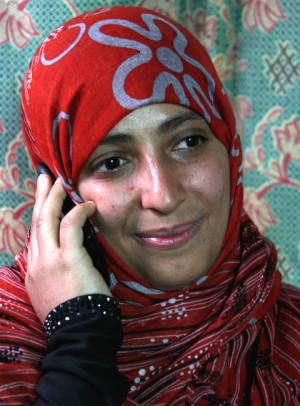
Tawakkul Karman

Yesterday I wondered how the Yemeni party Islah would respond to the Nobel Prize being given to one of its members. Here is the official letter, congratulating her, sent to Karman from Muhammad Abdullah al-Yadumi,

بسم الله الرحمن الرحيم

الأخت المناضلة / توكل عبدالسلام كرمان

رئيس منظمة صحفيات بلا قيود, عضو مجلس شورى التجمع اليمني للإصلاح

تحية وتقدير وبعد :

بكل ابتهاج تلقينا في التجمع اليمني للإصلاح إعلان فوزكم بجائزة نوبل للسلام كأول امرأة عربية تحظى بهذا التكريم وأول شخصية يمنية تمنح هذه الثقة الدولية الهامة.

إننا ونحن نهنئكم بهذا الإنجاز التاريخي نعتبر هذا الفوز مكسبا للثورة اليمنية السلمية وللمرأة اليمنية المناضلة والواعية القادرة على صنع النجاح رغم عوائق التخلف وموروثات الإستبداد التي حالت بين شعبنا وبين الإبداع لعقود من الزمن.

كما أن تكريمكم اليوم بجائزة نوبل للسلام يعد تتويجا مستحقا لجهود سنوات من نضالكم السلمي الدؤوب وكفاحكم المرير ضد منظومة الجهل والظلم والفساد في مختلف الميادين الإعلامية والحقوقية والسياسية ونصرة المظلومين وغيرها من المجالات وصولاً إلى العمل الثوري السلمي الذي مازال شعبنا برجاله ونسائه وشبابه وشيوخه يخوضه دون استكانة أو لين حتى يتحقق له ما يصبو إليه من حرية وكرامة وعدالة وحكم رشيد .

كما أننا نرى في هذا التكريم شهادة أممية على حضارية شعبنا اليمني وعدالة مطالبه وسلامة نهجه السلمي في التغيير، متمنين في هذا السياق ان يرافق هذا الإعتراف من المجتمع المدني الدولي بعدالة المطالب اليمنية إعتراف سياسي دولي بهذه المطالب وان يسارع العالم بأسره الى الوقوف مع الشعب اليمني التواق للحرية والتغيير.

نكرر تهانينا الصادقة لكم ولكل ذوي المبادرات الرائدة في وطننا الحبيب ، مع تمنياتنا لكم بالتوفيق والنجاح ومزيداً من العطاء.

والسلام عليكم ورحمة الله وبركاته،،

أخوكم /

محمد بن عبدالله اليدومي

رئيس الهيئة العليا للتجمع اليمني للإصلاح

Yemeni woman shares Nobel Peace Prize


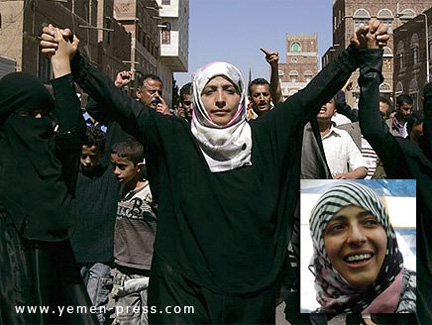
The Nobel Peace Prize for 2011 has just been released with three recipients: Ellen Johnson Sirleaf, Lehmah Gbowee and Tawwakul Karman. All three were chosen “for their non-violent struggle for the safety of women and for women’s rights to full participation in peace-building work.” Karman is Yemeni; but beyond this she is the first Arab woman to win a Nobel prize, a point proudly noted on the Yemeni media site Yemen Press. It will be interesting to watch the reaction to the choice. Here is an activist who took to the streets to promote a peaceful transition from the corrupt secular dynasty of Ali Abdullah Salih. She is one of many Yemenis sharing the same goal and not a principle organizer, although her superb English skills attracted attention in the foreign media. She is also actively involved in the powerful Islamic party of Islah.

As always there will be much second guessing as to why these particular individuals were chosen. I suspect that Karman was not near the top of any speculation list. The Nobel Peace Prize, however, is the most symbolic of these “dynamic” Swedish awards, with the aim of promoting an idea more than finding the “best qualified” candidate. The stated aim this year, however, was a focus on the role of women as peacemakers. Fortunately there are many women activists peacefully advocating against corrupt politics and prejudicial practices. The choice this year appears to be a consciously rounded decision, also including the Liberian president Ellen Sirleaf and Lehmah Gbowee, a social worker also involved in the peace movement in Liberia. If it had just been Sirleaf, one might have dismissed the choice as yet another politician, no matter how worthy, but including Gbowee and Karman may have more to do with inspiring more women to participate at the local level than their actual accomplishments or impact.

As a senior member of the prominent Yemeni Islamic party Islah, Karman does not fit the mold most Westerners hold of Muslim women. She covers her hair with a scarf, but without the extreme niqab or even the more ubiquitous Yemeni sharshaf ( a full-length black outer veil introduced to Yemen by the Ottoman Turks). While the media is for the most part fixated on the masculine culture of Al Qaida, the role of women in Yemen is either ignored or stereotyped. So this choice will draw attention to the fact that there are women who are proud to be Muslim and do not view themselves as servile slaves. But it will also, I suspect, result in detractors within Yemen who will be jealous of the attention she is receiving and perhaps even dismiss it as yet another “Western” intrusion. Will the leaders of Islah promote this honor to one of their members? Will rival Islamic groups use her as a wedge issue? Continue reading Yemeni woman shares Nobel Peace Prize

Googling in Arabic (sort of)

Let’s say you really do not know the Arabic language, but you want to Google in Arabic. Where there is a linguistic will, there is a digital way. Now you can simply turn to Yamli, a Google-like engine that allows you to type in English, choose the relevant Arabic term and search Arabic sites. There are other sites as well. So I typed in “mawt” and up popped the Arabic word for death. The problem is that the sites chosen are actually in Arabic, so what good does it do to search when the sites themselves cannot be read? Continue reading Googling in Arabic (sort of)

The Voting Gap


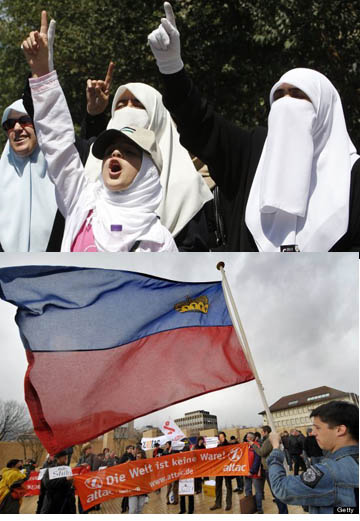
Women in Jordan (top); women in Lichtenstein (bottom): Which country first allowed women to vote?

In every region, there are laws that discriminate against women, in relation to property, the family, employment and citizenship. Too often, justice institutions, including the police and the courts, deny women justice.
Progress of the World’s Women, UN Report

Much attention is paid to the disparate gender roles in Islamic countries, from blanket veiling of women to not being allowed to drive cars. Yes, there are cultural elements in a number of Muslim-majority countries that treat women unequally. But gender inequality is not specific to Islam or any single nation. The sad truth is that in 2011 the species of Homo sapiens has not yet evolved a universal sense of the equal worth of males and females. Theories abound as to why males tend to dominate and it would be premature to believe that males have always been on top in social interaction. I do not defend cultural practices, dressed in religious rhetoric, that discriminate against women (nor would I if they discriminated against men, which is so rare it seems absurd to mention it). But it is useful to remind ourselves in the secular West of the Gospel advice that we should not be so intent on dissing the mote in someone else’s eye when there is a beam in our own (I see no problem in reversing the mote and beam for the moral).

Take voting, for example. Exactly a century ago only two countries in the world allowed women to vote. Today, that right is almost universal. It is not yet a century since women received the right to vote in the United States. Continue reading The Voting Gap

In Memory of BJ


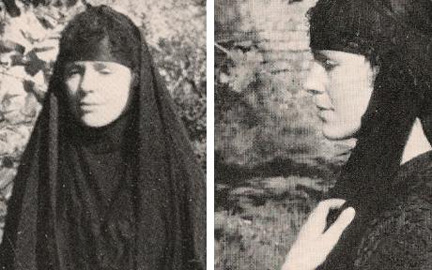
Elizabeth Warnock Fernea pictured wearing traditional tribal women’s dress of the southern Euphrates area. The headscarf with fringe is the asha, the chin scarf is the foota. These garments are worn under the abbaya or outer cloak Photo: KATHARINE RAMSAY

For many students and professors, the go-to text for Middle East ethnography for several decades has been Elizabeth Warnock Fernea’s Guests of the Sheik, still in print, about her life with anthropologist husband Bob Fernea in an Iraqi village during the 1950s. BJ, as her many friends knew her, went on to an academic career in several parts of the Middle East, producing books, articles and films of lasting value. Her passing in December, 2008 was a loss for us all. Now there is a short videography of her life available on Youtube. Check it out. And, if you have not read it in awhile or at all, get a copy of Guests of the Sheik and read it again or for the first time.

Love in a Time of Torture


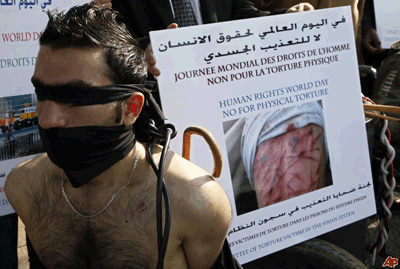
A young man’s account of sadistic torture in a Syrian secret prison, and how a girl’s note helped him through his pain.

Hugh Macleod and Annasofie Flamand, Al Jazeera, June 6, 2011

Arrested during a protest in the first days of the Syrian uprising, a young man endured acts of sadism and torture at the hands of Bashar al-Assad’s secret police.

As his body was beaten, whipped, electrocuted and worse; the prisoner could think only of the girl he loves, clenching a note from her in his hand as the torturers did their worst.

Told largely in his own words, this is his remarkable personal story of endurance and hope in a place filled with darkness and despair.

A small piece of paper held tight in a clenched fist. A lifeline to a better place.

Days become nights become days. The kicks, the punches, the questions, the insults, the humiliation and the pain.

“She was always on my mind in the toughest moments during the torture. The only thing that relieved the pain was my belief that, at that moment, she was comfortable in her bed.”

The beatings begun on the police bus driving arrested protesters to one of Syria’s most notorious secret police branches.

“Your mother is a whore!” screamed one of the policemen, as he slammed the butt of his rifle into the prisoner’s face. “We will f*** her and your sister!”

But the young man wasn’t listening.

“In the first five minutes I was only thinking of her. I was so afraid for her. But when the bus drove off I saw her trying to phone somebody, so I was so happy that she’s wasn’t under arrest. I didn’t know then that they arrested her a few minutes later. Continue reading Love in a Time of Torture

How appalling, Mr. Naipaul


Diana Abu-Jaber is the author of five award-winning books, including the forthcoming novel Birds of Paradise

From One Writer To Another: Shut Up, V.S. Naipaul

by Diana Abu-Jaber, NPR, June 3, 2011

Dear V.S. Naipaul:

You recently remarked, “I read a piece of writing and within a paragraph or two I know whether it is by a woman or not. I think [it is] unequal to me.”

I was sad to read this, to realize that you’re apparently unable to think beyond schoolyard rankings and peevish comparisons, that you’re incapable of recognizing grace and power from unexpected and unfamiliar places, such as a woman’s experience.

But what worries me more is your comment that that women write with “sentimentality, the narrow view of the world,” because, “inevitably for a woman, she is not a complete master of a house, so that comes over in her writing too.”

Your use of the word “master,” is chilling. Continue reading How appalling, Mr. Naipaul

These ‘virginity tests’ will spark Egypt’s next revolution


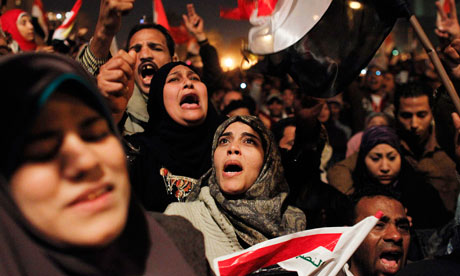
Egyptian women protest in Tahrir Square, Cairo. A general has admitted that women detained during protests in the square a month after Mubarak’s overthrow had been subjected to ‘virginity tests’. Photograph: Tara Todras-Whitehill/AP

by Mona Eltahawy, The Guardian, June 2, 2011

There’s a thin line between sex and politics, and it is nonsense to keep repeating the mantra that Egypt’s revolution “wasn’t about gender”. What revolution worth its salt can be fuelled by demands of freedom and dignity and not have gender nestled in its beating heart – especially in a country replete with misogyny, religious fundamentalism (of both the Islamic and Christian kind) and which for 60 years has chafed under a hybrid of military-police rule?

If the “it wasn’t about gender” mantra is stuck on repeat so that we don’t scare the boys away, then let them remember the state screwed them too, literally – ask political prisoners, and remember the condoms and Viagra found when protesters stormed state security headquarters. Continue reading These ‘virginity tests’ will spark Egypt’s next revolution