All posts by tabsir

Acid Pain


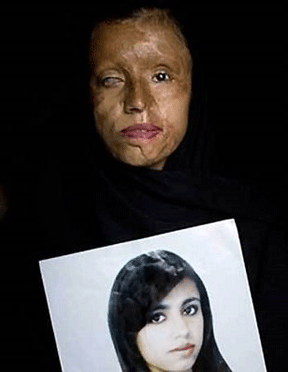
Twenty six year old Saira Liaqat poses for the camera, while holding a picture of her former self before her betrothed doused her face with acid.


Scarred by acid in Bangladesh

By Nicolas Haque in Dhaka, Bangladesh, Al-Jazeera, July 11, 2009

Rahima Begum, a young woman in the village of Kaligonj in the northwest of Bangladesh, turned down the romantic advances of a neighbour and paid dearly for it.

In the dead of night, while she was asleep, her neighbour poured acid over her face, leaving her disfigured for life.

“I may be still alive but he took my life away, I have become the shame of my family and of my village. I have no where to go,” she says.

According to official figures, there are only around 200 acid-related crimes reported every year in Bangladesh. Continue reading Acid Pain

Lisân al-‘Arab Online

The digital world is an extraordinary boon to those of us who depend on a variety of Arabic resources. One of my mainstays is the multi-volume Lisân al-‘Arab of the great lexicologist Ibn Manzur (died 1311 CE). I picked up my copy in 1979 in Dâr al-Muthana in Baghdad. Now I discover that this major classical lexicon, along with al-Fayrûzabâdî’s Qâmi¨s al-muhît and two other dictionaries are online at http://baheth.info. One can type in the Arabic word desired and all references to that in the extensive commentary will be highlighted. All the prompts are in Arabic, although I note that the one Google Ad prompt across the top in English advertised “Arabic Girls.” Poor Ibn Manzûr would no doubt roll over in his qabr, were he around to click his way today. On the right hand side notable quotes are posted. On one recent day I found one by Lenin. Ah, the power of words…

A Poet’s Recipe


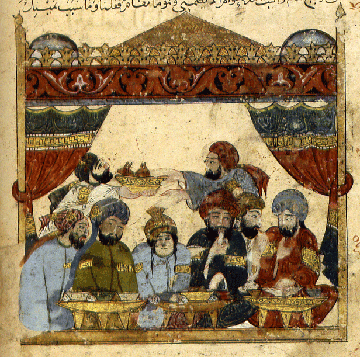
A host tending to the needs of his guests, Maqâmât al-Harîrî, 1236 CE

As richly illustrated in Geert Jan van Gelder’s delightul God’s Banquet: Food in Classical Arabic Literature (New York: Columbia University Press, 2000), Arab poets loved food and wrote extensively on the adab of cuisine. There are poems devoted to specific foods, but even a few recipes for the cook with a wit as well as a greasy thumb. Here is van Gelder’s translation of a recipe poem by the Baghdadi poet Kushajim (died 961 CE):

You have asked me about the best of dishes:
You’ve asked today someone who is not ignorant!
Now take, my friend, some ribs of meat,
And after that some meat of leg, and fat,
And chop some fat and succulent meat
And rinse it with sweet and clear water. Continue reading A Poet’s Recipe

Bani Hushaysh Archaeology

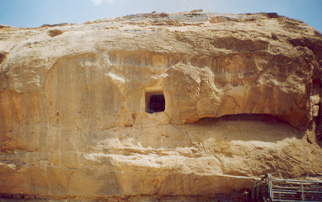
Archeological sites in Bani Hushaish suffer from vandalism

by Mansur Ali al-Muntasir, Yemen Observer, February 3, 2009

The Bani Hushaish district in the Sana’a governorate is 30 km east of the capital, and contains several important archeological sites.

Yemen has a great wealth of ancient archeological sites many of which date as far back as the pre-Islamic era and many more site which are still waiting to be discovered and documented. There is a fear though amongst the Yemen’s archeological establishment that without adequate protection and preservation much of Yemen’s historical record could be lost to natural and human damage. This article seeks to highlight the richness of Yemen’s archeological heritage and the need to preserve and document such heritage for future generations.

The most important of the discovered archeological sites is in Shibam al-Ghras, where several mummies were found. The district contains several other neglected sites, which have not yet been identified by archeological authorities. This is disturbing; as these sites have been damaged as a result of official negligence, and a lack of public awareness about their value and importance to Yemeni heritage. Continue reading Bani Hushaysh Archaeology

MECA Study Day at Hofstra

Hofstra University Announces Middle Eastern and Central Asian Study Day
A Series of Presentations Focused on Faculty Research

Who: Hofstra faculty who have conducted research on Middle Eastern and Central Asian (MECA) studies
What: MECA Study Day
When: September 16, 2009
Where: 310 C.V. Starr Hall and 117 Berliner Hall, South Campus
Why: To highlight and learn about the research Hofstra faculty have done on MECA studies

Hofstra faculty from a variety of departments such as fine art, art history, anthropology, history, comparative literature, economics, political science and religious studies will give presentations on their research in MECA studies. Topics from their research will include archeology, women’s issues, history and the contemporary Middle Eastern and Central Asian world. These talks are free and open to the public.

MECA Schedule

Western and Central Asia in the Middle Ages
9:30 – 11:15 a.m., C.V. Starr Hall, 310
Moderator: Dr. Stefanie Nanes, Department of Political Science

• Greeting by Dr. Bernard Firestone, Dean of Hofstra College of Liberal Arts and Sciences
• Opening remarks by Dr. Daniel Martin Varisco, Department of Anthropology

• Dr. Aleksandr Naymark, Department of Fine Arts/Art History
Amazing Sogdians: Masters and Creatures of the Silk Road

• Dr. Anna Feuerbach, Department of Anthropology
The Damascus Steel Sword

• Dr. Daniel Martin Varisco, Department of Anthropology
The Sultan’s Green Thumb: Yemeni Agriculture in the 14th Century Continue reading MECA Study Day at Hofstra

The Wives (make that Wife) of the Prophet

[Webshaykh’s Note: Revisionism is found in all religions. I recently came across a blog posting that seeks to restore the marital status of Muhammad to one wife at a time, although it appears to be more an attack on at-Tabari, Ibn Ishaq and Ibn Hisham. I post the commentary not because I agree with it, but as an example of the variety of views held by Muslims in representing the Prophet Muhammad.]

THE PROPHET (S) HAD ONLY ONE WIFE AT A TIME by Dr. Shabbir Ahmed, The Quran as it Explains Itself, August 30th, 2009

THE PROPHET (S) HAD ONLY ONE WIFE AT A TIME

MARRIAGE WITH HAZRAT AYESHA 622 CE:
Contrary to the Imamist propaganda, the exalted Prophet had no more than one wife at a time. And Hazrat Ayesha was a sister, not daughter of Hazrat Abu Bakr. The Prophet (S) did not marry for three years after Hazrat Khadijah’s demise in Makkah three years before Hijrah. Hazrat Ayesha was the widow of a martyr, Saleh bin Saleh Al-’Ataib. She was 48 years old at the time of marriage to the exalted Prophet. Sahaba Kiraam including Hazrat Abu Bakr strongly recommended that the Prophet (S) and she got into the solemn union of marriage. The blessed wedding took place in 622 CE when Muhammad (S) was 52 years old. Kitab-e-Dalail-e-Nabawwut Syedna Muhammad (S), by Abdul Jabbar Fatimi, written 150 years before Tabari, the first ever ‘canonized’ historian. Azwaaj-in-Nabi wal-Ashaab, by Sheikh Hammad bin Hakam. The rest is nothing but slanderous imagination of the Zoroastrian “Imam” Tabari and the Jewish biographer Ibn Ishaq and his Parsi follower Ibn Hisham. Continue reading The Wives (make that Wife) of the Prophet

Ramadan Around the Globe


A vendor of headscarfs waits for customers in the 4th day of Ramadan at a market in Jakarta, Indonesia on August 25, 2009. (Adek Berry/AFP/Getty Images)

The Boston Globe published a series of excellent photographs of Muslims around the world as they prepared for Ramadan this year. There is a total of 39 photographs and these are well worth looking at. Click here to go to the website.