All posts by tabsir

Iraq, Islam and Sweden


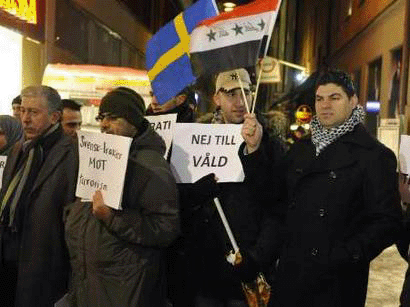
Swedish-Iraqi immigrants protest in central Stockholm, where a car bomb exploded two days ago December 13, 2010. The placard on left reads, “Swedish Iraqis against terrorism”. REUTERS/Bertil Ericson

The recent bomb attempt in Sweden has been linked to an Iraqi who grew up in Sweden. Not much has been written about the influx of Iraqis to Sweden, whose open door policy in the past has led to it being a haven for refugees. However, one of my students, Sarah Skiold-Hanlin conducted an ethnographic project on Swedish reactions to the Iraqi community in the summer of 2008. Her research paper, an Honor’s Thesis in the Department of Anthropology at Hofstra, is available online and I recommend it for anyone wanting more information on the subject of Iraqis in Sweden.

I attach Sarah’s introduction below, but encourage you to read her entire paper:

“One place where many Iraqis have found refuge from the war is Sweden,” stated Renee Montagne, the host of NPR’s Morning Edition. This was her opening line as she introduced the news story titled: Sweden Begins Sending Iraqi Refugees Home. The story aired March 25, 2008. Renee goes on to explain how the “many Iraqis” numbered somewhere in the range of 20,000. A momentary flash of elation followed this opening as my mind began turning over the meaning, estimating its possible weight. Perhaps Sweden, a nation with which I have close family ties, could help rectify the political actions of my country of birth. But like trying to dam the Mississippi River with a box of pop sickle sticks and a bottle of Elmer’s Glue, the flow of refugees fleeing the war in Iraq is far to numerous for one small Scandinavian country to hold. Renee’s voice fervently interjected as she continued washing away my melodic dreams of relief and solution to the persistent humanitarian crisis plaguing so many civilians. “The Swedish government is stopping that flow of Iraqi refugees and sending some back home against their will,” she reported. Continue reading Iraq, Islam and Sweden

The Liberation of Erotic Literature


Interview with Salwa al-Neimi
in al-Qantara, 7/2010

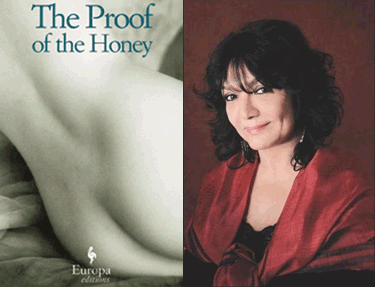
The novel The Proof of the Honey by Syrian author Salwa al-Neimi is celebrated by some as a milestone of modern Arabic literature and condemned by others as scandalous prose. In an interview with Rim Najmi, the author explains that despite the lightness of its literary style, her novel poses fundamental intellectual and political questions

Your first novel, The Proof of the Honey, attracted a great deal of attention from both readers and critics alike. The most frequent response had more to do with your “courage” in tackling one of the greatest taboo themes in Arab culture and less with the literary qualities of your novel. What do you think was the decisive factor for all the attention?

Salwa al-Neimi: Thank you for this question. I always say the success of the book is primarily based on its language and style. I make this claim even though most of the critics tend to emphasize the theme of the novel and the fact that it crosses the red line. Unfortunately, they have little interest in the actual text itself. Some critics constantly talk about freedom of expression, although this often turns out to be just an end in itself. When it comes to a contemporary text, it is often judged in terms of moral categories, which is just another form of censorship.

By Arab standards, your novel, The Proof of the Honey, sold in record numbers in only a short time. It has also been translated into many languages. What does the international publication of your work mean to you?

Al-Neimi: First and foremost, I wrote The Proof of the Honey for Arab readers. Continue reading The Liberation of Erotic Literature

Shariah at the Kumback Café

By Roger Cohen, The New York Times, December 6, 2010

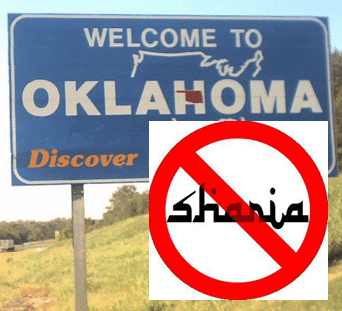
PERRY, OKLAHOMA — They call Oklahoma the buckle of the Bible Belt. It’s the state where all 77 counties voted Republican when Barack Obama was elected and where 70.8 percent of the electorate last month approved a “Save Our State Amendment” banning Islamic, or Shariah, law.

So I decided to check the pulse of a resurgent conservative America at the Kumback Café. The Kumback, established 1926, is a cozy, memorabilia-filled joint that sits opposite the courthouse in downtown Perry, population 5,230.

Things work like this at the Kumback: The guys, average age about 80, arrive around 8 a.m. and get talking on “the whole gamut of life”; the girls, average age too indelicate to print, gather later at a horse-shoe shaped table toward the back. Ken Sherman, 86 and spry, explained: “We’ve got to come here every day to find out what’s going on. And by the time we leave we forget.”

I asked Paul Morrow, a whippersnapper at 71, how things were going. “There’s just too much Muslim influence, all this Shariah law,” he said. “We’re conservative here, old and cantankerous.” Continue reading Shariah at the Kumback Café

A Philosophical Tale


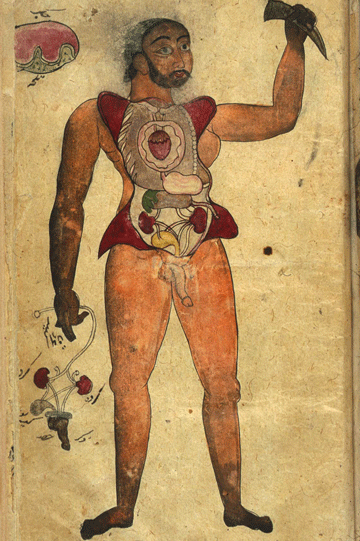
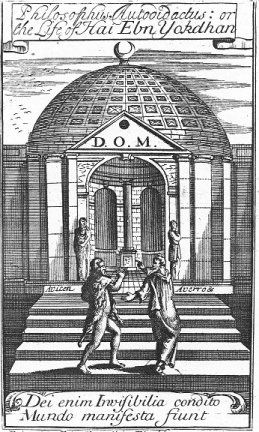
While teaching Hofstra’s Honors College Culture and Expression course this term, I suggested the text Hayy ibn Yaqzan by the Andalusian Muslim scholar Ibn Tufayl, who died in 1185 CE, as an antidote to the otherwise “Great Western” bent such courses inevitably take. Ibn Tufayl’s 12th century text is a brilliant fable built on the author’s knowledge of earlier philosophical arguments by Greek (including Plato and Aristotle) Neoplatonist and Muslim (such as Al-Farabi and Ibn Sina) intellectuals and also on the best science of his day. The plot revolves around a child stranded or spontaneously generated (take your pick) on an island, brought up by a nurturing doe and then growing through basic logic from an empirical youth to an enlightened mystic. In effect the hero, Hayy ibn Yaqzan, comes to the ultimate state of being a Muslim without ever having heard of Muhammad or being introduced to Islamic rituals and law. Ibn Tufayl turns St. Augustine’s “original sin” on its head, although still arriving at belief in one God as a First Cause, Prime Mover or Prime Sustainer.

The book is worth a read, since so many European intellectuals did in fact read it after it was translated into English by Simon Ockley in 1708. If you have ever read Robinson Crusoe or Tarzan, this book is worth checking out for its literary prehistoric value. Ibn Tufayl presents a strikingly modern view on the role of symbolism, no matter what you think of his ultimate theological spin. Here is an example from late in the book, once Hayy has gone as far as reason will take him:

Having attained this total absorption, this complete annihilation, this veritable union, he saw that the highest sphere, beyond which there is no body, had an essence free from matter, which was not the essence of that one, true one, nor the sphere itself, nor yet anything different from them both; but was like the image of the Sun which appears in a well polished looking-glass, which is neither the Sun nor the looking-glass, and yet not distinct from them. And he saw in the essence of that sphere, such perfection, splendour and beauty, as is too great to be expressed by any tongue, and too subtle to be clothed in words; and he perceived that it was in the utmost perfection of delight and joy, exultation and gladness, by reason of its beholding the essence of that true one, whose glory be exalted. Continue reading A Philosophical Tale

Afghan Trucks 2

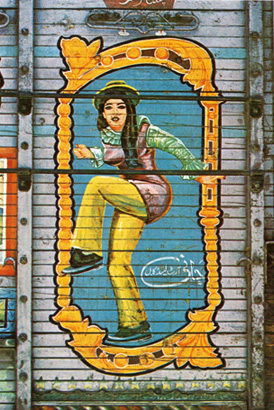
In a previous blog entry, I mentioned a photographic book by Jean-Charles Blanc on Afghan Trucks. In addition to legendary and technological themes, in this pre-Taliban world there was an interest in women as well, at least among truck drivers and those who appreciated truck driven art. Here is what the Introduction to the text says about the female image unveiled:

Occasionally another motif appears amongst these tablaux: that of women – a rare and daring theme for this Islamic society where tradition is so carefully guarded. they are depicted in the form of sensual, Felliniesque, sulphurous-eyed vamps whose looks are inspired from Indian statuary – the flesh of Marilyn and Sophia draped in Oriental clothing, and with just a few puffs of hashish their colored images spring to life …


to be continued

Building Southern Sudan


Building southern Sudan through promotion of our history and culture

Dr. Jok Madut Jok, New Sudan Vision, October 15, 2010

(New York) – To be a nation means having a citizenry that takes pride in citizenship in “South Sudan” first and in tribal citizenship second. Such a nation can no longer assume that shared interests alone will continue to unite us. So far, our struggle to wrestle our freedom from the grips of the Khartoum-based successive governments has been the most unifying force for South Sudan. Now that this struggle has seen some success, what will unite us is the desire to build a strong nation together, and such a nation will need a shared identity. Such a shared identity will need to be harnessed, it needs to be politically constructed, and it is our task to forge it.

To this end, I envision my task as undersecretary of the Ministry of Culture and Heritage as joining a collective effort with the minister, the staff of the ministry and other branches of GOSS to set a policy for constructing our nation’s identity.

A solution begins with the correct identification of the nature of the problem. The most significant enemy of South Sudan’s cohesion, national loyalty and the citizens’ pride in their nation will be a growing sense of exclusion from the national platform, media, government programs and access to services. Any citizen who will feel excluded will never develop that important sense of pride in his/her nation. A starting point to addressing the feeling of exclusion is to state the obvious, that South Sudan belongs to all South Sudanese; it does not belong to any ethnic, religious or political group. Continue reading Building Southern Sudan

Me and the Feminists

By Mona Eltahawy, The Jerusalem Report, November 24, 2010

I was 23 years old and I was interviewing an Egyptian feminist who had just taken over as editor-in-chief of a women’s magazine of the cooking-and-fashion variety, which she had vowed to turn into the go-to magazine for women’s rights.

I was excited to meet her because she was one of the real-life feminists that my recently returned-to-Egypt self loved to meet to help me turn theory into action. Ever since I’d discovered feminist journals on the bookshelves at my university in Jeddah, Saudi Arabia, at the age of 19, I’d devoured all I could of the theory.

I had returned to Egypt at 21 hungry to put it into action. My first encounter with those essays was nothing short of terrifying. That’s how you know what you need – it scares the hell out of you because it encourages you to jump but you don’t know if you’ll ever land. Religious conservatism was suffocating me in Saudi Arabia and I was losing my mind. I didn’t care about landing. I was overdue for a jump.

So returning to Egypt at 21 after 14 years away was a chance to water that seed of feminism with the sustenance of real-life women who embodied it. I looked for them everywhere I could. Many of the older women practically adopted me, inviting me to their meetings, sending me their latest reports and alerting me ahead of important conferences they were holding. Continue reading Me and the Feminists