All posts by tabsir

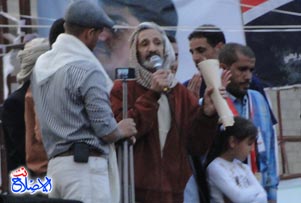
كيف استقبل شباب الثورة بصنعاء ظهور صالح؟!


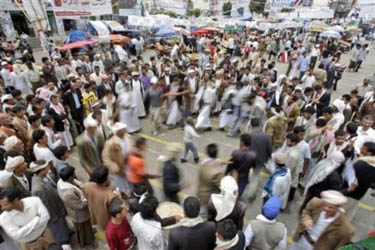
  • الصورة لمتظاهرين في ساحة التغيير بصنعاء في 4 يوليو الجاري (AP).

    لمصدر أونلاين ـ صلاح القاعدي

    تباينت ردود الفعل لدى شباب الثورة في ساحة التغيير بصنعاء من الظهور العلني للرئيس صالح من خلال خطابه المسجل الذي بث يوم الخميس الفائت، وتوزعت بين حالة من الاحتقان والسخط على القوى المحلية والدولية لتأثيرها على مسار الثورة، وأخرى ساخرة.

    الشباب الذين استولى عليهم السخط والغضب نتيجة شعور سيطر عليهم، بسبب تفويتهم الفرص المتاحة لحسم الثورة، التي كان أبرزها فرصة رحيل صالح إلى السعودية. ومع ذلك خرج الشباب في مسيرات تجوب ساحة التغيير مرددين هتافات ضد قوى يعتقدون أنها سبباً حقيقياً في تأجيل حسم الثورة وومن بينها أحزاب اللقاء المشترك ودولتي السعودية والولايات المتحدة الأمريكية.

    وتنامت حالة العداء تجاه السعودية والولايات المتحدة في أوساط شباب الثورة في اليمن خلال الآونة الأخيرة بسبب دور الأخيرتين البارز في حل المشكلة اليمنية، وسط اتهامات لهما بالتواطؤ مع نظام صالح والسعي لإجهاض الثورة السلمية المطالبة بإنهاء حكم صالح المستمر منذ نحو 33 عاماً.

    الاختلاف في الآراء ووجهات النظر كان سيد الموقف حول انعكاسات خطاب صالح، ويرى الشاب سليمان الراشدي ان اتضاح حالة صالح الصحية بعد أسابيع من التضارب، سيسهل في الإقدام على الخطوات القادمة وتحقيق بقية الأهداف التي قامت من أجلها الثورة.

    لكن كثيراً من شباب الثورة جعلوا من ظهور صالح مادة لصياغة النكتة التي تتميز بسرعة انتشارها على قطاع واسع من اليمن بمختلف الوسائل المتاحة.
    Continue reading كيف استقبل شباب الثورة بصنعاء ظهور صالح؟!

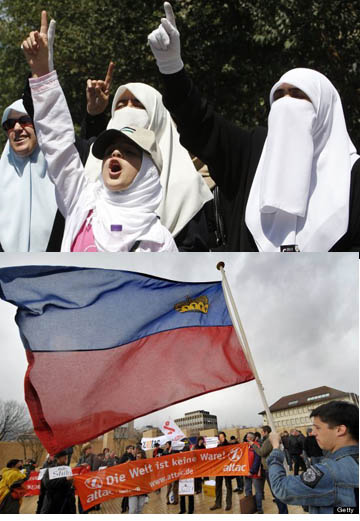
  • The Anti-Muslim Inner Circle


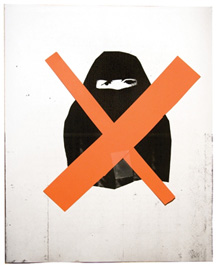
    Illustration by James Victore

    By Robert Steinback, Southern Poverty Law Center, Intelligence Report, Summer 2011, Issue Number: 142

    The apparent recent surge in popular anti-Muslim sentiment in the United States has been driven by a surprisingly small and, for the most part, closely knit cadre of activists. Their influence extends far beyond their limited numbers, in part because of an amenable legion of right-wing media personalities — and lately, politicians like U.S. Rep. Peter King (R-N.Y.), who held controversial hearings into the radicalization of American Muslims this March —who are eager to promote them as impartial experts or grassroots leaders. Yet a close look at their rhetoric reveals how doggedly this group works to provoke and guide populist anger over what is seen as the threat posed by the 0.6% of Americans who are Muslim — an agenda that goes beyond reasonable concern about terrorism into the realm of demonization.

    Of the 10 people profiled below, all but Bill French, Terry Jones and Debbie Schlussel regularly interact with others on the list. Most were selected for profiling primarily because of their association with activist organizations. People who only run websites or do commentary were omitted, with two exceptions: Schlussel, because she has influence as a frequent television talk-show guest, and John Joseph Jay, because he is on the board of Pamela Geller’s Stop Islamization of America group. Three other activists, Steve Emerson, Daniel Pipes and Frank Gaffney, have interacted with many of the core group as well and also have offended many Muslims, but they are somewhat more moderate in their views of Muslims than those who are profiled below.

    For the description of the ten people, click here.

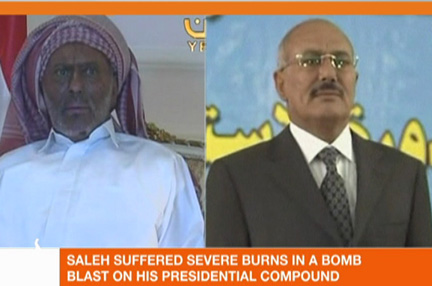
    Breaking News: Salih on Yemeni TV


    from Al Jazeera website

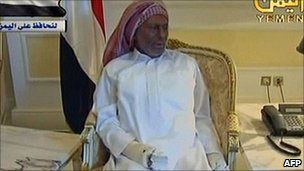
    The first video of President Ali Abdullah Salih since his severe injuries has been broadcast in Yemen just a short while ago. A brief excerpt is already on Youtube with better videos likely to be posted. As the pictures above and below show, he is heavily bandaged and the audio indicates he has trouble speaking. It is hard to imagine that he would be able to resume work any time in the foreseeable future. It appears he is lucky to even be alive. For an interview on Al Jazeera with Dr. Ameen al-Himyari of Qatar University, click here.


    from the BBC website

    Tabsir Redux: A Sailor and his Camel Ride


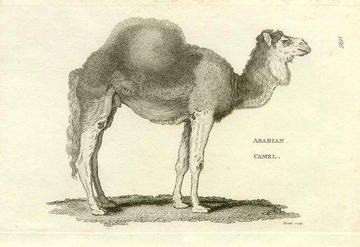
    [Illustration: Arabian Camel from George Shaw, Zoology (1801)]

    [Tabsir Redux is a reposting of earlier posts on the blog, since memories are fickle and some things deserve a second viewing.]

    [Joseph Osgood was a Black American sailor who visited the Yemeni port of Mocha about a dozen years before the start of the American Civil War. He offers a rich, descriptive account of his visit to the Yemeni coast, including a sailor’s view of the ship of the desert.]

    No wheel carriages are used here, the most general mode of transportation being by camels, for which the males along are serviceable. The flesh of the camel forms a staple article of food, the head and neck being excepted, because one of the race unwittingly rendered these parts unholy by obtrusively poking his head and neck into Mahomet’s tomb. Wellsted says that a camel is welcomed at its birth, by the Arab, with “another child is born unto us.” Continue reading Tabsir Redux: A Sailor and his Camel Ride

    Old World Travel 90 years on: #2 The Simoon and Mirage


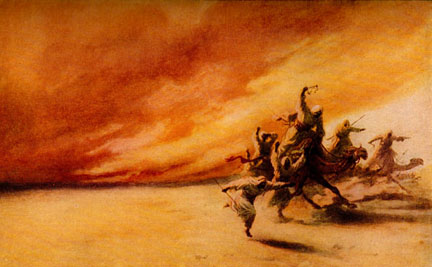
    Exactly 90 years ago a four-volume set of encyclopedia-like human interest books was published as The Human Interest Library: Visualized Knowledge by Midland Press in Chicago. In a previous post I commented on its thoroughly “Orientalist” flavor. Not only was the Sahara portrayed as a barren landscape with people who have nothing to do, but the only winds of change are violent storms summed up in the Anglicized “simoon.” Above is an image from the frontispiece to volume 2 in the series and entitled “The Dreaded Simoon – The Scourge of the Desert”. I have not been able to find the name of the artist, which is clearly pre-1921. The caption reads: “The fury of the simoon is like the blast of a furnace. Winged with the whirlwind. and charioted with thunder, it blasts everything in its course. It has the appearance of a train of fire whose murky smoke fills the whole wide expanse of the desert.”

    Here is the text describing “The Scourge of the Desert” (Vol. 4, p. 97):

    As the color plate shows, the simoon, described by writers, must have presented a majestic and awe-inspiring spectacle. Continue reading Old World Travel 90 years on: #2 The Simoon and Mirage

    In Memory of BJ


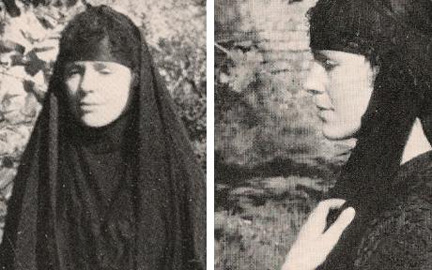
    Elizabeth Warnock Fernea pictured wearing traditional tribal women’s dress of the southern Euphrates area. The headscarf with fringe is the asha, the chin scarf is the foota. These garments are worn under the abbaya or outer cloak Photo: KATHARINE RAMSAY

    For many students and professors, the go-to text for Middle East ethnography for several decades has been Elizabeth Warnock Fernea’s Guests of the Sheik, still in print, about her life with anthropologist husband Bob Fernea in an Iraqi village during the 1950s. BJ, as her many friends knew her, went on to an academic career in several parts of the Middle East, producing books, articles and films of lasting value. Her passing in December, 2008 was a loss for us all. Now there is a short videography of her life available on Youtube. Check it out. And, if you have not read it in awhile or at all, get a copy of Guests of the Sheik and read it again or for the first time.

    The Seduction of Simple Solutions


    Over at Waq al-Waq there is an excellent commentary by Greg Johnsen on the situation in Yemen, responding to a “think tank” report from people who really do not know Yemen very well (or apparently want to know it in a certain way). Here is the start…

    Late last week Frank Cilluffo and Clint Watts released a policy brief from George Washington University’s Homeland Security Policy Institute entitled “Yemen and al-Qaeda in the Arabian Peninsula: Exploiting a Window of Counterterrorism Opportunity.”

    My in-box quickly filled up with helpful people sending me copies of the report, I have now had time to read it and digest and my thoughts follow below.

    (Note:) I don’t know Frank Cilluffo but I do know and respect Clint and he has seen a copy of my rebuttal here prior to posting.

    For those who are faithful readers of Waq al-waq it should come as no surprise that I strongly disagree with the report and its conclusions. I think this is what happens when smart people tackle a complex problem in an environment they don’t know particularly well. The report, in my opinion, is full of assumptions that make sense broadly but break down the closer one gets to Yemen.

    Obviously there are parts of the report I agree with, and many other places where well-intentioned people can disagree.

    (Quotes from the paper are in italics; mine are in regular caps.)

    Assumption 1: AQAP suddenly stronger this month

    “This week’s escape of 63 suspected al Qaeda in the Arabian Peninsula (AQAP) fighters from a Yemeni prison exemplifies how President Saleh’s departure to Saudi Arabia and Yemeni instability embolden this lethal al Qaeda affiliate.“

    I’m pretty sure that AQAP was emboldened prior to Salih’s departure, the group has been incredibly active in Yemen recently and I would argue that largely as a result of US air strikes between December 2009 and May 2010, the organization is actually stronger now in terms of recruits than it was when it dispatched the so-called underwear bomber who tried to bring down the airplane over Detroit on Christmas Day 2009.

    Assumption 2: Huthis and Southern Movement are responsible

    “In recent weeks, the writ of government in Yemen has evaporated under the twin strains of the Houthi rebellion in northern Yemen and the Secessionist movement in southern Yemen.”

    This is simply untrue – the writ of Yemen’s government has evaporated under popular protests. The Huthi rebellion has been ongoing since 2004 and the Southern movement since 2007 – neither of these are new, and neither of these are the cause of the recent collapse.

    For Greg’s full commentary, click here.