Last Thursday was dubbed “Topless Jihad Day,” a call by the feminist group FEMEN for women to protest in support of a Tunisian woman who posted photographs of herself topless (with remarks on her body that many would consider tasteless) on her Facebook site and soon received condemnation and calls for punishment. The result was hardly an outpouring of indigenous support like the “Arab Spring” that flooded the main squares of Tunis, Cairo and Sanaa. The FEMEN website has posted images of women baring their breasts in Rio de Janeiro, San Francisco, Montreal, Paris, Milan, Kiev, Brussels, Berlin and a few other major cities. Two things stand out about this day of protest. First, it takes place only in cosmopolitan Western cities, not in Muslim-majority countries. Second, several of the scenes focus on the protesting women being arrested for breaking the law. The patriarchy that is being protested is not, therefore, only an issue about Islam.
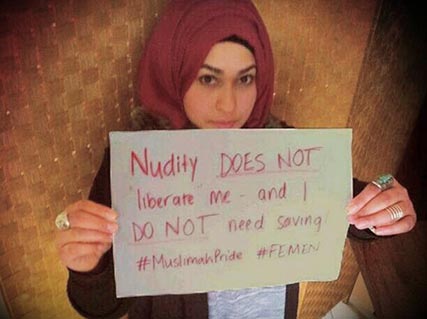
There is a basic principle of physics that every action results in a reaction. The moral code that would cause a Tunisian cleric to condemn a young Tunisian woman for exposing her breast on Facebook causes a protest from an international feminist organization. And, not surprisingly, there is a counter to this from a “Muslimah Pride” network. As the young woman in the image above indicates, she does not feel liberated by exposing her body. But perhaps even more poignant is her comment that she does not need saving. It is not clear if this Muslim woman is condemning the Tunisian woman at the center of the current protest, but she is definitely making a statement about her own body. Whose body is it anyway?
FEMEN has attracted followers for a variety of reasons. I suspect that some testosterone-loaded males in the West cheer wildly whenever a woman shows her bare breasts. These hardly support the stated goal of FEMEN: “sextremism serving to protect women’s rights, democracy watchdogs attacking patriarchy, in all its forms: the dictatorship, the church, the sex industry.” Historically there is no question that women have not had equal rights with men in economic, political or legal contexts; this is true for almost all cultures, ranging from those with despicable patriarchal rules to democracies with permanent glass ceilings. Secularism has challenged many (but not all) of these inequalities, giving women the right to own property, vote, and theoretically have equal opportunities in education and the workplace. Appeals to women’s rights resonate with most people, whether secular or religious, but the devil is in the details.
There is also an elephant in the room, in everyone’s room: who decides what women’s rights are? Continue reading Whose body is it anyway?