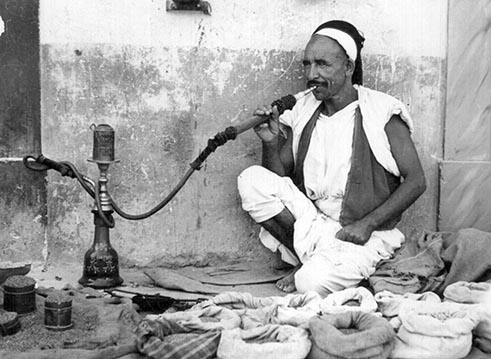
Above and below are two scenes in Tripoli, Libya from the 1950s, when it was still a kingdom. Both are from Christmas and New Years greeting cards with the greeting in English.
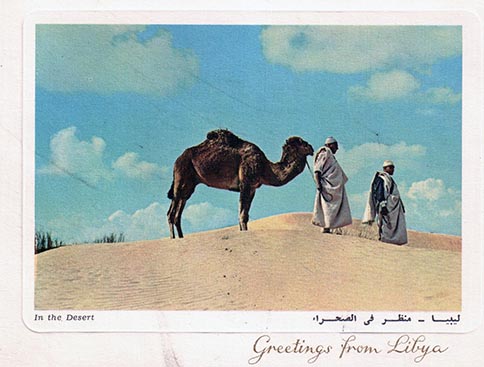 Photo by Jenah in Tripoli; printed in Italy
Above and below are two scenes in Tripoli, Libya from the 1950s, when it was still a kingdom. Both are from Christmas and New Years greeting cards with the greeting in English.
Photo by Jenah in Tripoli; printed in Italy
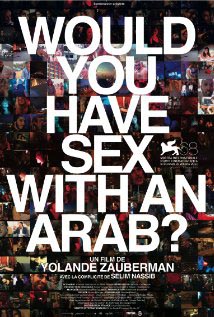 Sleeping With the Enemy? Review of “”Would You Have Sex With an Arab?
By Clara Abdulaziz,http://ta3beer.blogspot.com, April, 19
“One in five Israelis is an Arab, but it is difficult to find places where they touch fingertips.â€
In her latest feature-length documentary, French filmmaker Yolande Zauberman ventures out into the nightlife of Tel Aviv and asks the people she meets a deceptively simple question: “Would you have sex with an Arab?†It is clear that sex serves merely as a proxy to grapple with a much larger question: can individuals transcend identities rooted in long histories of conflict, or is identity so rigidly constructed that it in fact defines one’s humanity?
Zauberman has said that she produced the film to “give space for awareness.†It is meant to be “a little bit sexy, a little bit funny.â€
It is also, quite frankly, pretty depressing.
Zauberman’s choice of Tel Aviv for her film was not arbitrary. It is famous for its non-stop club scene, and is one of the most LGBT and queer-friendly cities in the world. She shows that even here, where most young residents seem more concerned with partying than religion and politics, the boundaries of Jewish and Arab identity remain stubbornly situated within the larger Arab-Israeli conflict. Continue reading Would You Have Sex With an Arab?
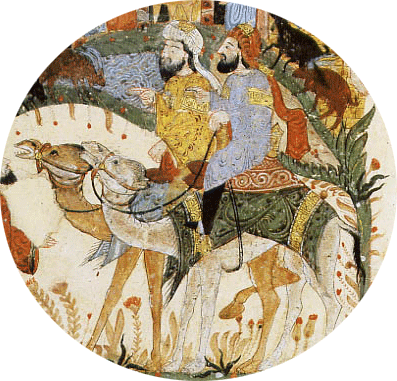
One of the most entertaining Arabic compendia on animal life, taken in the loose sense of the term for things that breathe or are thought to breathe, is the Hayât al-Hayawân (Life of Animals) of the Egyptian savant Kamâl al-Dîn Muhammad ibn Mûsâ al-Damîrî. Writing a century before Columbus discovered America, al-Damiri spins stories about animals with a variety of folklore about uses of animal products and parts. A scientist would no doubt shudder at the magical and literary focus of the text, only occasionally finding description useful today. A partial English translation was made by a British officer, Lieutenant-Colonel Jayakar, and published in two volumes in 1906 and 1908 in India. Unfortunately, this text is virtually inaccessible. I have looked at two copies, one in the New York Public Library and the other at the Library of Congress, and only with trepidation have I turned the fragile pages in this poorly bound volume. So far there is no digital version, which is a shame, since it is a delight to read.
Our author was a prolific copyist, quoting from over 800 other authors and providing a thousand entries, some simply an animal’s name and its more common synonym. Ironically, Jayakar’s Victorian sensitivity makes the translation as much an oddity as the primary work. Continue reading Tabsir Redux: Animal House in the 15th Century: Part 1
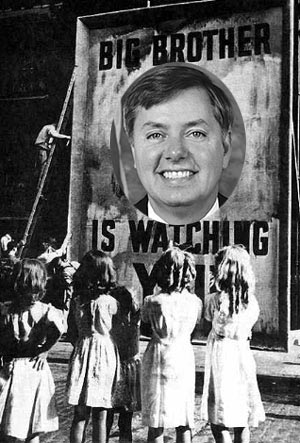
If George Orwell had lived to see how 1984 plays out in 2013, he would no doubt shake his head, marveling at how a novel he wrote in 1949 could come so close to reality. Senator Lindsay Graham, a South Carolina Republican (who may not gulp down Tea Party rhetoric but surely likes to sip some of its poison), was interviewed yesterday in the Washington Post before the second suspect in the Boston Marathon bombing was caught. His intent, as reported in the article, seemed more to downgrade the libertarian Rand Paul than to offer any kind of constructive comment on the unfolding tragedy of the bombing.
In his senate filibuster, Senator Paul had argued that America is not a battlefield, so Graham used his senatorial perch to argue “It’s a battlefield because the terrorists think it is.†Really? When exactly did a terrorist act, not an attack from another country or an armed insurrection from within, define what a “battlefield” is? Yorktown was a battlefield in 1781; Gettysburg in 1863; Normandy in 1944. If the sadistic setting of bombs targeted at civilians proves that America is a battlefield, then what about Waco in 1993 or Oklahoma City in 1995 or even the hijackings that led to the destruction of the Twin Towers in 2001? When a battle is fought in war there are battlefields stained with the blood of combatants and often civilians as well; when a terrorist detonates a bomb it is a criminal act no less than when a disturbed 20-year old walks into an elementary school in Newtown, Connecticut and shoots 20 children and 6 adults, after having killed his own mother. If every act of violence defines a battlefield, there can be no peace anywhere. Continue reading “It sure would be nice to have a drone up there”

Â

Part 3 of a three-part trilogy by George N. El-Hage
وأمس Ø£ÙقتÙ
أمس Ø£ÙقتÙ
لا وجهي ولا اسمي
كما كانا …
ولا شَعري… ولا صدري
كما كانا
رأيت٠الرعبَ يرسم٠Ùيّ
أشكالاً … وألوانا …
ولم أعرÙÙ’ سوى أنّي
ضÙربت٠… وليس من سَببÙ
وكدت٠أموت٠من تعبي
وجرّوني إلى الساØاتÙ
عرَّوني ….
سÙÙ„Ùبْت٠بكارتي منّي
Ø£ÙÙ‡Ùنت٠…
Ø£Ùخذت٠بالظنّ٠…
أرادوني
عَروسَ الساØر٠الأكبرْ،
عَروس٠الساØر٠الأØمرْ …
وساقوني
إلى الØاكمْ
زعيم٠الØمْر٠… والبربرْ …
ولم يدروا بأنَّ اللهَ
ÙÙŠ بيروتَ لن يٌقهرْ ….
أنا بيروت٠… يا الله٠!
هل تذكÙرْ؟ …
سأبقى، رÙغمَ Ø£Øزاني
ورÙغمَ الجرØÙ
ÙÙŠ وجهي وإنساني،
بØجم٠الشرقÙ
إنَّ الشرقَ …. أدماني
بØجم٠الØبّ
إن الØبَّ لبناني
بÙØَجم الØقّÙ
إنّ٠الØقّ لبناني.