My friend, the historian G. Rex Smith, has recently translated into English a marvelous travel diary by the French military official and traveller Pierre Loti (1850-1923). It is also available on Amazon as a Kindle Book. This day-by-day diary details Loti’s trip along the caravan trail of 1900 from the coast at Bushire to Shiraz and his ultimate goal of Isfahan in order to visit the area during the season of roses. One might expect such an account to be dry, but Loti comments on what he saw, including the people, along the way and one gets a first-hand sense of what it was like to travel a treacherous route that was at times over pure desert and at other times up or down seemingly impenetrable mountain heights. There is also a brief account of his stop at Muscat on the way to Persia. Smith, with the aid of his son, has done an admirable job in reflecting the flavor of the original French and includes 24 photographs taken by Loti. This is a book well worth reading, whether you are interested in Persia at the time or not.
The original French version is available as a pdf here. Archive.org has quite a few of his works.
This article relates to a previous paper entitled “Egyptian Cosmology and the Grand Canyon” published by Tabsir on September 1, 2007. I revisited the Grand Canyon in October this year (2021) to have a closer look that might help with rethinking earlier views. In this present thesis I aspire to shed more light on the obfuscated issue of ancient Egyptians and other past people who are thought by several explorers to have impacted the Grand Canyon and other places in the North America prior to the arrival of Columbus. In fact, there has been ongoing debate since the appearance of a front-page story of the Arizona Gazette on April 5, 1909 reporting on an archeological expedition of the Grand Canyon in which an underground network of tunnels, caves and cities was found above the Colorado River, containing various oriental and ancient Egyptian artifacts, statues, hieroglyphs, and mummies, among other items. The report in the Arizona Gazette relied on the findings of G. E. Kinkaid and Professor David Jordan (McEwen, 2000; Reyes, 2019). It is interesting to note that, preceding them, John Wesley Powell, an American geologist and the first director of the Smithsonian’s Bureau of Ethnology, made several expeditions funded by the government, to the area in 1868 and 1871-1872, and proposed the name of the “Grand Canyon” instead of the previous name, the “Big Canyon.” Powell and other explorers coined historically and mythically inspired names of temples and towers including those of Isis, Osiris, Horus, Ra, Set, Cheops Pyramid, and Shiva, for example (Carpenter, 2020) for some of the outstanding and poignant geographical features/sites in the Canyon.
The following points highlight the controversial aspects or pros and cons concerning the findings of Kinkaid reported by Arizona Gazette. 1- The Smithsonian Institute, motivated by conspiracy theories, rejected both the findings of Kinkaid and the Gazette’s report. 2- The Smithsonian Institute described the report of the Arizona Gazette as a hoax aimed at gaining publicity and selling more copies. 3- The Smithsonian’s Department of Anthropology denied hiring Kincaid and Professor Jordan for conducting any research. It also denied any records verifying the existence of Kincaid or Professor Jordan (Carpenter, 2020). 4- Government institutions have been involved in protecting what they consider a forbidden zone encompassing secret caves and sensitive areas in the Grand Canyon, even guarding them with armed forces. People have not been allowed to approach these caves. This forbidden zone contains Egyptian and oriental monikers as well as ancient manmade chambers (Carpenter, 2020). 5- Those who support the findings of both Kinkaid and the Arizona Gazette’s report argue that the Smithsonian Institute intended to cover up archeological discoveries in order to preserve the current view that there was no transoceanic contact in pre-Columbian time (Eisten, 1999) and that the ancient Egyptians never ventured outside of the river Nile (CNY Artifact Recovery, 2013). 6- Several authors have indicated that the Smithsonian, in its rejection of the historical findings, referred to the Phoenix Gazette rather than the Arizona Gazette, which might be considered an error, but might also be viewed as a cover-up (CNY Artifact Recovery, 2013; McEwen 2000). 7- The government has been criticized for its role in covering up historical and archeological discoveries that oppose traditional academic teachings (Carpenter, 2020). As Don Lago (2009) put it, when the Smithsonian and the government deny the reality of the Egyptian cave, they are denying the existence of the spiritual world; they become symbols of the secular worldview. 8- Supporters of the findings of Kincaid and Jordan state that Professor D. S. Jordan, who served as President of Indiana University (1885-1891), and as President and then Chancellor of Stanford University (1892-1916), was affiliated with the Smithsonian for a 30-year period (1880-1910), when he was offered a top job at the Smithsonian in 1906. In 1898, Jordan made an expedition down the Grand Canyon. He, accompanied by T. Kincaid, also made an expedition to Alaska. He is also prominently found in many Smithsonian publications from the 1800s (Newswire, 2014). In a word, despite their denial of any association with him, Professor Jordan’s photo can be found within the Smithsonian Archives (See, Accession 90-105, Science Service Records, Image No. SIA2008-4524: https://collections.si.edu/search/detail/edanmdm:siris_arc_397686?q=Professor+David+Starr+Jordan&fq=online_media_type%3A%22Images%22&record=14&hlterm=Professor%2BDavid%2BStarr%2BJordan&inline=true) 9- Despite the denial of the existence of Egyptian caves, there are caves named after the explorers of Kincaid and Powell (Reyes, 2019). Forensic geologist, Scott Wolter (2014), funded by the History Channel, produced a video documenting caves and other sites in the Grand Canyon pertaining to Egyptian treasures discovered in the Grand Canyon. 10- In conclusion, there is an urgent need to objectively rethink historical and archeological discoveries in the Grand Canyon and elsewhere without disturbing cultural and historical chains.
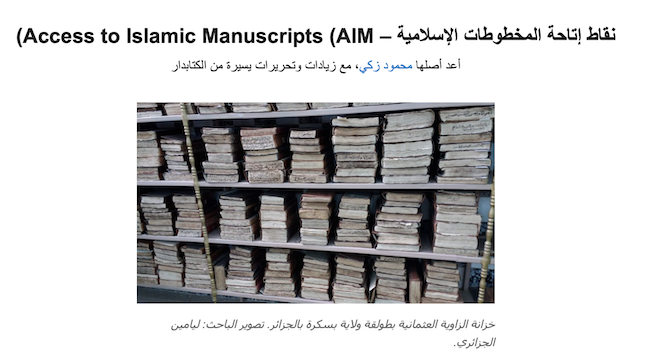
Mahmoud Zaki has assembled a major resource on sources for the study of Islamic manuscripts, including links to major digital collections and publications. It can be accessed here. This is an extraordinary resource for anyone working on manuscripts of the Islamic era.
Practising Community in Urban and Rural Eurasia (1000–1600): Comparative and Interdisciplinary Perspectives, eds. Fabian Kümmeler, Judit Majorossy, and Eirik Hovden (Brill Publishing, November 2021)
This volume explores social practices of framing, building and enacting community in urban-rural relations across medieval Eurasia. Introducing fresh comparative perspectives on practices and visions of community, it offers a thorough source-based examination of medieval communal life in its sociocultural complexity and diversity in Central and Southeast Europe, South Arabia and Tibet. As multi-layered social phenomena, communities constantly formed, restructured and negotiated internal allegiances, while sharing a topographic living space and joint notions of belonging. The volume challenges disciplinary paradigms and proposes an interdisciplinary set of low-threshold categories and tools for cross-cultural comparison of urban and rural communities in the Global Middle Ages.
The articles relevant to Yemen include:
Balancing a Community’s Food and Water Supply: The Social Impact of Rural-Urban Interdependences in Kor?ula (Dalmatia) and ?a?da (Yemen) — Fabian Kümmeler and Johann Heiss
Conceptualizing City-Hinterland Relations and Governance: Medieval Sanaa as a Case Study — Eirik Hovden, Johann Heiss, and Odile Kommer
The Monuments of Rasulid Ta?izz: The Physical Construction of Power and Piety — Noha Sadek
Defining Rules of Rural-Urban Flows: Endowments, Authority and Law in Medieval Zaydi Yemen in a Comparative Perspective — Eirik Hovden
“To Extol Knowledge”: Celebrating the Completion of Books in Rasulid Yemen — Johann Heiss
Nodal Conglomerates and Their Visions: Comparative Reflections on Urban-Rural Settings across Asia and Europe (1000–1600 CE) — Andre Gingrich
A fascinating commentary by Ahmed El Shamsy on the ISIS flag logo as a hoax from a 19th century forged letter attributed to Muhammad. Check it out here.
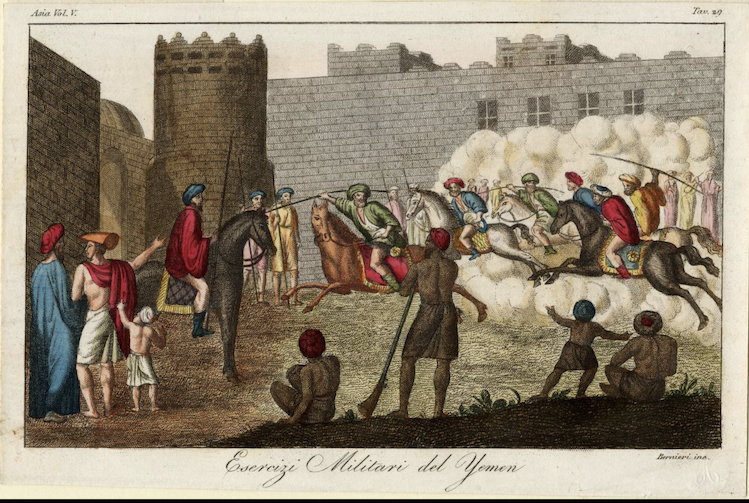
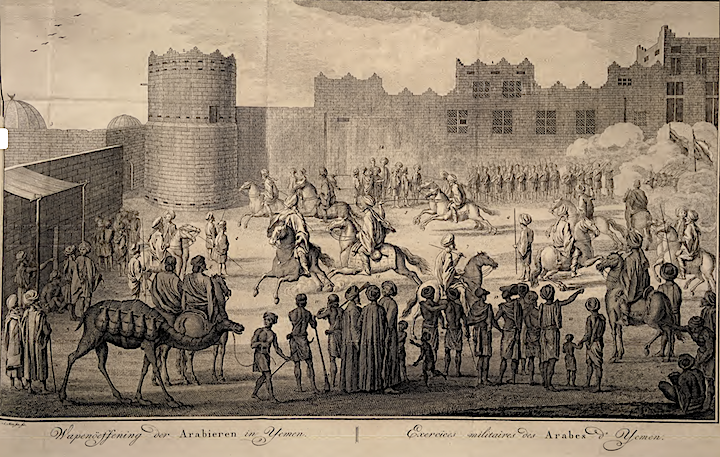
The Library of Congress has an online print of an engraving by Andrea Bernieri. It does not appear to be based on an actual observation by the artist. Below is the description on the website:
This hand-colored engraving of a work by Andrea Bernieri (flourished 1826–42) depicts Yemeni horsemen with lances exercising in the courtyard of a fort. The horsemen are watched by a soldier holding a musket, and civilians are looking on in the foreground. Bernieri was one of the Italian artists who contributed works to a 15-volume set by Giulio Ferrario (1767-1847) entitled Il costume antico e moderno, o, storia del governo, della milizia, della religione, delle arti, scienze ed usanze di tutti i popoli antichi e moderni (Customs old and new, or the history of government, militia, religion, arts, sciences, and the ways of all nations, ancient and modern) published in Italy in 1823–38. Ferrario was a Milan publisher, printer and librarian whose monumental work contained more than 1,500 hand-colored plates depicting clothing from the classical period through the early 1800s, as well as many architectural drawings and engravings. The engraving appeared as plate 29 in Asia, volume 5 of Ferrario’s work. It is from the Anne S.K. Brown Military Collection at the Brown University Library.
Bernieri, Andrea, flourished 1826-1842.
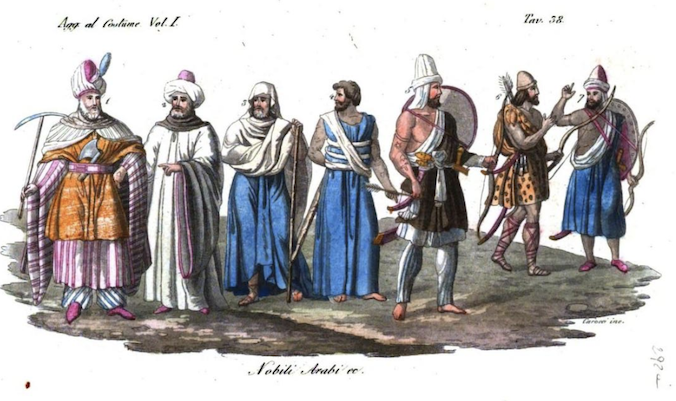
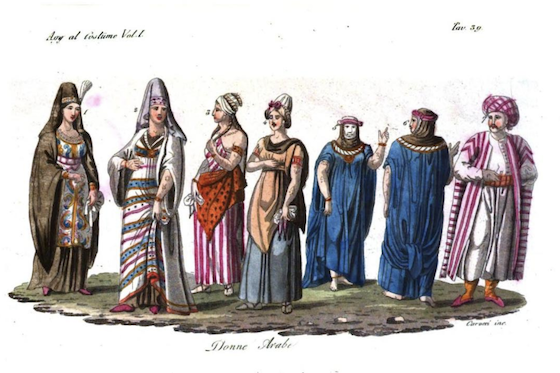
I have not been able to find the exact match of the volume with the image above, although an edition from 1833 includes two engravings of Arabs of the Peninsula in a chapter that is primarily about Mecca. These come across as rather fanciful, especially the females with no veils. These images are attached below.
As pointed out by Noha Sadek, the military image above is a copy of an earlier image in an edition of Niebuhr’s travel account. Below is the earlier image it is based on from the 1774 French edition: