الى اللاعبين السياسيين

الى اللاعبين السياسيين الذين يلعبون بالنار، النار ستحرق فلذات اكبادكم قبل ان تحرق الآخرين.
الى كل المناضلين الطيبين، التهرب من مواجهة الحقائق المريرة، والبحث عن شماعات يلقى عليها اللوم في كل صغيرة وكبيرة، لا يحل المشاكل، بل يساعد على تفاقمها.
الى الأغلبية السلبية من المتفرجين، سلبيتكم هي الهشيم الذي تنتشر فيه نيران الفوضى والهدم والقتل وتنتزع الابتسامة من وجوه أطفالكم.
أبناء الجنوب وأبناء الشمال اخوة في الدنيا والدين، والمخاطر والظلم والمعاناة واقعة على الجميع، والعابثين بأمن واستقرار الجنوب هم العابثين بأمن واستقرار الشمال.
وعلى من أمن بالله ورسوله ان يتذكر قوله تعالى: “وَاذْكُرُوا نِعْمَةَ اللَّهِ عَلَيْكُمْ وَمِيثَاقَهُ الَّذِي وَاثَقَكُمْ بِهِ إِذْ قُلْتُمْ سَمِعْنَا وَأَطَعْنَا Û– وَاتَّقُوا اللَّهَ Ûš إِنَّ اللَّهَ عَلِيمٌ بِذَاتِ الصُّدُورِ”. صدق الله العلي العظيم

محمد احمد جرهوم
صنعاء اليمن

New CyberOrient issue is out

The latest issue of CyberOrient (Vol. 7, Iss. 2, 2013) is now available online as open access. Here are the contents:

Editorial

Orchestrating Hip-hop Culture Online: Within and Beyond the Middle East

Anders Ackfeldt

Articles

Muslimhiphop.com: Constructing Muslim Hip Hop Identities on the Internet
Inka Rantakallio

Hanouneh style resistance. Becoming hip-hop authentic by balancing
skills and painful lived experiences

Andrea Dankic


“I Am Malcolm X” – Islamic Themes in Hip-hop Video Clips Online

Anders Ackfeldt Continue reading New CyberOrient issue is out

Tabsir Redux: God’s Equal Curse


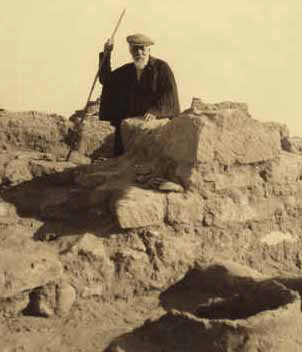
English poet and traveller Wilfrid Scawen Blunt (1840 – 1922), circa 1880.

Webshaykh’s Note: Given the ongoing crises in the Middle East, it is useful to return to earlier commentaries. In the excerpt below the voice of Wilfrid Scawen Blunt echoes with resonance for events currently in the news about Syria, Egypt, Gaza, Iraq and Afghanistan. Let us all hope that the new year brings tolerance and peaceful intentions for us all.

Wealthy and well connected Wilfrid retired from the foreign service in 1869 and soon the traveling Blunts went east. As Wilfrid noted about his first visit to Egypt in 1879, he was still “a believer in the common English creed that England had a providential mission in the East.” After learning about Bedouin customs firsthand in Syria Lady Anne spoke for both travelers about their interest in no longer looking at the people “with the half contemptuous ignorance” of Europeans. Not only were the Blunts aware and appalled at Eurocentric attitudes, but Wilfrid wrote of Islam as a “true religion,” which certainly had far more to offer African converts than Christianity. In 1881 Blunt bought an estate in Cairo, where he became a neighbor and friend of the Islamic reformer Muhammad ‘Abduh. On a visit to England Blunt arranged a visit between ‘Abduh and the reigning social philosopher, Herbert Spencer; the Egyptian reportedly told Spencer that the East was learning the evil rather than the good from the West, but the best of both was the same.

Blunt was perhaps the most famous aristo-critic of British imperialism in Egypt. With the impunity his elite upbringing bequeathed at the time, he admonished Lord Cromer, whose “wrong-headed administration” only served to Anglicize Egypt. He used his impeccable social connections to lobby British politicians, including Prime Minister Gladstone, whose “Oriental” policies he deplored. Blunt’s radical critique of the colonial transgressions committed by the burdensome white race is second to none, including Fanon and Césaire. Consider his prescient diary note at the close of the nineteenth century:

The old century is very nearly out, and leaves the world in a pretty pass, and the British Empire is playing the devil in it as never an empire before on so large a scale. Continue reading Tabsir Redux: God’s Equal Curse

Brotherhood, Brotherly Hate, Brotherly Love


Egyptian drink seller near al-Azhar in 1983; photography by Daniel Martin Varisco

Egypt faces an ethical dilemma, one that affects anyone who has ever visited or carried out research in the country. My first experience in Egypt was in early 1981 when I conducted research in Asyut on rural sanitation for a USAID project, my first development assignment. This was still Sadat’s Egypt, open to American aid and seeking to end the bitter taste of unwinnable war with Israel. I felt safe no matter where I traveled. The only time I winced was when I visited the Pharaonic ruins in Luxor and stayed in one of the lesser hotels. Striking up a conversation with the young man at the hotel desk, he asked me if I could tell the nationality of another guest’s passport. The passport was in Hebrew and the guest was the Israeli consul. I calmly explained this to the clerk, who took it in stride – another paying customer. In 1983 I was able to spend a year in Cairo studying Islamic manuscripts at Dar al-Kutub, the Egyptian National Library. I could walk from my apartment in Zamalek on Ahmet Hishmet Street across the kubri to the library with my only fear being how to dodge the insane traffic crossing the corniche. I literally walked everywhere, enjoying the kebab, falafel and Groppi sweets. And everywhere I was welcomed with a hospitality and humor that anyone who has lived in Egypt can attest. This is the Egypt I have fond memories of, but this is now the Egypt that is exploding from within.

Egypt’s problems have always been forced upon the people by conquest after conquest from the Hyksos to the Greeks to the Arabs to the French to the British. The Arab Spring that seemed to bring the modern era of pseudo-Mamluk dictators to a close was heralded as a new beginning. The election, despite doubts of its validity, of Ibrahim Morsy as president with the obvious blessing at the time of the military was seen by many pundits as a hopeful sign. Would the Muslim Brotherhood, long in opposition but with a wide following, manage to meld their Islamic fervor with a stable and tolerant democracy? Whether this experiment might eventually have worked is now a moot point. The military coup that deposed Morsy last summer has now declared the Muslim Brotherhood a terrorist organization. Continue reading Brotherhood, Brotherly Hate, Brotherly Love

The Death of Bryan

by Ian Burrell, The Independent, October 18, 2013

The British public has such “poor religious literacy” that a modern audience would be baffled by the Monty Python film The Life of Brian – because it would not understand the Biblical references, a senior BBC figure has claimed.

Aaqil Ahmed, the BBC’s head of religion and ethics, told The Independent that failings in religious education over two generations were undermining public understanding of contemporary national and international issues. “You had generations that missed out. We have poor religious literacy in this country and we have to do something about it,” he said.

He was speaking at the launch of an ambitious three-part BBC2 series which will address the subject of pilgrimage from a broad perspective and is intended to attract the interest of Atheists as much as religious believers.

“If you tried to make The Life of Brian today it would fall flat on its face because the vast majority of the audience would not get most of the jokes. They don’t have the knowledge,” Ahmed said. He questioned whether modern audiences would appreciate that the “great joke about the Sermon on the Mount” in the 1979 Python film, where a woman asks “What’s so special about the cheesemakers?”, was a reference to Jesus’s words “Blessed are the peacemakers” from the Bible. Continue reading The Death of Bryan

Prince of Peace, Prince of War


Madonna del Prato, Givanni Bellini, 1505

Today is Christmas, the annual celebration of a Jewish man who literally turned history inside out and gave his name, knowingly or not, to what is the world’s largest religion, Christianity. Within Judaism he is one of many messiah hopefuls; among Muslims he is a major prophet whose followers did not tell the real story that was later revealed to Muhammad, the last of the biblical-line prophets. Regardless of who Jesus really was, one of his titles sounded at this time of year is the “Prince of Peace.” The Gospels quite clearly indicate that Jesus was not a warmonger. Anyone who would say “Blessed are the peacemakers” (Matthew 5:9) or “turn the other cheek” (Matthew 5:39) would hardly charge into any battle with intent to kill. The irony is that the Gospel prophet promoting peace has been turned into the cause for doing exactly the opposite, whether slaughtering fellow Christians, launching pogroms against the Jews or crusading against Muslims. As Mark Twain so eloquently put it:

“Man is a Religious Animal. He is the only Religious Animal. He is the only animal that has the True Religion–several of them. He is the only animal that loves his neighbor as himself and cuts his throat if his theology isn’t straight. He has made a graveyard of the globe in trying his honest best to smooth his brother’s path to happiness and heaven…”

So if the Jesus of the Gospels, even of the Epistles, was so peace-loving, even to the extent of not fighting to save his own life on earth, why are there so many princes of war that think they are being loyal to his memory? I suppose Machiavelli’s The Prince offers as good an explanation as any; this is a book that advocates war to maintain peace rather than peace to eliminate the need for war. Continue reading Prince of Peace, Prince of War