Napoleon Tried It: He Failed


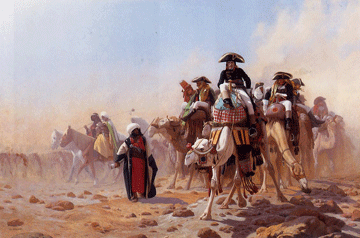
Illustration: “Napoleon and his General Staff in Egypt” by Jean-Léon Geróme, 1867

In 1798 the French leader Napoleon, a seemingly mature 28 year old at the time, set off from France with a fleet of 400 ships and 36,000 men. The goal was to conquer Egypt and “liberate” it from the corrupt Mamluk overlords. No CNN or BBC reporters were around; nor had al-Jazeera set up a satellite feed. It did not take long for the French to overwhelm the Egyptians with about 25,000 French against 15,000 local Mamluks. Napoleon won in sight of the Pyramids, but very soon after the entire mission was doomed to failure when Lord Nelson obliterated the French fleet. Napoleon himself left Cairo secretly a year later, returned to France and turned his conquest machine against fellow Europeans.
Continue reading Napoleon Tried It: He Failed

The Book of Sanaa

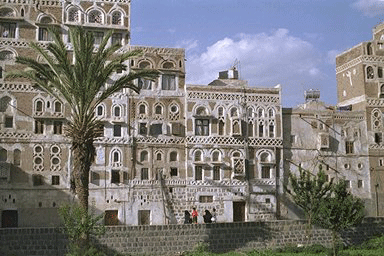
One of the Arab World’s most important modern poets is the Yemeni ‘Abd al-‘Aziz al-Maqalih. Dr. al-Maqâlih received his Ph.D. from ‘Ayn Shams University in 1977. He was President of Sanaa University from 1982-2001. He has received the title of “Knight of the First Rank in Arts and Letters” in 2003 from the government of France. The poem (translated here by Bob Holman and Sam Liebhaber) was written during the 70 day siege of Sanaa in 1968 when the poet was 31 years old. Sanaa is the capital of the modern Yemeni nation state, as it was for the Zaydi imamate when Dr. al-Maqalih was born.

The 26th Qasida
By ‘Abd al ‘Aziz al-Maqalih

Where are the gardens of Sanaa?
Dusty souqs have killed them,
covered them with corruption.
Nothing remains of their walls,
no one marched in their funeral.

Continue reading The Book of Sanaa

Beirut Speaks

by George El-Hage

I am Beirut
Look at me
DonÂ’t you remember?
I am Beirut
The Jewel of eternity
A boat of emeralds and rubies
A lighthouse built in marble
DonÂ’t you remember?

I am the bride of all cities
Mother of ships and alphabets
And home for those
Who are homeless
DonÂ’’t you remember?
Sole daughter of the East
Sun-colored daughter
Of the brown Levant.
Continue reading Beirut Speaks

This Is Not an Easter Egg

Christians around the world celebrate Easter with thoughts of the empty tomb and resurrection of Christ. But there is more. Weather permitting, children are let loose in their Sunday best to hunt for Easter eggs, adding a secular, healthy, dietary blessing to the baskets of chocolate bunnies and jelly beans waiting at home. Even the White House lawn is set for the annual Easter Egg Roll (minus the Christian Rock) on Monday. It is as though many Christians are not content to leave the tomb empty. Apparently egged on by the spring fever of long forgotten fertility rites, the main message of Christianity gets sidetracked to a debate of anything but intellectual designing: which comes first, the Easter egg or the Easter bunny?

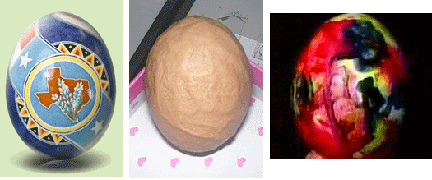
Eggs are not the exclusive mystical domain of Christendom (although the ludicrous lengths taken to parade a sacred holiday into outrageous bonnets and Texas-shaped eggs suggest we have entered the dispensation of Christendumb). Secular folk and agnostics eat their eggs for breakfast with bacon, toast and diner coffee. But all God’s children like eggs, including Muslims with internet savy and a taste for the miraculous. Take a gander (but do not confuse his spouse’s eggs with those shown here) at the three eggs shown below. What do you see different in the middle egg than the ones on either side (hint: the left is from the White House State of the Union Eggroll and the right is reported from last year’s Easter Sunday):
Continue reading This Is Not an Easter Egg

Reflections on Fieldwork in Yemen


Reflections on Fieldwork in Yemen: The Genealogy of a Diary in Response to Rabinow’s Reflections on Fieldwork in Morocco
by Daniel Martin Varisco


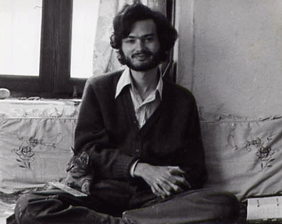
[Anthropologist at rest with cat, al-Ahjur, Yemen, 1978]

[The following excerpt is from an article recently published in Anthropology of the Middle East (Volume 1(2):35-62, 2006).]

Abstract: In preparation for writing an ethnographic monograph on fieldwork in Yemen, I compare and contrast my field diary, written in 1978–9, with Paul Rabinow’s ‘Reflections on Fieldwork in Morocco’ (1977). The underlying question is what post-fieldwork reflections reflect meaningfully about the immediacy of ethnographic fieldwork. I criticize the reflexivist trope of privileging ‘writing culture’ over the significance of ‘being there’ in the field. Point by point, I examine the implications of graduate training in anthropology, culture shock, health problems, language skills, the unreflective male voice, visual ethnography and the rhetoric of narrative writing.

Keywords: culture shock, ethnography, fieldwork, reflexivity, Visual Anthropology

Continue reading Reflections on Fieldwork in Yemen

Real Change from Interfaith Dialogue

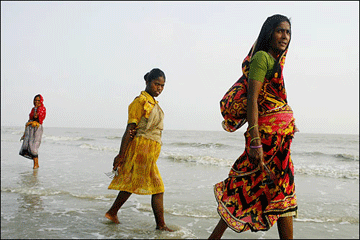
Muslim women search the beaches of Sagar Island for coins thrown into the waters of the Ganges by Hindu pilgrims. Heathcliff O’Malley/Telegraph Media Group © 2007

This morning’s news is predictable deja vu: another car bomb explodes in Iraq killing at least 20 people, the Taliban are poppying up again in Afghanistan, children are still starving in Darfur as their mothers get raped, Somalia is summarily consigned to old news since no new soldier bodies have been paraded in the streets. Page two… So much killing, so much religious faith spread around the ever warming globe, and seemingly so little dialogue for God’s children. But here’s a story from where the river bends, the Ganges of India that is, at the last bend it makes into the sea. Here is a river so holy to Hindus that it is viewed as alive, if not life itself, prompting both the devout and the just-following-the-nabob-mob to toss rupees into the polluted current. As Philip Reeves reports for NPR today, this all results in real change (if you dig hard enough in the sand) for a few of the poorest of India’s 150 million plus Muslims.

Continue reading Real Change from Interfaith Dialogue

Mary in the Qur’an

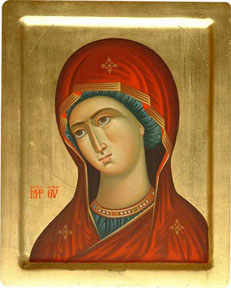
Illustration: Theotokos, Virgin Mary, Albanian icon

Bismillah al-Rahman al-Raheem. In the name of God, the Merciful, the Compassionate.
. . .And make mention of Mary in the Scripture, when she had withdrawn from her people to a place in the East, and had chosen seclusion from them. Then We [God] sent unto her Our Spirit and it assumed for her the likeness of a perfect human being. She said: “Truly I seek refuge in the Merciful One from you, if you are God-fearing”. He said: “I am only a messenger of your Lord, to give to you a pure son”. She said: “How can I have a son when no man has touched me, neither have I been unchaste”? He said: “Even so. Your Lord says: ‘It is easy for Me. And that We may make of him a revelation for humanity and a mercy from Us, and it is a thing ordained’”. And she conceived him, and she withdrew pregnant with him to a distant place. And the pains of childbirth drove her to the trunk of a palm-tree: She cried out: “Oh! Would that I had died before this! Would that I had been a thing forgotten and unseen!” Then (a voice) called out to her from beneath her: “Do not grieve, for surely your Lord has made a stream to flow beneath you; And shake towards you the trunk of the palm tree, it will drop on you fresh ripe dates: So eat and drink and refresh yourself. Then if you see any person, say: ‘Surely I have vowed a fast to the Merciful One, so I shall not speak to any one today’”. Then she brought the child to her own people, carrying him. They said: “O Mary! You have come with an amazing thing. O sister of Aaron! Your father was not a wicked man nor was your mother an unchaste woman”. Then she pointed to the child. “But they said, ‘How shall we speak to one who is still in the cradle, a little child?’ Jesus said, ‘Behold, I am God’s servant; God has given me the book and made me a prophet. God has made me blessed, wherever I may be; and God has enjoined me to pray and to give alms so long as I live, and likewise to cherish my mother; God has not made me arrogant or unblessed. Peace be upon me the day I was born, and the day I die, and the day I am raised up alive’”. Qur’an, Chapter of Mary, (19:16—35)

Good evening, al-salaamu alaikum, peace be upon you all.

I am, as ever, honoured to be here with you on this blessed night at Trinity-St. Paul’s. It is a great joy to be back in this church, both in the primary meaning of that word as this gathering of people, and in the secondary meaning of this amazing physical space that we share. Continue reading Mary in the Qur’an

Another Blow for the Horn of Africa

The news this morning after Christmas is more bad news, especially for the Horn of Africa. As if the Darfur debacle in Sudan is not bad enough, the civil war in Somalia has escalated beyond the borders. Yesterday Ethiopia dispatched a fighter plane to briefly strafe the international airport in Mogadishu. This was not exactly shock-and-awe, but then Mogadishu is not Baghdad and the self-styled “Islamists” in more-or-less control of the capital are not a trained and disciplined army.

Continue reading Another Blow for the Horn of Africa