Up Against a Wall

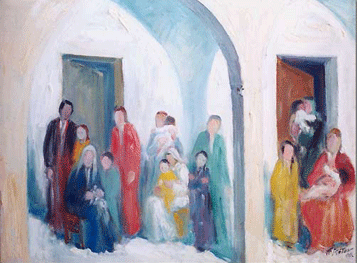
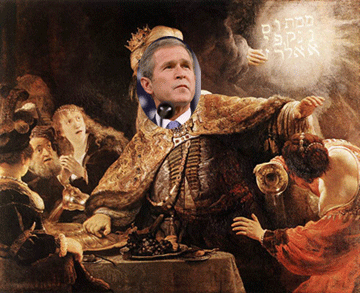
The Iraq War on its way to the record books as one of the longest wars in American history is at last, without any lingering doubt, up against a wall. One of the top stories today in the New York Times says it all: “U.S. Erects Baghdad Wall to Keep Sects Apart.” “American military commanders in Baghdad are trying a radical new strategy to quell the widening sectarian violence by building a 12-foot-high, three-mile-long wall separating a historic Sunni enclave from Shiite neighborhoods,” write reporters Edward Wong and David S. Cloud. In other words, when push comes to surge and surge comes up against a brick wall, then just go ahead and do something concrete, like building a wall. The new military strategy becomes ‘ where there is a wall, there is a way.’ Continue reading Up Against a Wall
Tancred or the New Crusade


Benjamin Disraeli
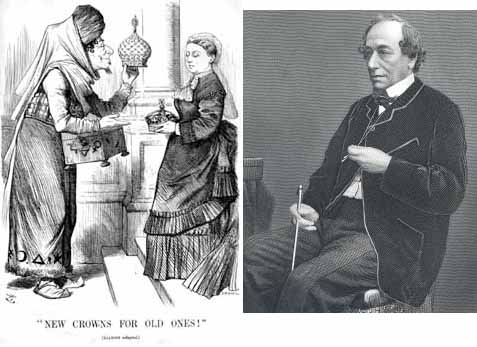
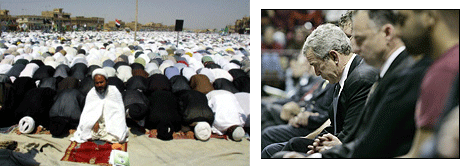
(1804-1881) was one of the most colorful and literary of British Prime Ministers in the latter half of the 19th century. Among his novels was one about a young conservative English lord named Tancred who made a spiritual quest to the “Holy Land.” This is his Tancred, of The New Crusade, originally published in 1877. In the novel Tancred is disillusioned with the lack of morality in British politics. Instead of taking his inherited place in high society, he chooses instead to go on a quest for spiritual meaning to the land where his religion began. Disraeli, as novelist, uses the Levant as a backdrop for his psychological portrait of young Tancred, but it is as much about the foibles of the British political scene as it is an “Orientalist” rendering of the cradle of Judaism, Christianity and Islam. The novel is full of intrigue, as adventure stories should be. It has not made canonization as a “great” work, but it is still worth a read (if you can find a copy). Continue reading Tancred or the New Crusade

Names of the Dead

Each day the New York Times has the courage to publish the names of American military personnel killed in Iraq. Today nine names are listed, the youngest at age 18. A Private first class from Paradise, California only found hell in serving his country in a war that even the most diehard (and these young men seem to die all too easily) neocons know cannot be won, only endured until the next election. These soldiers had first names of Shaun, Jesse, Mario, Aaron, Daniel, Joshua, Lucas, Steven and Brandon – a genealogical snapshot of America’s diversity. They grew up in Indiana, Illinois, California, Pennsylvania, Ohio, Minnesota, and Missouri. They could have been studying at a college. But for the names of those dead you would need to flip through the pages to read about the victims of the student rampage massacre at Virginia Tech on Monday.

What do these two lists have in common? In each case young lives were taken and careers ended before they began. Families had to confront the horror of death close to home. There are new scars that will never heal. There are tears that can never stop flowing. There is the nagging question of how could this happen. Continue reading Names of the Dead

“when I asked him what a Moslem was”

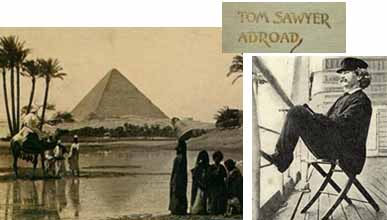
According to all three major monotheisms even God needed time to take a rest and so the sabbath was created. With the spate of mosque bombings, torture of prisoners and outright mayhem dominating the news about the Middle East these days, it might help to sit back and read what the American humorist Mark Twain wrote about his Missouri-born creation Tom Sawyer set loose in the Holy Land more than a century ago. Continue reading “when I asked him what a Moslem was”

Gibran Kahlil Gibran: A Timeless and Universal Vision

By George Nicolas El-Hage

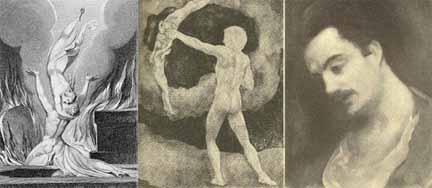
Poetry and art are twins. Both are the offspring of suffering and joy. Gibran translated Blake’s “Innocence and Experience” into a “Tear and a Smile.” Nevertheless, the unending drama of human existence unfolds itself in the pages of both men. Only the elected and gifted soul is capable of creativity, of reading the world differently, and of rebelling against evil clothed in a lamb’s garment. Art knows no boundaries. It transcends all national limits and is only satisfied with the universal. There, time and place lose their ability to imprison the artist in a closed cell. The inspired poet becomes a winged soul floating over life, embracing the infinite. It is in the midst of this vast expanse where the responsibility of the artist becomes eternal and his mission turns holy that we can speak of Kahlil Gibran and William Blake together. Continue reading Gibran Kahlil Gibran: A Timeless and Universal Vision

The Founding of Baghdad

The Founding of Baghdad
by
Ahmad ibn Abu Ya’qub ibn Ja’far ibn Wahb Ibn Wadih Yaqubi (died ca. 897 CE)

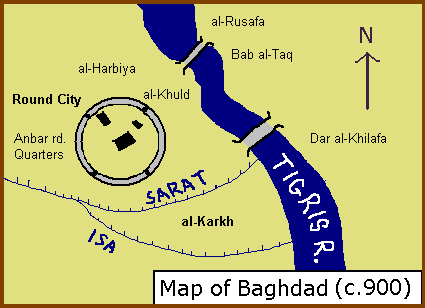
“I mention Baghdad first of all because it is the heart of Iraq, and, with no equal on earth either in the Orient or the Occident, it is the most extensive city in area, in importance, in prosperity, in abundance of water, and in healthful climate. It is inhabited by the most diverse individuals, both city people and country folk; people emigrate to it from all countries, both near and far; and everywhere there are men who have preferred their own neighborhoods there, their trade and commercial centers; that is why there is gathered together here what does not exist in any other city in the world. Continue reading The Founding of Baghdad

A Sailor and His Camel Ride


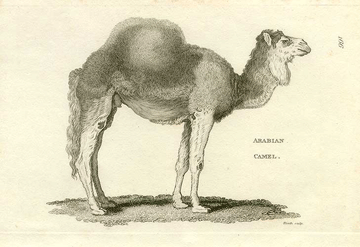
[Illustration: Arabian Camel from George Shaw, Zoology (1801)]

[Joseph Osgood was a Black American sailor who visited the Yemeni port of Mocha about a dozen years before the start of the American Civil War. He offers a rich, descriptive account of his visit to the Yemeni coast, including a sailor’s view of the ship of the desert.]

No wheel carriages are used here, the most general mode of transportation being by camels, for which the males along are serviceable. The flesh of the camel forms a staple article of food, the head and neck being excepted, because one of the race unwittingly rendered these parts unholy by obtrusively poking his head and neck into Mahomet’s tomb. Wellsted says that a camel is welcomed at its birth, by the Arab, with “another child is born unto us.” Continue reading A Sailor and His Camel Ride