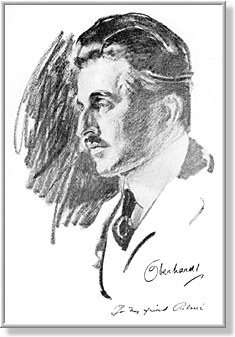
Selections from al-Rihaniyyat

by Ameen al-Rihani (1876-1940)

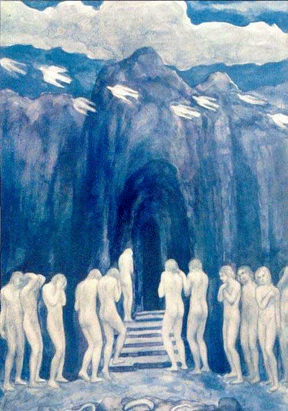
1 – Oh Freedom: When would you direct your face towards the East? When would your light merge with the light of this bright moon so it would rotate with it around the earth and enlighten the darkness of every oppressed people?

2 – When would the religious chasms be obliterated and sectarianism be trampled under the boots of civilization? When would we form the organization of tolerance and build the church of forebearance?. When would we raise and establish the school and journal of tolerance?

3 – I am the flower that bloomed out of the despair of the Prophets. A flower that flourished and then withered and finally its buds were scattered until the seeds of life gushed out of her heart and the winds carried it to the four corners of the earth. Continue reading Selections from al-Rihaniyyat

Apocalypse Watch: The Man Who Knows Squat

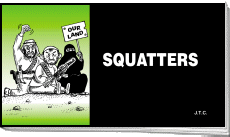
Most people find it hard to take cartoons seriously, apart from political satire and that can become a deadly issue, depending on the target. Given the recent Danish cartoon controversy it would seem that comics and religion do not mix well or at least settle well for the believers who see themselves as the target. But what about comic relief for the political struggle between Israel and the Palestinians? Fundamentalist tract artist Jack Chick, whose comic empire is dedicated to winning souls for Christ by drawing on God’s hate, has been using his pen to spread a rather sinister version of the fundamentally reduced Gospel for over 40 years. One of his more recent offerings is called “The Squatters” and it provides a virtual roadmap to apocalypse. Continue reading Apocalypse Watch: The Man Who Knows Squat

A Taylor Made Bath in Damascus

The American man of letters Bayard Taylor (1825-1878) was one of many travelers to the Near East of his time. His tour in 1853 resulted in a travel account above the common lot of Holy Land roller overs. Of particular interest is his frank account of a Turkish bath in Damascus.

“The Bath is the ‘peculiar institution’ of the East. Coffee has become colonized in France and America; the Pipe is a cosmopolite, and his blue, joyous breath congeals under the Arctic Circle, or melts languidly into the soft airs of the Polynesian Isles; but the Bath, that sensuous elysium which cradled the dreams of Plato, and the visions of Zoroaster, and the solemn meditations of Mahomet, is only to be found under an Oriental sky. The naked natives of the Torrid Zone are amphibious; they do not bathe, they live in the water. The European and Anglo-American wash themselves and think they have bathed; they shudder under cold showers and perform laborious antics with coarse towels. As for the Hydropathist, the Genius of the Bath, whose dwelling is in Damascus, would be convulsed with scornful laughter, could he behold that aqueous Diogenes sitting in his tub, or stretched out in his wet wrappings, like a sodden mummy, in a catacomb of blankets and feather beds. As the rose in the East has a rarer perfume than in other lands, so does the Bath bestow a superior purification and impart a more profound enjoyment… Continue reading A Taylor Made Bath in Damascus

The Fort Dix Deep Six

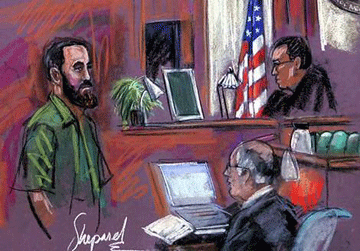
Things can’t get worse; they can only get worse. No, this is not poor grammar or end-of-semester illogic but my first impression after listening to the hard-to-digest dollop of the morning news. Another suicide bomb killed and maimed scores in Iraq, this time in the Kurdish town of Irbil. The Bush administration suggests that things are getting better in Baghdad since the wall-less security crackdown, but that is debatable. What is not open to debate is that other parts of the country continue to spiral in insecurity, perhaps due in part to the targeted crackdown in one place. None of this seems to matter to Vice-President Cheney who has made a surprise visit to the Green Zone, mainly it seems to convince the Iraqi parliament not to take a summer vacation this year and be nice about dividing up the spoils of America’s, I mean Iraq’s, oil profits.

In this case it is not only the shit hitting the fan, but the gold as well. Gold as in Fort Dix (Fort Knox or whatever…) but I hope not a golden journalistic award to a local newspaper. Continue reading The Fort Dix Deep Six

Faces of the Fallen

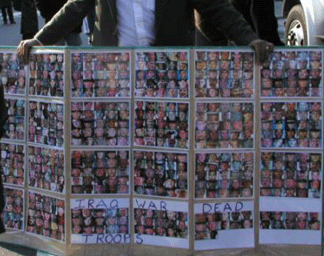
While Congress debates target dates for withdrawal and President Bush wields his veto bravado, the casualties from a no-longer-admired, quagmired war in Iraq continue to mount. For Operation Iraqi Freedom 3,345 American military personnel have lost their lives; for Operation Enduring Freedom in Afghanistan the number is a far more modest 381, yielding a total of 3,726 total fatalities overall. Then there are the Iraqi civilians and insurgents who have died, usually in bloody and terror-damned ways, reaching between 63,000 and 69,000 according to Iraq Body Count, but with estimates well above 100,000. Figures for Afghanistan are harder to come by. The initial bombing campaign four years ago took an estimated 3000-3400 civilian lives, with more every passing year. The sheer numbers, although not catastrophic when compared to big bloody wars of the past, are still numbing. But listing names is the easy way out; looking at the faces of the fallen takes more courage. Continue reading Faces of the Fallen

Letters of an Egyptian Kafir


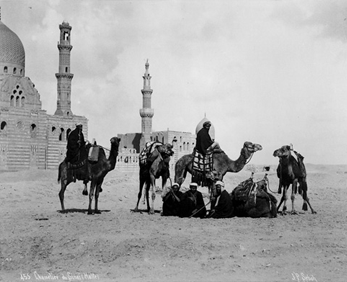
[Illustration: “Camels and Tombs of the Mamelukes” ca 1870]

While conducting research in Oxford’s Bodleian Library two summers ago, I came across an anonymous work entitled Letters of an Egyptian Kafir on a Visit to England in Search of a Religion, enforcing some neglected views regarding the duty of theological inquiry, and the morality of human interference with it. Published in London in 1839, the plot of the lengthily titled treatise is a series of letters allegedly written by a non-Muslim Egyptian to a Muslim friend back home. I rather suspect these were penned in a learned vicar’s study as an attempt to rationalize the superiority of Protestant Christianity over all comers. There is little to be learned about Egypt and much about the arguments Christians might use at the time to convert these descendants of the pharaohs. Continue reading Letters of an Egyptian Kafir

In and Out of Aden

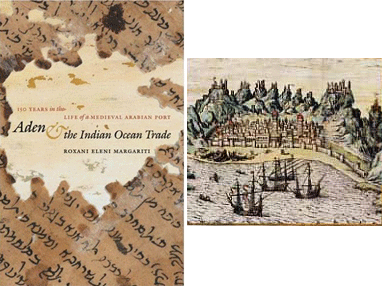
[The following is an excerpt from a recently published historical analysis of the Yemeni port of Aden in the 13th and 14th centuries by Roxani Margariti (Emory University), who reconstructs port life vividly through archival records in the Cairo Genizeh, relevant Arabic texts and archaeological research. This is a fascinating look at one of the most important medieval ports in the Red Sea/Indian Ocean trading network that ultimately linked Europe with the Far East before Portuguese galleons changed the complex equation of global trade.]

by Roxani Eleni Margariti

In the current era of giant container ships, GPS, and e-commerce, a single vessel can carry forty-eight hundred trailer-sized containers of merchandize from Bremen, Germany, to Elizabeth, New Jersey, in a single voyage. The exact position of a ship is knowable at the push of a button and the blink of any eye, and one can place an order one minute and have confirmation of its receipt in the next. It is therefore difficult to grasp the medieval dimensions of dimensions and time. A respectably sized medieval Arab ship held the equivalent of about two trailer-sized containers. Continue reading In and Out of Aden