A Dialogue With Allah


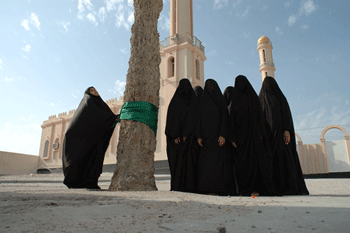
Figure 1: Mosque, women and palm tree.

By el-Sayed el-Aswad

Folk culture provides members of the society with living models in the form of iconic images, key symbols, and root metaphors that enable them to express themselves, and the other as well. Sanctity or religious meaning is bestowed on an object or place for the reason that a religiously significant event (a miracle, wonder or blessing) is associated with it.

At an art exhibition at the College of Art, Bahrain University last year, 2006, I was surprised to see very beautiful and stunning pictures in which a group of women were climbing palm trees (figure 2-5). Recognizing the cultural significance of the palm tree in Arab societies, I decided to interview Waheeda Malullah (figure 6), the artist whose photos show that the climbing of palm trees is not just aimed at the collection of dates commonly consumed in the Arab Gulf countries, but rather at the engagement in spiritual communication with invisible spheres of the cosmos and the achievement of blessing or grace (baraka), among other objectives. Continue reading A Dialogue With Allah
Six Biblical Days of War

Quick, here’s a trivia question. How long did it take God to create the world, according to the book of Genesis? Six days, of course. If you miss this one, you may have been brought up in the backwaters of the Amazon, although it would not be the fault of Christian missionary translators who have tried to undo God’s rash Babeling of tongues to get the Bible into every known tongue. But what’s a day? Before the scientific revolution sealed by Darwin, the ordinary 24-hour variety day posed few problems for the devout. Once it seemed that the world must be older than Bishop Ussher’s supposed official date of 9 AM on October 23, 4004 BC, seeds of doubt grew into Enlightenment-nurtured forests. But is nothing sacred? it turns out that poor Bishop Ussher never ordained that God slept in late on Day One; the distinction of 9 AM goes to a certain Dr. John Lightfoot. But there’s still the problem of how to define a day, especially in a creation scenario in which the creation of light precedes the sun, moon and stars. Theologians in retreat (as distinguished from those who remained, and still do so, in denial) resorted to a semantic salvation of the scriptural record, arguing that with God a day is the same as a thousand years.

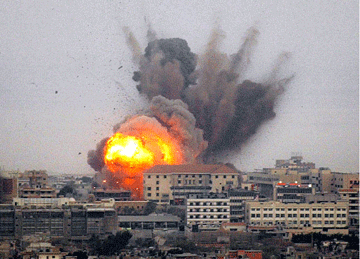
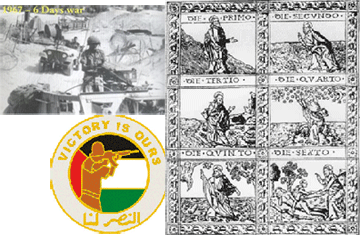
Tomorrow, June 5, is the 40th anniversary of a modern event on Holy Land soil of biblical proportions: the Six-Day War of 1967 in which Israel expanded its borders, took total control of Jerusalem and embroiled the region in the plight of the Palestinians. It only took six days for the overmatched armies of Egypt, Jordan and Syria to be effectively eliminated and since that war there has been little doubt that Israel as Zionist-revived David to a disorganized Arab Goliath lies only in myth. Only six days, but how long is a day? Continue reading Six Biblical Days of War

The Dervish Dishes it Out

Some messages are timeless. This poem of Rumi, though at least seven centuries old, still resonates no matter how sanitized the morality of the day.

Dervish at the Door

A dervish knocked at a house
to ask for a piece of dry bread,
or moist, it didn’t matter.

‘This is not a bakery,’ said the owner.

‘Might you have a bit of gristle then?’

‘Does this like like a butchershop?’

‘A little flour?’

‘Do you hear a grinding stone?’ Continue reading The Dervish Dishes it Out

The Forbidden Fruit of the Iraq War

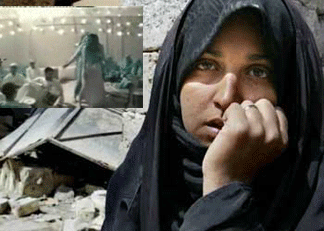
War is mainly a man’s game. Men like Osama Bin Laden send men like Muhammad Atta to bomb a New York building. Men like George Bush and Tony Blair react like, well like men, and take it out on men like Mullah Omar and Saddam Hussein by sending young men to dodge bullets and iuds in a real video-game scenario. Men like Nouri al-Maliki are purple-fingered into a Green Zone political club so that mostly men can wear uniforms or hide bombs in order to kill other men, as well as women and children. Even a pacifist like Jesus predicted no end to war and rumors of war.

Everyone, not just men, suffers in the manly game of war. But while some men think it honorable to kill others, the burden of war probably hits women harder than anyone else. Suicide bombs are as likely to tear apart female bodies as male bodies, as able to cut short the life of a child as trump the survival of the elderly. In Iraq we see the blood smears that mark death and hear the mourning that haunts the grieving of the left behind. But beyond the battlefield and the car-blown open markets the exercise of war bears more fruit, one that harks back to the forbidden fruit in the innocence of Eden. Continue reading The Forbidden Fruit of the Iraq War

A Candid[e] View of an Honest Turk

[One of the great moral tales of the 18th century is Voltaire’s (1759) Candide, a book well worth reading and rereading from time to time. Here is an excerpt from the end of the book, but it is not Orientalism in the Saidian sense of negative portrayal; indeed it is the honest Turk which stands in contrast to tyrants of all stripes.]

During this conversation, news was spread abroad that two viziers of the bench and the mufti had just been strangled at Constantinople, and several of their friends impaled. This catastrophe made a great noise for some hours. Pangloss, Candide, and Martin, as they were returning to the little farm, met with a good-looking old man, who was taking the air at his door, under an alcove formed of the boughs of orange trees. Pangloss, who was as inquisitive as he was disputative, asked him what was the name of the mufti who was lately strangled.

“I cannot tell,” answered the good old man; “I never knew the name of any mufti, or vizier breathing. I am entirely ignorant of the event you speak of; I presume that in general such as are concerned in public affairs sometimes come to a miserable end; and that they deserve it: but I never inquire what is doing at Constantinople; I am contented with sending thither the produce of my garden, which I cultivate with my own hands.” Continue reading A Candid[e] View of an Honest Turk

A Quiet Revolution in Algeria?


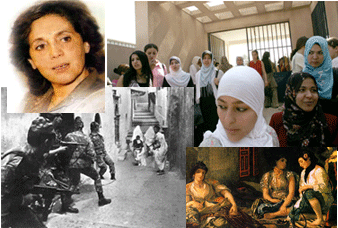
[left to right: Djamila Bourhiredf; Women waiting for bus at University of Algiers, photo by Shawn Baldwin for The New York Times; scene from “The Battle of Algiers”; “Algerian Women in Their Apartments” by Eugene Delacroix, 1834

One of the lead articles in yesterday’s New York Times was titled “A Quiet Revolution in Algeria: Gains by Women” by Michael Slackman. Revolutions, no matter where they erupt, tend to be noisy, even when they are not successful. The French stormed the Bastille; America had its Boston Tea Party; the Russians knocked off the Czar and his family. The Algerian Revolution, which took eight years from 1954-1962, claimed an estimated one to one-and-a-half million lives, not to mention the French military casualties of some 18,000. In the past decade or so more than 100,000 Algerians have died as a direct result of partisan extremist religious fighting. So if Algeria is now having a quiet revolution, where did all the noise go? Continue reading A Quiet Revolution in Algeria?

Book of Curiosities

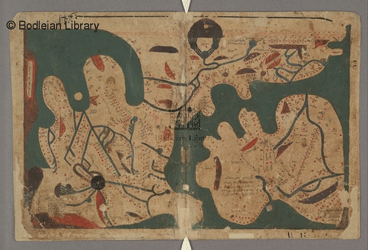
The Bodleian Library in collaboration with The Oriental Institute, University of Oxford, announces the electronic publication of The Book of Curiosities of the Sciences and Marvels for the Eyes, a newly discovered medieval Arabic treatise on the depiction of the Heavens and the Earth. The treatise is one of the most important recent finds in the history of Islamic cartography in particular, and for the history of pre-modern cartography in general. The publication of the treatise is mounted on a dedicated website employing a new method for publishing medieval maps. Continue reading Book of Curiosities

Lebanese Hymns of Love and War

By George N. El-Hage

1-
Thirty years of prosperity, patriotism, harmony and florescence, ruined in one year, it is true that destroying is easier than building, but it is also true that a year in which the masks fell and the buffoons stepped from their disguises into the shadows, was more real to them and to us than the thirty years they masked themselves in falsehood, hypocrisy and exploitation.

2 –
There were those who sold Lebanon and lost their families, their children and their villages. Then the strangers spit in their faces and cursed them. Their shekels were plundered, the price of treason. Do not ask those of their honor and patriotism. How can they give you what they do not possess?

3 –
The youth of Lebanon who abandoned their books and embraced rifles, know that they will triumph, because those who know how to live life, know how to live death and resurrection. Continue reading Lebanese Hymns of Love and War